 Blaine
 Siding Replacement for Grandview, Near Blaine
Grandview is a residential area in and around Blaine, in the northwest corner of Whatcom County, and most of the siding work here isn't new construction — it's replacement. That's an important distinction. New construction siding goes onto fresh sheathing with no history and no unknowns behind it. Replacement siding comes off a home that's already spent years, sometimes decades, absorbing salt air, driving rain, and a moss season that runs longer here than it does further inland. What's underneath the old siding, and what it tells you about the wall assembly, matters as much as what goes back on top.
This page is specifically about full siding replacement for homes in the Grandview area — not new-build installation, not a small patch repair. It covers how to tell when a home has crossed from "repairable" into "replace it," what tear-off on an older home in this climate typically reveals, what a correct replacement job involves, and why hiring a crew that already works this part of Blaine changes the outcome.
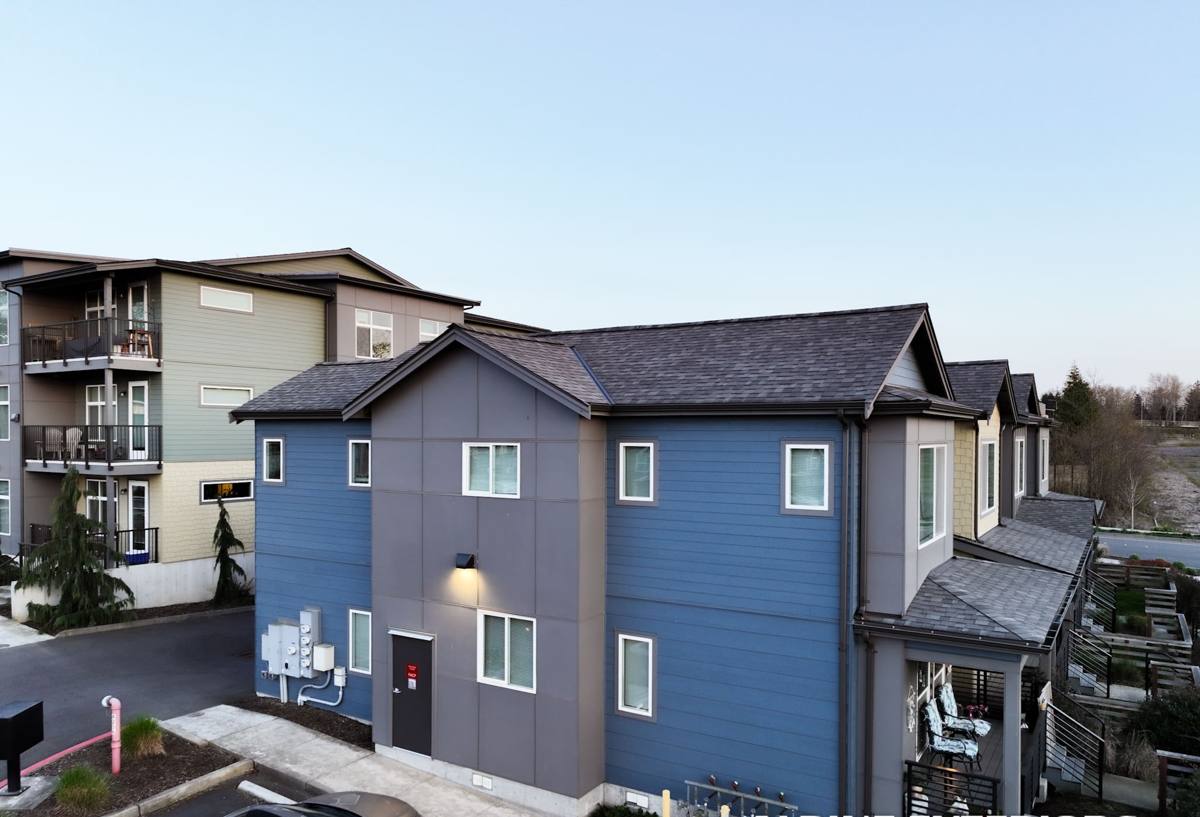
Knowing When It's Replacement, Not Repair
When Damage Has Moved Past a Patch
Siding repair makes sense when the problem is localized — a cracked panel, a damaged section near a downspout, a single area where flashing failed. Replacement becomes the right call when the damage is spread across multiple walls, when soft or spongy spots show up in more than one location, or when moisture has clearly gotten behind the siding and into the sheathing rather than staying on the surface. Patching individual spots on a wall that's failing broadly usually just delays a bigger job and adds cost on top of the eventual full replacement.
Age and Material Type
How old the siding is matters, but what it's made of matters more. Older wood siding, aging vinyl, and primed wood products all have a shorter realistic service life in this climate than fiber cement, and homes in the Grandview area with original siding from decades back are frequently at or past the point where continued patching stops making financial sense compared to a full replacement done once, correctly.
- Paint or finish failing repeatedly in the same spots within a year or two of repainting
- Soft, spongy, or crumbling material when pressed, especially near the bottom of walls or under windows
- Visible cracking, warping, or buckling across more than one section of the house
- Moss or dark staining that keeps coming back on the same walls no matter how often it's cleaned
- Rising energy bills with no other clear cause, which can point to a wall assembly that's no longer sealing properly
- Multiple past repairs in different spots over the last several years
What Grandview's Climate Puts Old Siding Through
Salt Air
Grandview's proximity to Blaine's shoreline means homes here take on salt-laden air as a regular condition, not an occasional event. Over years, that accelerates corrosion in fasteners and exposed hardware and speeds up finish breakdown on materials that weren't engineered with coastal exposure in mind. It's one of the main reasons siding that performs acceptably twenty miles inland can fail noticeably sooner here.
Driving Rain
Storms coming off the water in this part of Whatcom County don't always fall straight down — wind pushes rain sideways and drives it into seams, laps, and trim joints that were never designed to take water from that angle. On older siding, especially anything with failed caulking or worn lap joints, that wind-driven pattern is often what finally pushes moisture behind the cladding after years of otherwise holding up.
A Long Moss Season
Mild temperatures and near-constant moisture give moss a growing season that runs most of the year in this area. Moss holds water against a wall surface far longer than open air would, and any siding with even minor surface porosity gives it a foothold. On aging siding, moss coverage is often less a cosmetic issue and more a sign that a section of wall has been staying damp for a long time.
Repair vs. Full Replacement
| Situation | Repair Usually Makes Sense | Replacement Usually Makes Sense |
|---|---|---|
| Extent of damage | Isolated to one or two small areas | Spread across multiple walls or the whole house |
| Underlying material | Sound, still within its expected service life | Aging wood, vinyl, or primed product nearing end of life |
| Moisture history | No signs of moisture behind the cladding | Evidence of water intrusion into sheathing or framing |
| Repair history | First issue, no prior repairs nearby | Multiple past repairs in different spots over time |
| Long-term cost | Lower upfront cost, addresses the immediate issue | Higher upfront cost, resets the whole wall assembly at once |
What Tear-Off Usually Uncovers
Once old siding comes off a Grandview-area home, what's underneath tells the real story of how the house has held up. It's common to find sheathing that's soft or water-stained near window openings, corners, or the bottom courses of the wall — areas where wind-driven rain and long-term moisture exposure do the most damage over time. It's also common to find a water-resistive barrier that was thin, torn, poorly lapped, or missing entirely in sections, especially on homes built before that detailing became standard practice. Sometimes the framing itself is sound and only the outer layers need attention; sometimes there's real repair work to do before new siding can go back up at all.
This is why we don't quote a full replacement sight-unseen from a photo or a phone call. What's actually behind the old siding determines the real scope of the job, and finding problems at tear-off — rather than after new siding is already up and covering them again — is the whole point of doing a full replacement properly instead of skipping straight to the finish material.
What Goes Back On: Why We Replace With James Hardie
We install James Hardie fiber cement siding exclusively on replacement projects — we don't offer vinyl, LP SmartSide, Cemplank, Allura, primed spruce, or cedar as alternatives, and that's a deliberate standard rather than a limitation of what we're capable of installing. Fiber cement is non-combustible, holds a factory-applied ColorPlus finish that resists the fading and chalking that plagues field-painted products in this climate, and James Hardie's HZ5 formulation is engineered specifically for regions with sustained moisture exposure and freeze-thaw cycling — which describes Grandview's marine climate closely. It also carries a strong transferable warranty, which matters more on a full replacement than it does on a repair, since a replacement is meant to be the last siding job this house needs for a long time.
None of that means other products are without merit — vinyl is inexpensive and low-maintenance in mild conditions, cedar has real natural appeal, and engineered wood has improved over the years. Our position is narrower than a blanket claim that those products are bad: for the specific combination of salt air, wind-driven rain, and sustained moss pressure that a Grandview-area home deals with, we've found fiber cement's moisture behavior, fire resistance, and finish durability to be the more reliable long-term choice, and it's the only system we'll put our name behind here.
Our Replacement Process, Step by Step
Site Assessment
We start by walking the property and looking at each wall's actual exposure — which faces take the most wind and salt air, where moss and staining are worst, and whether the pattern of damage suggests a widespread wall problem or a few isolated trouble spots.
Tear-Off and Sheathing Inspection
Old siding comes off and the sheathing underneath gets inspected before anything new goes up. If there's rot or water damage, we address it at this stage rather than covering it with new siding and letting it keep spreading unseen.
Water-Resistive Barrier
A new, properly lapped and sealed water-resistive barrier goes on before siding, since this hidden layer does most of the actual work of keeping wind-driven rain out of the wall long after the new siding looks fine on the surface.
Installation to Manufacturer Spec
Hardie panels go up following the manufacturer's fastening, spacing, and clearance requirements as the baseline for every job, not as an upgrade option, with all field-cut edges sealed as they're made.
Final Walkthrough
We walk the finished job with the homeowner, explain what was found and fixed during tear-off, and go over what the new siding actually needs going forward, which is minimal but not nothing this close to the water.
Questions Worth Asking Before You Sign a Replacement Contract
A siding replacement is a significant investment, and it's worth holding any contractor's proposal — including ours — to a real standard before committing:
- Does the quote include sheathing inspection and repair as a line item, or does it assume the wall underneath is fine sight-unseen?
- What water-resistive barrier product will be used, and how will it be lapped and sealed at seams and penetrations?
- What fastener grade is specified for a home this close to salt air, and is it in writing?
- Is the crew doing the tear-off and install the contractor's own employees, or subcontracted labor?
- What does the manufacturer's warranty actually cover, and does it require the installer to be certified or preferred to stay valid?
- What happens, cost- and timeline-wise, if tear-off uncovers sheathing damage that wasn't visible before the old siding came off?
Why a Crew That Already Works Grandview Matters
A contractor who mostly works further inland can still do competent siding work, but a replacement in Grandview involves judgment calls that don't come up as often elsewhere in Whatcom County — how much wind exposure a particular wall actually sees off the water, which fastener grade is worth the extra cost versus which is overkill, and how aggressively moss has typically worked into siding that's been up for twenty or thirty years in this specific microclimate. Working this area regularly means those aren't unfamiliar variables on your project. We've torn off enough aging siding on homes near Blaine to have a realistic sense of what's usually underneath, and that shows up in more accurate estimates and fewer surprises mid-job.
If your home's siding is showing its age, or you're not sure whether you're looking at a repair or a full replacement, we're glad to come take an honest look. Reach out using the form below for a free, no-pressure estimate.