 Blaine
 Why Birch Bay Homes Wear Out Faster Than You'd Expect
Birch Bay sits right on the water, and that location cuts both ways. The views and the breeze are why people love living there, but that same exposure puts a real strain on the outside of a house. Salt-laden air off the Strait of Georgia, near-constant onshore wind, long stretches of driving rain, and a moss season that can run most of the year all work on exterior siding at the same time. A material that performs fine in a sheltered inland neighborhood can fail early a few blocks from the beach in Birch Bay.
We're a Whatcom County exterior contractor, and Birch Bay is one of the areas we work in regularly. That matters because coastal exposure isn't uniform — a home two rows back from the water faces different conditions than one right on the bluff, and a crew that works this stretch of coastline knows the difference. It shapes what siding we recommend, how we detail the flashing and trim, and where we tell homeowners to expect the most wear.
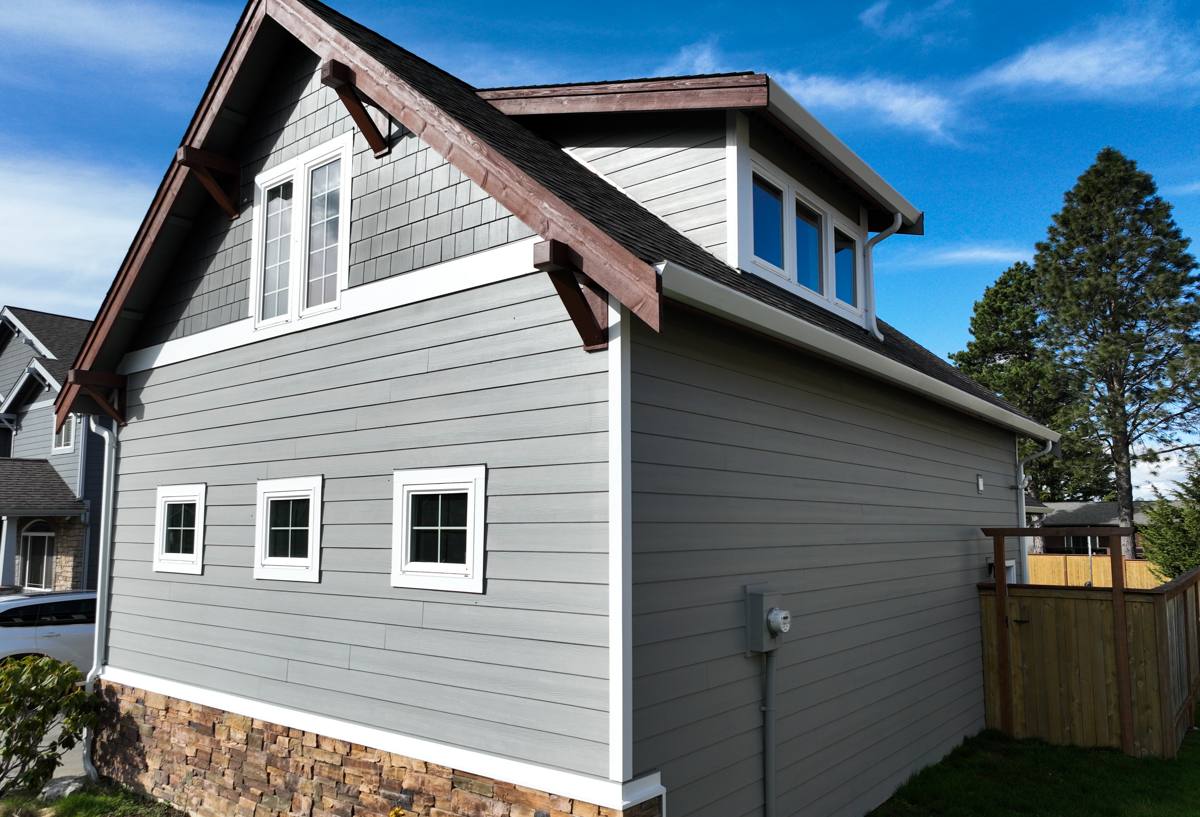
Salt Air and What It Does to Siding Over Time
Salt spray carries inland further than most people assume, especially with the wind patterns common along this part of the Whatcom County coastline. It settles on siding, trim, and fasteners, and it accelerates corrosion on anything metal and breakdown on anything organic.
What this means for material choice
Untreated wood and wood-based composite siding absorb moisture readily, and salt air keeps that moisture cycle going even on days without rain — fog and humidity alone are enough. Vinyl siding doesn't rot, but it does chalk, fade, and become brittle faster in salt-exposed, UV-heavy coastal settings, and hairline gaps at seams give salt-laden moisture a path behind the panels. Fasteners and trim accessories matter just as much as the siding itself; corroded fasteners are one of the more common failure points we see on coastal homes, regardless of what siding is installed over them.
This is a big part of why we standardized on James Hardie fiber cement siding for every home we side, in Birch Bay and everywhere else we work. Fiber cement doesn't rot, doesn't provide a food source for mold or moss, and holds up structurally in salt-air environments in a way that wood and many composite products simply don't over a 20- or 30-year horizon.
Moss: The Slow-Motion Problem Nobody Notices Until It's Bad
Whatcom County's wet season is long, and Birch Bay's proximity to the water keeps humidity elevated even on days without rain. That combination is exactly what moss and algae need to establish themselves on exterior surfaces — north-facing walls, areas shaded by trees or neighboring structures, and any siding with a textured or porous surface are the first to show it.
Why moss is more than cosmetic
Moss holds moisture directly against the siding surface. On wood or wood-composite products, that sustained moisture contact accelerates rot underneath the visible growth, often before a homeowner notices anything beyond a green tinge. On fiber cement, moss can still take hold on the surface, but because the substrate itself doesn't absorb and hold water the way wood does, it's a cleaning issue rather than a structural one. A factory-applied finish like James Hardie's ColorPlus also gives moss and algae less to grip onto compared to field-painted or bare wood surfaces, which makes periodic cleaning more effective.
We can't promise a moss-free house in Birch Bay — nothing realistically stops moss from landing and growing in this climate — but we can build the exterior so moss is a surface-level nuisance you rinse off, not a moisture problem working its way into your wall assembly.
Wind and Driving Rain: The Installation Side of the Equation
Coastal wind in Birch Bay doesn't just push rain against the house — it pushes it sideways and, in the right conditions, upward under laps and around trim. That's a water-management problem as much as a material problem, and it's where installation quality matters as much as product choice.
Details that matter more here than inland
- Correct lap exposure and fastener placement so wind-driven rain can't work its way behind panels
- Properly flashed and caulked window and door openings, since these are the most common leak points on any home
- House wrap and weather-resistant barrier installed and lapped correctly before siding goes on
- Trim and butt joints sealed with products rated for sustained UV and moisture exposure, not just standard caulk
- Attention to inside and outside corners, where wind-driven rain concentrates
A siding product only performs as well as its installation. We've seen quality materials fail early because of shortcuts in flashing or fastening, and we've seen more modest budgets go a long way when the details were done right. On an exposed site like Birch Bay, we don't treat these steps as optional extras — they're the difference between siding that lasts and siding that needs attention in five years.
Why We Install Only James Hardie Fiber Cement
We don't install vinyl, LP SmartSide, primed spruce, cedar, or other fiber cement brands. That's a deliberate standard, not a lack of options. Each of those products has legitimate uses and reasonable arguments in its favor — cost, appearance, or installation speed — but each also carries trade-offs that show up over time in a climate like this one: moisture sensitivity at cut edges and seams, UV degradation, limited fire resistance, or maintenance demands that don't match how most homeowners actually want to spend their weekends.
James Hardie fiber cement is non-combustible, dimensionally stable across our wet-to-dry seasonal swings, and holds its factory-applied ColorPlus finish far longer than field-applied paint on wood or composite siding. It's also backed by a strong transferable warranty when installed by a certified, trained crew — which is part of why we invested in becoming one.
The HZ5 product line
James Hardie engineers its siding by climate zone, and the HZ5 line is formulated for regions like ours with sustained moisture exposure, freeze-thaw cycling, and — relevant to Birch Bay specifically — coastal conditions. It's the line we specify for Whatcom County installs, including Birch Bay, Blaine, and the surrounding coastline.
| Factor | James Hardie Fiber Cement | Vinyl | Wood / LP-Style Composite |
|---|---|---|---|
| Salt air resistance | Strong — non-organic, won't corrode or rot | Moderate — can chalk and become brittle | Weak — absorbs moisture, prone to rot at exposed edges |
| Moss/algae impact | Surface-level, cleanable | Surface-level, cleanable | Can trap moisture, leading to rot beneath growth |
| Fire resistance | Non-combustible | Melts/deforms under heat | Combustible |
| Finish longevity | Factory ColorPlus, typically 15+ years before repaint needed | Color molded in, but fades and chalks over time | Field-applied paint, often needs attention every 5-8 years |
| Typical lifespan when properly installed | 30+ years | 20-30 years, variable | 15-25 years, highly maintenance-dependent |
More Than Siding: The Whole Exterior Envelope
Siding doesn't work in isolation. On a coastal property like the ones in Birch Bay, roofing, windows, and decking all face the same salt air, wind, and moisture exposure, and they all interact with each other at flashing points, transitions, and penetrations. We handle all four — siding, roofing, windows, and decks — because a siding job done well but poorly tied into an aging roofline or leaky window flashing just moves the water problem somewhere else.
Where this shows up in practice
When we're on-site for a siding project, we're also looking at roof edge conditions, window flashing, and deck ledger connections, because those are common points where water gets behind an otherwise sound exterior. If we see something that's going to undermine the siding work — a roof nearing the end of its service life, window flashing that's already failing — we'll tell you directly rather than sidestep it. It's less about upselling and more about not wanting to warranty siding installed over a problem that's going to leak from somewhere else.
What Working With a Local Crew Actually Gets You
Birch Bay's microclimate — the wind exposure, the salt air gradient depending on how close you are to the water, the drainage patterns on sloped lots near the bluff — isn't something you learn from a spec sheet. It's something a crew picks up from working this specific stretch of coastline repeatedly. That local knowledge shows up in small decisions: how much house wrap overlap to use, which corners of a given lot see the worst wind-driven rain, when to recommend additional flashing beyond the manufacturer's minimum spec.
We're not a national franchise cycling through crews. We're a Whatcom County contractor that returns to this same area year after year, which means we're also the ones a homeowner calls back in three years if something needs a look — not chasing down a call center.
What Affects the Cost of a Birch Bay Siding Project
Every home is different, but a few factors consistently move the price on coastal siding projects in this area:
| Factor | Why It Matters |
|---|---|
| Home size and wall complexity | More corners, gables, and dormers mean more cutting, flashing, and labor time |
| Existing siding removal | Tear-off adds cost but lets us inspect and repair the sheathing and weather barrier underneath |
| Substrate condition | Water damage found once old siding comes off needs repair before new siding goes on |
| Trim and detail level | Board-and-batten accents, shake-style panels, or extensive trim work add time |
| Access and site conditions | Bluff-adjacent or tightly landscaped lots can slow staging and material handling |
We give straightforward, itemized estimates so you can see what's driving the number, not just a lump sum.
Keeping Coastal Siding Looking Right Between Projects
Even the most durable siding benefits from basic upkeep, especially this close to the water. A simple annual routine goes a long way:
- Rinse siding with a garden hose (not a pressure washer on high setting) once or twice a year to clear salt residue, pollen, and grime
- Trim back vegetation and tree limbs that shade walls and keep them damp longer, which encourages moss growth
- Check and clear gutters each fall so overflow doesn't run down the siding face
- Inspect caulking around windows, doors, and trim annually and have gaps resealed before winter rains set in
- Address any moss or algae buildup with a gentle wash rather than letting it accumulate over multiple seasons
None of this requires a contractor visit — it's the kind of maintenance any homeowner can handle, and it meaningfully extends how long your exterior looks good.
Get a Straight Answer on Your Birch Bay Home
If your siding is showing its age — chalking, soft spots, persistent moss, or gaps opening up at the trim — it's worth having someone look at it before those issues turn into water damage. We'll walk the property, tell you honestly what we see, and lay out what a James Hardie fiber cement replacement would look like for your specific home. There's no pressure and no cost to get an estimate.