 Blaine
 One Product, One Reason
Most siding contractors in Whatcom County will install whatever a homeowner picks — vinyl, engineered wood, fiber cement, cedar, whatever's on sale that month. We stopped doing that. Every siding job we take on in Blaine and the surrounding area uses James Hardie fiber cement, full stop. That's not a sales pitch; it's a standard we set after years of watching which products actually held up against this coastline and which ones turned into callbacks.
This page explains the reasoning in plain terms: what fiber cement is, why we walked away from the alternatives, and what you're actually getting when a crew installs Hardie correctly. If you're comparing siding options for a home near the water or up in the county, this is the honest version of that comparison.
What Blaine's Climate Does to Siding
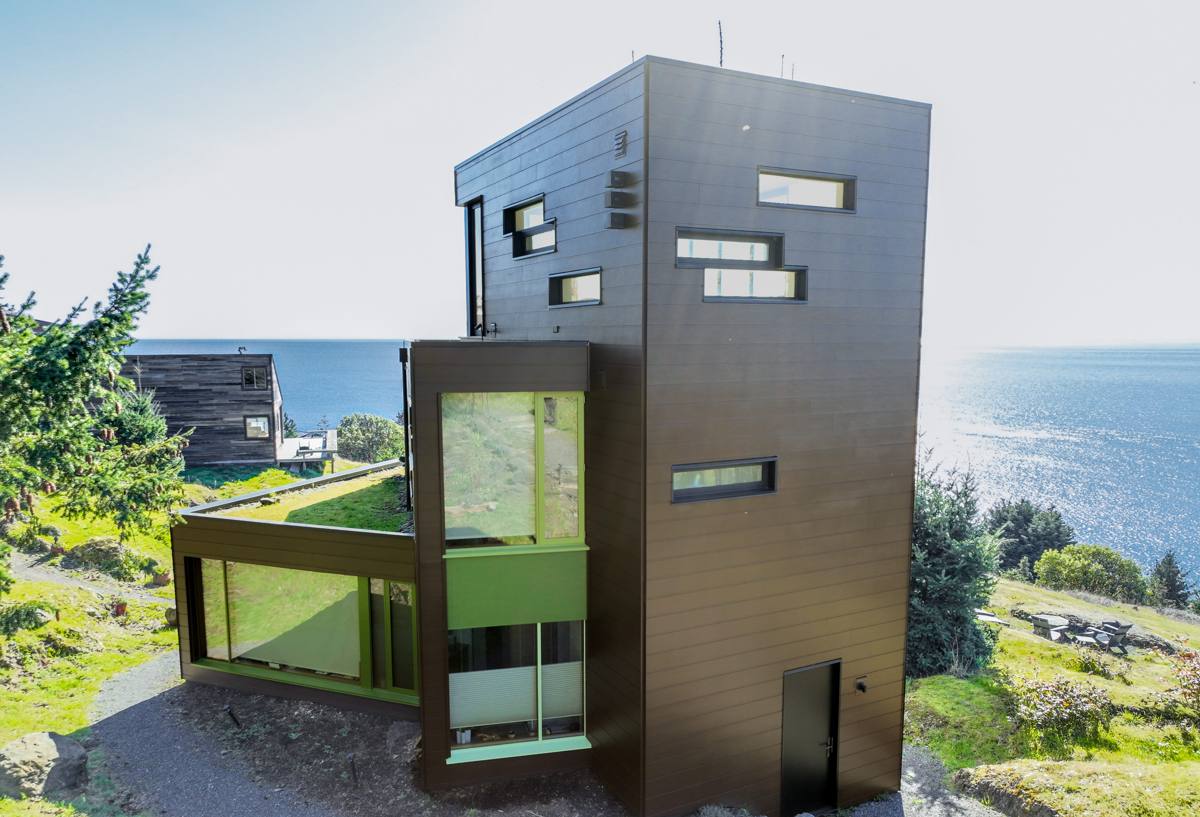
Blaine sits right on Semiahmoo Bay, and that proximity to salt water changes the math on exterior materials. Salt-laden air accelerates corrosion on fasteners and trim, and it degrades certain coatings faster than manufacturers' inland test data ever accounts for. Add in the driving rain that comes off the Strait during fall and winter storms, and you've got wind-driven moisture finding every gap, seam, and staple hole in a wall system.
Then there's moss. Whatcom County's damp, mild climate keeps north-facing walls and shaded elevations wet for weeks at a stretch, which is exactly the environment moss and algae need to take hold on porous or textured siding surfaces. A product that shrugs off two weeks of rain in a lab test doesn't necessarily hold up to five months of it every year, plus salt air, plus a moss season that never fully ends.
Why We Stopped Installing the Alternatives
We didn't arrive at an all-Hardie policy by reading a brochure. We arrived at it by installing and later repairing several other products and noticing a pattern. Here's the honest rundown, product by product.
Vinyl Siding
Vinyl is inexpensive and low-maintenance in the sense that it doesn't need painting. But it's a petroleum-based product that expands and contracts significantly with temperature swings, which means it has to be installed loose enough to move — and that "hung, not fastened tight" installation method is unforgiving of a crew that doesn't know the material. In coastal wind, panels can rattle, buckle, or blow off in a bad storm. It also can't be painted a darker color without risking warping from heat absorption, which limits design choice on a lot of Blaine's craftsman and coastal-style homes.
LP SmartSide and Other Engineered Wood
Engineered wood siding (strand-based products like LP SmartSide) performs reasonably well when it's kept dry and every cut edge is sealed per spec. The problem is that it's still wood at its core — treated and resin-bonded, but wood — and wood swells when it takes on moisture repeatedly. In a climate where driving rain hits siding for months at a time, any lapse in caulking, flashing, or edge-sealing becomes a slow moisture entry point. We've pulled off engineered wood siding with soft, swollen bottom edges on homes that were otherwise well maintained, simply because the material doesn't forgive installation shortcuts the way fiber cement does.
Cedar and Primed Spruce
Real wood siding has genuine appeal — it's a beautiful, traditional look, and some homeowners want that specifically. But solid wood requires an ongoing maintenance commitment: repainting or restaining every few years, constant caulk inspection, and vigilance against rot, especially on the shaded, damp-prone elevations common in this area. Primed spruce in particular is a lower grade product that depends entirely on the paint film staying intact; once that film fails anywhere, moisture gets into unprotected wood fast. We're not willing to sell a homeowner a product that turns into a recurring maintenance project within a few years of installation.
Other Fiber Cement Brands (Cemplank, Allura, etc.)
This one's less about the material — other fiber cement brands are chemically similar to Hardie's — and more about the system behind it. Hardie has invested specifically in climate-zoned formulations, a factory-applied finish warranty, and a national network of certified installers with documented installation standards. Competing fiber cement brands are reasonable products, but we standardized on the one backed by the deepest engineering data and the clearest installation specification, because that's what determines how the siding performs 15 years out, not just on installation day.
| Product | What It Gets Right | Why We Don't Install It |
|---|---|---|
| Vinyl | Low upfront cost, no painting | Loose-hung installation, wind vulnerability, limited dark colors |
| LP SmartSide / engineered wood | Wood look, easier install than solid lumber | Swells with repeated moisture exposure if edges aren't perfectly sealed |
| Cedar / primed spruce | Authentic natural wood appearance | High ongoing maintenance, paint-film dependent, rot risk |
| Other fiber cement brands | Similar material chemistry to Hardie | Less climate-specific engineering and installer certification depth |
| James Hardie fiber cement | Non-combustible, climate-engineered, factory finish, strong warranty | What we install exclusively |
What James Hardie Actually Is
Fiber cement is a blend of cellulose fiber, sand, and Portland cement, cured into rigid boards and panels. It's dimensionally stable — it doesn't expand and contract with temperature the way vinyl does, and it doesn't absorb and swell with moisture the way wood-based products do. It's also non-combustible, which matters for insurance considerations and for peace of mind generally, and it holds paint or factory finish far longer than wood substrates because it isn't feeding moisture back into the coating from underneath.
Hardie specifically engineers its boards by climate zone under what it calls HZ5 and HZ10 formulations, adjusting the product for regional moisture and freeze-thaw conditions rather than shipping one national formula everywhere. For the Pacific Northwest, that means a product built with our rain and humidity in mind, not a generic spec.
The Hardie Product Lines We Install
- HardiePlank lap siding — the most common choice, available in several textures and exposure widths, used on the majority of the traditional and craftsman-style homes we work on around Blaine.
- HardiePanel vertical siding — often paired with board-and-batten trim for a modern or farmhouse look, or used on gable ends and accent walls.
- HardieShingle siding — a shingle-profile option for homes wanting a coastal or cottage aesthetic without the maintenance burden of real cedar shingles.
- HardieTrim boards — matched trim material for corners, window casings, and fascia, so the whole exterior system ages consistently instead of trim rotting out while the field siding holds up.
ColorPlus Finish vs. Field Paint
One of the biggest practical differences between Hardie and almost every alternative is the ColorPlus factory finish option. Instead of painting the siding on-site after installation — where weather, dust, and inconsistent coats can all affect the result — ColorPlus boards are finished at the factory in a controlled, baked-on process with multiple coat layers. That finish carries its own dedicated warranty against fading and peeling, separate from the substrate warranty, and it holds color far longer than a field-applied coat exposed to salt air and UV from day one.
We still install primed Hardie for homeowners who want a custom field-painted color, and there's nothing wrong with that choice. But for anyone who wants the lowest long-term maintenance, ColorPlus is worth the conversation.
Installation Is Half the Product
Fiber cement's real-world performance depends heavily on installation quality — probably more than any other siding material we've worked with. Hardie publishes detailed installation specifications covering fastener type and placement, minimum clearances from grade and roofing, flashing details around windows and penetrations, and joint treatment. Skip or shortcut any of those, and you can undermine an otherwise excellent product.
Because we only install one product, our crews aren't switching between five different manufacturers' specs from job to job. That specialization is part of why we made this call — depth of experience with one system beats surface familiarity with several.
What Correct Hardie Installation Involves
- Minimum clearance maintained between siding and grade, decks, patios, and roof lines
- Corrosion-resistant fasteners appropriate for coastal, salt-air exposure
- Proper flashing and weather barrier integration at every window, door, and penetration
- Correct fastener spacing and placement per Hardie's published specification, not generic carpentry judgment
- Joint and butt-seam treatment that keeps water from tracking behind the boards
- Factory-cut edges sealed or primed where field cuts expose raw material
Warranty: What You're Actually Backed By
James Hardie offers a transferable limited warranty on its fiber cement substrate — meaning if you sell the home, the remaining coverage typically passes to the new owner, which is a real selling point in a market like Blaine where buyers ask about exterior condition. ColorPlus-finished products carry a separate finish warranty covering fade and peel performance. Coverage terms vary by product line and are spelled out in Hardie's published warranty documentation; we'll walk through the specifics for whichever product fits your home during an estimate, including what installation practices are required to keep the warranty intact.
What This Means for Your Project
Standardizing on one product means we're not upselling you between five options with five different margins. It means every crew member on your job has installed this exact system dozens of times, not learned it last month on a different manufacturer's panel. And it means the material going on your walls was engineered for exactly the conditions Blaine throws at it — salt air off the bay, sustained driving rain, and a moss season that tests every seam.
If you're weighing a full re-side or replacing storm-damaged sections, we're happy to walk your property, point out where the current siding is or isn't holding up, and give you a straight answer on what Hardie product and finish makes sense for your home. Reach out for a free, no-pressure estimate — no obligation, just an honest look at your options.