 Blaine
 What LP SmartSide Actually Is
LP SmartSide is an engineered wood siding product made from strand-oriented wood fiber, similar in concept to oriented strand board (OSB), pressed and bonded with resins, then treated with LP's SmartGuard process, which adds zinc borate to resist fungal decay and insects. It comes in lap boards, panels, and trim, and it installs faster and cuts easier than fiber cement or real wood. For builders working on a tight schedule, that's a real advantage, and we're not going to pretend otherwise.
It's also genuinely better than the raw OSB siding products that gave engineered wood siding a bad name in the 1990s. LP has put real engineering into SmartGuard, and on a dry site with a disciplined installation crew, it can perform reasonably well for years. We just don't think "reasonably well, if everything goes right" is good enough for homes on the northwest corner of Whatcom County, where very little about the weather cooperates with a wood-based product.
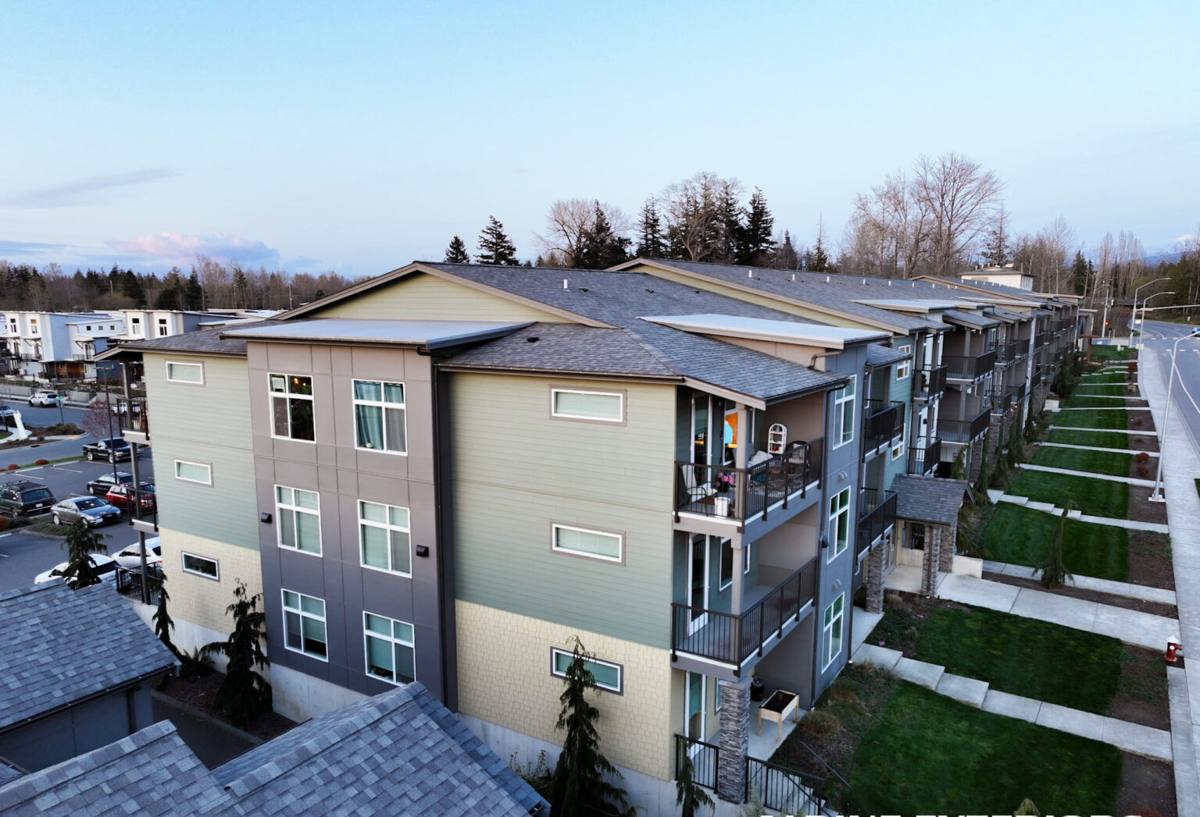
Our Standard, Not a Verdict on the Product
We want to be clear about what this page is and isn't. We're not telling you LP SmartSide is junk or that every installer who uses it is doing something wrong. We're telling you that after years of installing and repairing siding in Blaine, we made a company decision to install James Hardie fiber cement exclusively, because it removes several failure points that engineered wood siding simply can't avoid. That's a standard we hold ourselves to, not an attack on a competitor's product line.
The Moisture Problem in a Blaine Climate
Blaine sits right on Semiahmoo Bay and Drayton Harbor, with Boundary Bay and the Salish Sea shoreline a few minutes in either direction. That means salt-laden air moving across every exterior surface in town, on top of the steady, driving rain that Whatcom County gets off the Pacific for most of the year. Add the long stretch of cool, damp months that keeps moss and algae established on roofs and siding from fall through spring, and you have a climate that is about as demanding as it gets for any wood-based building product.
LP SmartSide's core material is still wood fiber. SmartGuard resists fungal growth and slows moisture absorption, but it doesn't make the product waterproof. Wood-based siding that takes on repeated moisture at cut edges, fastener holes, or seams over years will eventually swell, and once a board swells it doesn't return to its original dimension. In a climate with a real dry season, a board gets a chance to fully dry out between wet stretches. In Blaine, that dry window is short, and salt air adds its own corrosive pressure on fasteners and finishes at the same time.
Fiber cement doesn't have this problem because there's no wood fiber to swell. It's cement, sand, and cellulose fiber, and it doesn't absorb and expel moisture the way an engineered wood product does. That single material difference is the biggest reason we standardized on Hardie.
Where Moisture Actually Gets In
- Cut ends and factory edges that lose their protective treatment when trimmed on site and aren't fully sealed before installation
- Fastener penetrations, especially where a nail is driven at an angle or slightly overdriven
- Butt joints and panel seams where caulking has shrunk, cracked, or was never applied thick enough
- Areas below rooflines and gutters that see near-constant runoff during Blaine's wet months
- Ground-level clearance issues, where splashback keeps the bottom courses wet for days after a storm
Field-Applied Finish vs. Factory-Cured Finish
Most LP SmartSide installations rely on a field-applied paint system, meaning the finish coat goes on after the boards are up, in whatever weather the crew and the calendar allow. That finish is the primary barrier protecting the wood fiber underneath, and its performance depends heavily on surface prep, temperature, humidity, and how evenly it's applied. Painting siding correctly in Blaine's damp shoulder seasons is harder than it sounds, and a rushed or thin coat shortens the product's real-world lifespan regardless of what the warranty paperwork says.
James Hardie's ColorPlus finish, by contrast, is baked on at the factory under controlled conditions, with multiple coats and a UV-cured process that field painting can't replicate. It carries its own multi-year finish warranty separate from the substrate warranty, and it holds color and adhesion far more consistently in coastal, high-moisture climates. For a homeowner, that means fewer repaint cycles and less guessing about whether this particular installer's paint job will hold up through a Blaine winter.
Edge and Seam Sensitivity: Where Installation Quality Matters Most
Every siding product depends on correct installation, but some products punish mistakes more severely than others. LP SmartSide is on the sensitive end of that scale. Field cuts, gaps left un-caulked, fasteners placed outside the manufacturer's specified pattern, or clearance issues at grade can all shorten the product's service life significantly, and the damage often doesn't show up as a visible problem for a year or more, once moisture has already worked its way into the material.
Fiber cement is more forgiving. It doesn't mean installation quality doesn't matter with Hardie — it absolutely does, and we follow Hardie's fastening, clearance, and flashing specifications closely because that's what protects the manufacturer's warranty and the wall assembly behind it. But the consequence of a minor field error is different: a fiber cement board that gets a little wet at a seam doesn't swell and delaminate the way a wood-fiber board can.
Warranty Structure: What "Installation-Sensitive" Really Means
Both products carry manufacturer warranties, and both warranties include installation requirements that, if not followed, can limit or void coverage. The practical difference is how much room for error each product tolerates before those installation clauses become relevant. Because LP SmartSide's moisture defense depends on an unbroken finish and properly sealed edges everywhere, a warranty claim can turn into a dispute over whether a specific joint was caulked to spec, whether a specific board was primed on all six sides before installation, or whether ground clearance was maintained at every point around the foundation. Those are hard things to verify years later.
James Hardie's warranty is also installation-dependent, but the material itself carries less inherent risk, so fewer of the disputes we've seen in this trade over the years trace back to material failure at properly installed seams. We install to Hardie's published specifications on every job specifically so the warranty stays intact and so we're standing behind work that doesn't rely on a perfect paint job holding up for 20 years in salt air.
Cost Comparison: LP SmartSide vs. James Hardie
| Factor | LP SmartSide | James Hardie Fiber Cement |
|---|---|---|
| Base material | Engineered wood strand fiber with zinc borate treatment | Fiber cement (cement, sand, cellulose) |
| Finish | Typically field-applied paint | Factory-baked ColorPlus finish (prefinished options) |
| Moisture behavior | Resists but does not eliminate swelling risk at exposed/damaged edges | Does not swell or rot; dimensionally stable when wet |
| Repaint interval (coastal WA climate) | Often every 5-8 years depending on exposure | ColorPlus finish typically holds well beyond a decade |
| Installation sensitivity | High — edge sealing and caulking are critical | Moderate — clearances and fastening still matter |
| Combustibility | Wood-based, treated but organic | Non-combustible |
| Upfront material cost | Generally lower | Generally higher, offset by lower long-term maintenance |
What We Install Instead — and Why
We put James Hardie fiber cement siding on every home we side, using their HZ5 product line engineered for the Pacific Northwest's wet, marine-influenced conditions. It's non-combustible, it won't swell or rot the way a wood-fiber product can, and the ColorPlus factory finish holds up under the combination of salt air and near-constant moisture that defines a Blaine winter. Hardie also backs it with a strong transferable warranty, which matters if you sell the house before the siding's service life is up.
None of that makes Hardie maintenance-free — it still needs to be caulked at trim joints, checked periodically, and installed to spec with correct clearances and flashing. But it removes the specific failure mode that concerns us most with wood-based siding in this climate: slow, hidden moisture damage that doesn't announce itself until repair costs are already significant.
Questions Worth Asking Before You Choose a Siding Product
- Is the finish factory-applied and warrantied, or will it depend on a field paint job holding up?
- What happens to the material if moisture gets past a seam or a damaged edge — does it swell, or stay dimensionally stable?
- How installation-sensitive is the manufacturer's warranty, and what specifically voids it?
- What's the realistic repaint or refinish interval for this climate, not the manufacturer's best-case number?
- Is the product rated or commonly used in a similar coastal, high-moisture climate, or mostly marketed for drier regions?
- Does the installer follow the manufacturer's published fastening and clearance specs, and will they show you those specs?
Talk to Us Before You Decide
If you're comparing siding options for a home in Blaine, we're happy to walk your property, look at your exposure to wind, rain, and salt air, and give you a straight answer about what will actually hold up — even if that means talking you through options beyond what we install. Reach out for a free, no-pressure estimate, and we'll show you exactly what a Hardie installation looks like for your home and why we think it's worth the difference.