 Blaine
 Exterior Work Built for Grandview's Corner of Whatcom County
Grandview sits close enough to the water that salt air is a fact of daily life, and far enough into Whatcom County's marine climate pattern that rain isn't an occasional inconvenience — it's the default. Homes here take a slow, steady beating: wind-driven rain off the Strait, months of overcast humidity, and a moss season that seems to start earlier every year. None of that is unusual for this part of Washington, but it does mean the exterior materials on a Grandview home have a harder job than the same materials would have twenty miles inland.
We work on siding, roofing, windows, and decks throughout the Blaine area, and Grandview is part of our regular service footprint. That matters more than it sounds like it should — a crew that drives through the neighborhood regularly knows which streets sit in the fog belt longest, which lots get shaded and stay damp, and which homes are catching the brunt of storms moving in off the water. That local pattern recognition shapes real decisions: where we pay extra attention to flashing, how we sequence a job around weather windows, and which products we're willing to put our name behind.
What the Climate Actually Does to a House Here
It helps to be specific about the mechanisms, not just say "wet climate" and move on.
Salt Air
Proximity to Semiahmoo Bay and the Strait of Georgia means airborne salt is a real factor for homes in and around Blaine, including Grandview. Salt accelerates corrosion on fasteners, flashing, and any exposed metal trim, and it can affect how paint and coatings hold up over time. It's not dramatic — it's slow, cumulative wear that shows up as premature failure five or ten years earlier than a homeowner would expect.
Driving Rain and Wind
Rain here doesn't just fall — storms moving in off the water regularly push rain sideways into wall assemblies. That's a different stress than a straight-down summer shower. Wind-driven rain finds every gap in flashing, every poorly lapped seam, and every spot where a fastener wasn't set right. Over years, water intrusion at those points is what actually rots sheathing and framing, not the surface material itself.
Moss and Sustained Moisture
Shaded, north-facing, and tree-lined lots — common throughout Grandview — stay damp longer after every rain event, and that extended dampness is exactly what moss, algae, and mildew need to establish. Once organic growth gets a foothold on a roof or siding surface, it holds moisture against the material even longer, which speeds up whatever deterioration process is already underway underneath.
Why We Only Install James Hardie Fiber Cement Siding
We get asked fairly often why we don't offer vinyl, LP SmartSide, or a cheaper fiber cement alternative alongside Hardie. The honest answer is that we made a standard, and we didn't make it lightly.
Vinyl siding is inexpensive and low-maintenance in mild conditions, but it's a petroleum-based product that becomes brittle in cold snaps and can warp or buckle under direct heat and sun exposure — and in wind-driven rain, its lapped seams and lack of true water-shedding detail at penetrations make it a weaker moisture barrier than a properly installed fiber cement system. LP SmartSide and other engineered-wood products perform well when the wood-strand core stays dry, but their entire durability case depends on unbroken factory sealing at every cut edge and penetration; in a climate where wall assemblies see near-constant moisture exposure, that's a demanding standard to maintain over decades. Primed spruce and cedar are beautiful materials with a long tradition in the Pacific Northwest, but both require an ongoing maintenance commitment — repainting, sealing, and moisture monitoring — that most homeowners underestimate when they choose them.
James Hardie fiber cement is non-combustible, doesn't support moss and algae growth the way wood-based products can, and holds paint and factory-baked ColorPlus finishes far longer than most alternatives because the cement substrate itself is dimensionally stable — it doesn't expand and contract with humidity the way wood or vinyl does. Hardie's HZ5 product line is engineered specifically for climates like ours, with moisture and freeze-thaw performance built into the formulation rather than added on. That's the material we stand behind, and it's the only siding we put on a home.
How a Siding Project Runs in Grandview
Every job starts with an honest look at what's actually happening behind the existing siding, not just what it looks like from the curb.
- On-site inspection of current siding, trim, and any visible water staining or soft spots
- Check of flashing at windows, doors, and roof-to-wall transitions — the most common failure points in wind-driven rain
- Assessment of sheathing condition once old siding is removed, with photos before anything is closed up
- Written estimate covering material, labor, disposal, and any sheathing repair contingencies
- James Hardie installation to manufacturer spec: correct fastener pattern, proper clearances, and sealed penetrations
- Final walkthrough covering warranty registration and basic care
We don't sell a job by promising the cheapest number. We sell it by showing a homeowner what we found and what it'll take to fix it right, and Grandview homeowners tend to appreciate that directness once they've been through a few contractor quotes.
Roofing, Windows, and Decks: The Rest of the Envelope
Siding doesn't work in isolation. A roof with failing flashing will send water down behind even perfectly installed siding, and windows that aren't properly flashed create the same problem at a smaller scale. We handle all four trades — siding, roofing, windows, and decks — because in a climate this wet, treating them as one connected system rather than four separate projects is the only way to actually solve moisture problems instead of moving them around.
Roofing
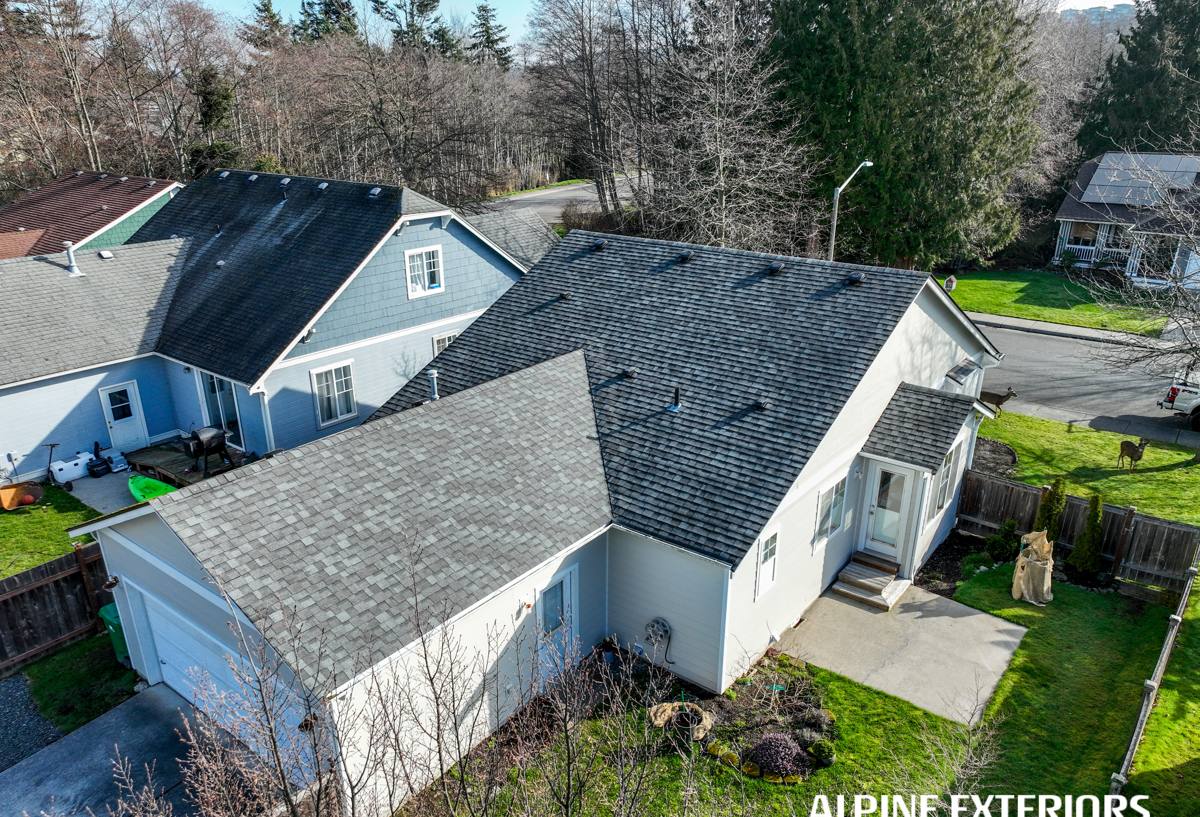
Moss growth and prolonged moisture exposure are the two biggest threats to roofs in this area. We look at ventilation, underlayment condition, and flashing detail — not just shingle wear — because a roof that's shedding water properly but trapping moisture underneath will fail from the inside out.
Windows
Old or poorly flashed windows are a common source of hidden water intrusion, especially on walls that take direct wind-driven rain. Replacement windows paired with correct flashing integration protect the wall assembly, not just the glass.
Decks
Exterior decks in this climate deal with the same sustained moisture and moss pressure as siding and roofing. Material choice and proper drainage detailing at ledger boards and joists matter as much as the decking surface itself.
Comparing Siding Materials for This Climate
| Material | Moisture Performance Here | Maintenance Burden | Typical Longevity |
|---|---|---|---|
| James Hardie Fiber Cement | Strong — dimensionally stable, resists moss/algae growth | Low — factory finish holds up for years | Decades, with proper install |
| Vinyl | Weaker seam/penetration detailing; can warp in temperature swings | Low upfront, but limited repair options | Variable, shorter in harsh exposure |
| LP SmartSide / Engineered Wood | Good if seals stay intact; vulnerable at cut edges and penetrations | Moderate — depends on sealing upkeep | Shorter if moisture gets behind seals |
| Primed Spruce / Cedar | Requires active moisture management | High — repainting and sealing on a cycle | Depends heavily on maintenance |
This table reflects general product behavior, not a claim about any specific manufacturer's failure rate. The trade-offs are real and worth weighing against upfront cost.
What Drives Cost on a Grandview Project
Every home is different, but a few factors consistently move the number:
| Factor | Why It Matters |
|---|---|
| Sheathing condition | Rot found after tear-off adds repair cost before new siding goes on |
| Home size and wall complexity | More corners, gables, and trim detail means more labor |
| Siding profile and color | Certain Hardie profiles and ColorPlus finishes carry different material costs |
| Access and lot conditions | Trees, slopes, and tight setbacks affect staging and labor time |
| Scope — siding only vs. combined with roofing/windows | Bundling trades can reduce redundant labor and staging costs |
We give written, itemized estimates so a homeowner can see exactly what's driving their number rather than a single lump-sum figure.
Why a Local Crew Matters
A crew that only shows up in Grandview once won't notice the pattern of a particular street catching wind off the water harder than the block behind it, or that a certain lot's tree cover means moss shows up on the north wall a full season before it does elsewhere. We're in Blaine and the surrounding Whatcom County area regularly, which means callbacks are easy, warranty follow-up isn't a logistical problem, and the crew installing your siding has actually seen how the last ten jobs in the area held up over time. That's not a marketing point — it's the practical difference between a contractor who treats your home as a one-off job and one who has to live with the reputation of every roof and wall they've touched in the neighborhood.
Get a Straight Answer for Your Home
If you're weighing a siding, roofing, window, or deck project in Grandview, we're happy to come take a look and give you a straightforward, no-pressure estimate — including an honest read on what your current exterior is actually dealing with, not just what a sales pitch wants you to hear.