 Blaine
 Siding in Nooksack: What the Climate Actually Does to a Home
Nooksack sits in a part of Whatcom County where homes spend most of the year damp. Rain doesn't just fall here — it drives sideways in winter storms, sits under tree cover for days at a time, and keeps north-facing walls shaded and wet long after the rest of the yard has dried out. Add in a moss season that can stretch from October through May, and you've got siding material that's under near-constant moisture pressure for most of the year.
That combination is hard on the wrong siding product. Wood-based sidings absorb moisture at cut edges, seams, and fastener points, and once water gets behind the surface, it doesn't leave quickly in a climate this humid. Paint film that would last a decade in a drier region can start failing here in half that time. Moss and algae find a foothold on any porous or textured surface that stays shaded and damp, and once established, they hold moisture against the wall even longer. Homes in and around Nooksack that carry the wrong exterior material tend to show it early — soft spots at the bottom courses, dark streaking under gutters, and paint that's peeling well before it should.
None of this is unique to any one house. It's the baseline condition for exterior work in this part of Whatcom County, and it's the reason we've built our siding, roofing, window, and deck work around materials and installation methods that are actually suited to it, rather than materials that simply look fine on the day they go up.
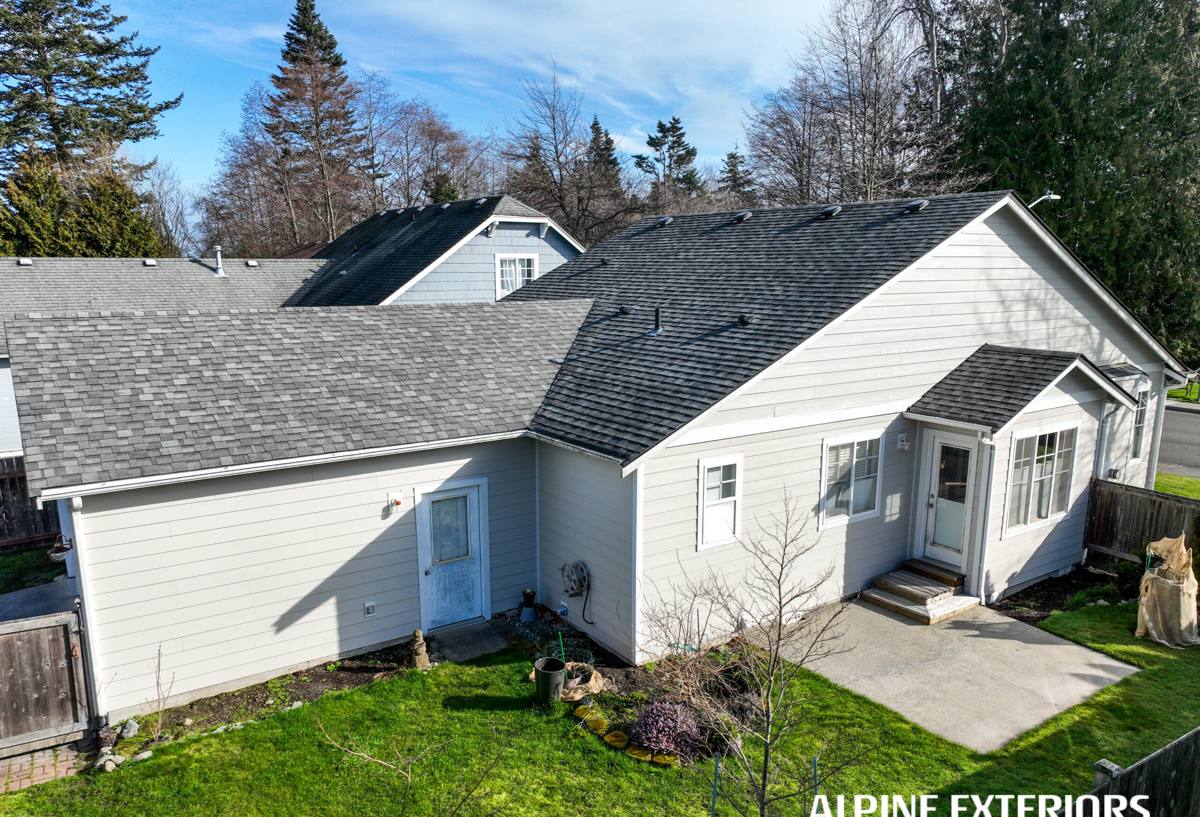
Our Approach to Siding Work in the Nooksack Service Area
We work across the Blaine and greater Whatcom County area, and Nooksack is part of our regular service territory. That matters more than it sounds like it should. A crew that only occasionally works this far from its home base tends to treat every job the same way regardless of local conditions. A crew that's out here regularly knows which walls take the brunt of the weather, how much ventilation a rain-heavy climate actually requires behind the cladding, and where corners get cut on jobs that don't hold up.
Our siding work starts with an honest look at the existing exterior — what's original, what's been patched, where moisture has already gotten in, and whether the sheathing and framing underneath are sound. We don't recommend a full re-side on a house that only needs targeted repair, and we don't patch a wall that's already compromised behind the surface. The goal on every estimate is to tell you what's actually happening on your house, not to upsell a bigger job than you need.
Why We Install Only James Hardie Fiber Cement
We made a deliberate decision to stop installing several common siding products — vinyl, LP SmartSide, primed spruce, cedar, and comparable fiber cement alternatives like Cemplank or Allura. That's not a knock on every homeowner who has one of those products on their house today; plenty of them perform fine for years under the right conditions and maintenance. It's a standard we hold for what we put on new installations, based on what we've seen hold up in this specific climate over time.
Vinyl siding is inexpensive and low-maintenance in a general sense, but it's a thin material that expands and contracts significantly with temperature swings, can crack in cold snaps, and doesn't offer much protection against wind-driven rain finding its way behind panels at loose seams. Wood-based products like cedar and primed spruce look good going up, but they're organic materials in a climate that stays wet for most of the year — they need consistent repainting and sealing to keep moisture out, and that maintenance schedule is easy to fall behind on. Engineered wood products like LP SmartSide have improved moisture resistance over older wood siding, but they're still wood-strand composites, and edge and cut-end sealing has to be done correctly and maintained over the life of the product or moisture will find a way in.
James Hardie fiber cement is a different category of material. It's roughly 90% sand, cement, and cellulose fiber, which makes it non-combustible and dimensionally stable — it doesn't swell, crack, or warp the way wood-based sidings can when they take on moisture. Hardie's ColorPlus factory finish is baked on under controlled conditions rather than field-applied, which gives a more consistent, longer-lasting finish than site-painted siding, and its HZ5 product line is engineered specifically for wet, freeze-prone climates like the Pacific Northwest. It's also backed by a strong transferable limited warranty, which matters if you sell the home down the road.
None of that makes Hardie maintenance-free — no siding product is. But it removes the moisture-absorption problem that drives most of the premature failures we see on this kind of exterior, and it's the product we're willing to stand behind on every job.
What Correct Installation Involves
Fiber cement performs the way it's engineered to only when it's installed correctly, and installation quality matters as much as the product choice itself. That includes proper clearance from grade and roof lines, correct fastener placement and spacing, sealed and flashed penetrations, and a drainage plane behind the siding that lets any incidental moisture escape instead of getting trapped against the wall. A rushed or under-detailed install can undercut even the best material, which is part of why we treat installation sequencing and flashing detail as seriously as the material spec.
Siding Options: A Straight Comparison
| Material | Moisture Behavior | Maintenance | Fire Resistance | Typical Lifespan |
|---|---|---|---|---|
| James Hardie Fiber Cement | Dimensionally stable, engineered for wet climates | Low — factory finish holds up for years | Non-combustible | 30+ years with proper install |
| Vinyl | Sheds surface water, but seams can let wind-driven rain in | Low, but prone to cracking and fading over time | Combustible, can warp near heat | 15-25 years |
| Cedar / Primed Spruce | Absorbs moisture at cuts and seams | High — regular painting/sealing required | Combustible | 15-25 years, shorter without upkeep |
| LP SmartSide (engineered wood) | Better than raw wood, but still moisture-sensitive at edges | Moderate — edge sealing and paint upkeep needed | Combustible | 20-25 years |
These are general characteristics, not guarantees for any individual product run or installation — but they reflect the trade-offs that led us to standardize on one material rather than offering all of them.
Beyond Siding: Roofing, Windows, and Decks
Siding rarely fails in isolation. A roof that's shedding water improperly, windows with failed seals, or a deck ledger board that's trapping moisture against the house can all undermine even a well-installed wall system. We handle all four trades — siding, roofing, windows, and decks — because they function as one connected exterior envelope, not four separate projects. When we're on-site for a siding job, we're also looking at roof edges, window flashing, and any deck attachment points that intersect the wall, because problems in one area routinely show up as damage in another.
For roofing, that means proper underlayment and flashing detail suited to a climate with sustained wet seasons. For windows, it means correct flashing integration with the new siding so water is directed out and down rather than into the wall cavity. For decks, it means ledger attachment and flashing that don't create a hidden moisture trap where the deck meets the house — a common failure point we see on older builds in wetter climates.
Signs Your Siding May Need Attention
- Dark green or black staining that returns shortly after cleaning
- Soft or spongy spots when you press on lower wall sections
- Paint that's peeling, bubbling, or chalking well before its expected repaint interval
- Visible gaps, warping, or separation at panel seams and corners
- A musty smell near exterior walls, especially in closets or rooms that back onto a north-facing wall
- Moss or algae buildup that keeps a section of wall shaded and damp longer than the rest of the house
Any one of these on its own isn't necessarily an emergency, but if you're seeing more than one, it's worth having someone look at what's happening behind the surface before it turns into a sheathing or framing repair.
What to Expect from a Project
Every job starts with an in-person walkthrough, not a phone estimate. We look at the current siding condition, check for moisture damage at trim, corners, and penetrations, and talk through what's driving the need for work — repair, partial replacement, or a full re-side. From there we give you a written scope and estimate before any work starts, so there's no ambiguity about what's included.
On installation day, that means proper tear-off and inspection of the sheathing underneath (repairing anything compromised before new siding goes up), correct house wrap or drainage plane installation, and Hardie panels installed to manufacturer fastening and clearance specs. We don't consider a job finished until flashing, caulking, and trim details are done right — those are the spots that determine whether a siding job lasts 10 years or 30.
Why a Local Crew Matters Here
Whatcom County's weather isn't dramatic, but it's relentless — steady rain, long stretches of overcast humidity, and a moss season that doesn't really end. A crew based in this region and working it regularly builds a feel for which details matter most: where water actually collects on a given roofline, which wall orientations need the most attention, and how much drainage capacity a wall system needs behind the cladding in a climate this wet. That's the kind of judgment that comes from doing this work here repeatedly, not from a general specification sheet.
If you're in Nooksack and dealing with siding that's showing its age, or you're planning ahead for a project, we're glad to come take a look. The estimate is free, there's no pressure to move forward, and you'll get a straight answer about what your house actually needs.