 Blaine
 Siding Built for Sumas, Washington
Sumas sits at the far northern edge of Whatcom County, tucked against the Canadian border with the Nooksack River valley and the Cascade foothills close by. It's a different kind of exposure than the coastline a few miles west, but the exterior of a Sumas home takes a beating in its own way. Homeowners here deal with a long, wet fall-to-spring season, heavy valley fog, seasonal flooding pressure from the Nooksack, and a moss-and-mildew climate that never fully lets up. Add in the salt-tinged marine air that rolls inland from the Strait of Georgia and Boundary Bay, and you've got a combination that punishes the wrong siding material fast.
We're a Blaine-based exterior contractor that works throughout Whatcom County, including Sumas, and we install one siding product: James Hardie fiber cement. That's not a marketing angle — it's a standard we set because we've seen what this climate does to everything else over ten, fifteen, twenty years, and we'd rather build something that holds up than something that looks good on install day and needs attention five years later.
What the Climate Actually Does to a House Here
Moisture That Doesn't Quit
Whatcom County gets a genuinely long wet season, and Sumas — sitting low in the Nooksack valley — holds onto humidity and fog longer than higher ground nearby. Wood-based siding products (cedar, primed spruce, and even engineered wood like LP SmartSide) rely on paint film and edge sealing to keep water out. Every seam, cut end, and fastener hole is a place water can get in if maintenance slips even one season. Once moisture gets behind or into a wood-based panel, it doesn't dry out quickly in a climate like this — it just sits there, and that's when rot and swelling start.
Salt Air From the West
Sumas is inland compared to Blaine, but prevailing weather still carries marine air off the Strait of Georgia and Boundary Bay across the county. Salt-laden moisture accelerates corrosion on fasteners and trim, and it breaks down cheaper paint films faster than a dry inland climate would. It's a slower, quieter version of what coastal Blaine and Birch Bay properties deal with directly, but it's real, and it shows up over time as chalking, fading, and fastener staining on lower-grade siding.
Moss, Algae, and Shade
Between tree cover, valley fog, and the sheer number of damp days per year, north-facing walls and shaded siding sections in Sumas grow moss and algae readily. On porous or textured wood siding, that growth can hold moisture against the surface for weeks at a stretch. On a factory-finished fiber cement product, it's a surface issue you can wash off — it doesn't have the same opportunity to work its way into the substrate.
Why We Only Install James Hardie
We get asked fairly often why we don't offer vinyl, LP SmartSide, cedar, or other fiber cement brands like Allura or Cemplank. The honest answer is that we used to install a broader range of products, and we watched the long-term callbacks concentrate almost entirely around a handful of failure modes: moisture intrusion at seams and cut edges, paint and caulk maintenance that homeowners either couldn't keep up with or didn't know they needed to, and warranty terms that were thinner or harder to transfer than what Hardie offers.
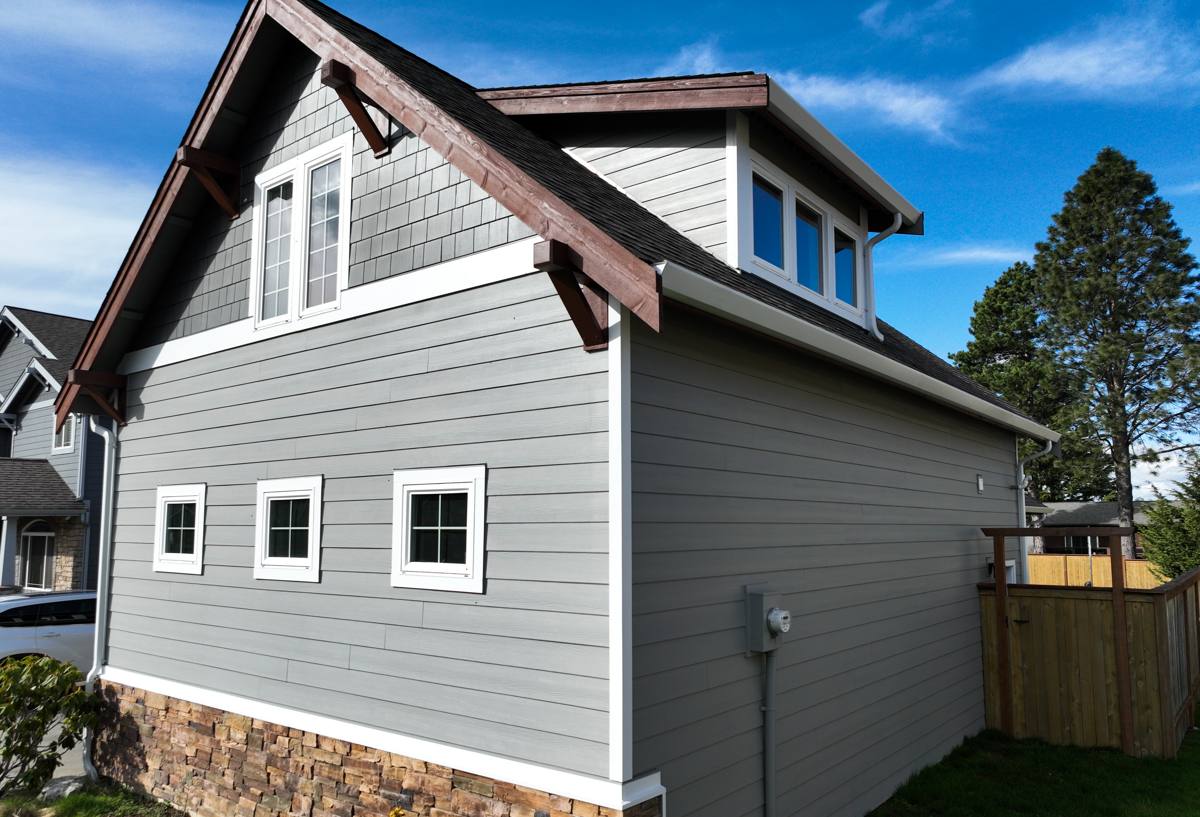
James Hardie fiber cement is engineered specifically to resist the freeze-thaw, rain, and humidity cycles the Pacific Northwest produces every year. It's non-combustible, which matters more each fire season as wildfire smoke and ember exposure become a bigger regional concern even this far north. It holds its factory-applied ColorPlus finish for years without repainting, and the company backs it with a strong, transferable warranty — a real asset if a Sumas homeowner sells within the ownership window.
What We Give Up by Not Offering Everything
We're upfront that specializing has a cost: we can't chase the lowest possible bid the way a contractor who also installs vinyl can, and we occasionally lose a job to a lower quote on a cheaper product. We're fine with that trade. We'd rather stand behind one system we trust in this climate than install something we know is more likely to bring a homeowner problems down the road.
How the Project Works
Assessment and Planning
We start with a walk-around of the home — checking existing siding condition, trim, flashing, window and door transitions, and any moisture staining that points to a problem hiding under the surface. In an area like Sumas, we pay particular attention to grade-level siding near foundations and any north- or shade-facing walls where moss and lingering dampness are more likely.
Removal and Prep
Old siding comes off, and we inspect the sheathing and framing underneath before anything new goes up. This is the step that gets skipped by contractors trying to move fast, and it's the step that matters most — covering rot or moisture damage with new siding doesn't fix it, it just hides it for a while.
Weather Barrier and Flashing
Correct house wrap, flashing at every window and door opening, and proper overlap at seams are what actually keep water out over the long run — the siding material is only part of the system. This step is where a lot of installation problems originate, regardless of what siding goes on top.
Installation to Manufacturer Spec
James Hardie panels and planks have specific fastening patterns, clearances, and caulking requirements. Installing to spec is what preserves the manufacturer warranty and what actually gives you the performance the product is designed for. We follow it because cutting corners here shows up as problems in five to ten years, not on day one.
Beyond Siding: Roofing, Windows, and Decks
Siding doesn't work in isolation — it's one part of a home's exterior envelope. We also handle roofing, window replacement, and deck construction, and we look at all four together when we're on a property. A roof that's shedding water onto a wall, or a window that's not flashed correctly, will undermine even a well-installed siding job. For Sumas homeowners dealing with valley moisture and moss, a coordinated look at the whole exterior — not just the siding — is usually the more useful conversation.
Comparing Siding Options
| Material | Moisture Resistance | Maintenance | Typical Lifespan |
|---|---|---|---|
| James Hardie Fiber Cement | High — engineered for wet climates | Occasional wash; no repainting for years | 30+ years with factory finish intact |
| Cedar | Moderate — needs consistent sealing | Regular staining/sealing required | 15-25 years with upkeep |
| LP SmartSide / Engineered Wood | Moderate — vulnerable at cut edges/seams | Paint maintenance, edge sealing | 20-30 years, condition-dependent |
| Vinyl | Low-moderate — can trap moisture behind panels | Low, but limited repair options | 20-30 years, fades/cracks over time |
What Affects Cost
- Size and complexity of the home's exterior, including gables, dormers, and trim detail
- Condition of the existing sheathing once old siding is removed
- Whether flashing and window/door transitions need rework, not just new siding
- Product line selected (HardiePlank lap siding, HardiePanel, HardieShingle) and ColorPlus finish choice
- Accessibility of the property and any specialty trim or accent work
We give straightforward, itemized estimates rather than vague lump sums, so homeowners can see exactly what they're paying for.
What to Check Before Hiring Any Contractor
- Washington state contractor license in good standing, plus proof of liability insurance
- Manufacturer certification or documented experience specifically with James Hardie installation
- A written scope that includes flashing and weather barrier work, not just panel installation
- Clear warranty terms — both manufacturer and workmanship — in writing
- Willingness to explain why they recommend a given product for your specific home and exposure
Why a Local Crew Matters
A contractor who works throughout Whatcom County knows the difference between a Sumas valley-fog problem and a Blaine coastal-salt problem, and that shapes real decisions — which walls need extra attention, how flashing details should account for the local moisture pattern, and what maintenance schedule actually makes sense here versus in a drier part of the state. It also means we're not disappearing after the job — if a question comes up two years down the line, we're still local and still reachable.
If you're weighing a siding, roofing, window, or deck project on a Sumas property, we're glad to come take a look and talk through what your home actually needs — no pressure, no obligation. Reach out for a free estimate using the form below.