 Blaine
 Dakota Creek sits on the quieter, greener edge of Blaine, where wooded lots, low-lying drainage, and proximity to the water shape how a house ages. It's a different exposure than the open bluffs closer to Semiahmoo Bay, but it comes with its own set of problems: shade that never quite dries out, moisture that lingers in the tree line, and the same salt-laden marine air that reaches every corner of Whatcom County's coastline. Homes here take a slower, quieter kind of beating than homes on the open water — but it adds up just the same.
We've worked on enough exteriors in and around Blaine to know that "coastal siding" isn't one problem — it's several, layered on top of each other. Dakota Creek homeowners deal with driving rain off the Strait, salt air drifting inland, and a moss and mildew season that can run eight months out of the year under tree cover. Any exterior product installed here has to handle all three at once, not just one.
What Dakota Creek's Climate Actually Does to a House
This part of Whatcom County doesn't get brutal winters, but it gets relentless wet. Rain doesn't just fall here — wind off the water drives it sideways into siding, window trim, and door casings. Add in the tree canopy common in Dakota Creek's residential pockets, and you get surfaces that stay damp long after a storm has passed. That combination — wind-driven moisture plus shaded, slow-drying wood and siding — is exactly what feeds rot, moss, and mildew.
Salt Air Doesn't Stay at the Waterfront
People assume salt air is only a problem for homes right on Drayton Harbor or Semiahmoo Bay. In practice, airborne salt travels well inland on Blaine's prevailing winds, and Dakota Creek is close enough to the water that it's still part of that exposure zone. Salt accelerates corrosion on fasteners, flashing, and hardware, and it interacts with cheaper coatings and finishes in ways that shorten their working life.
Moss Season Is Longer Than Most Homeowners Realize
In shaded, moisture-retentive spots like the ones common around Dakota Creek, moss and algae don't wait for a rainy month — they establish themselves and don't fully die back until the driest stretch of summer. On wood-based siding, that means sustained surface moisture sitting against the material for most of the year. On a well-sealed fiber cement product, it's a cosmetic issue you can wash off. On absorbent siding, it's a moisture pathway.
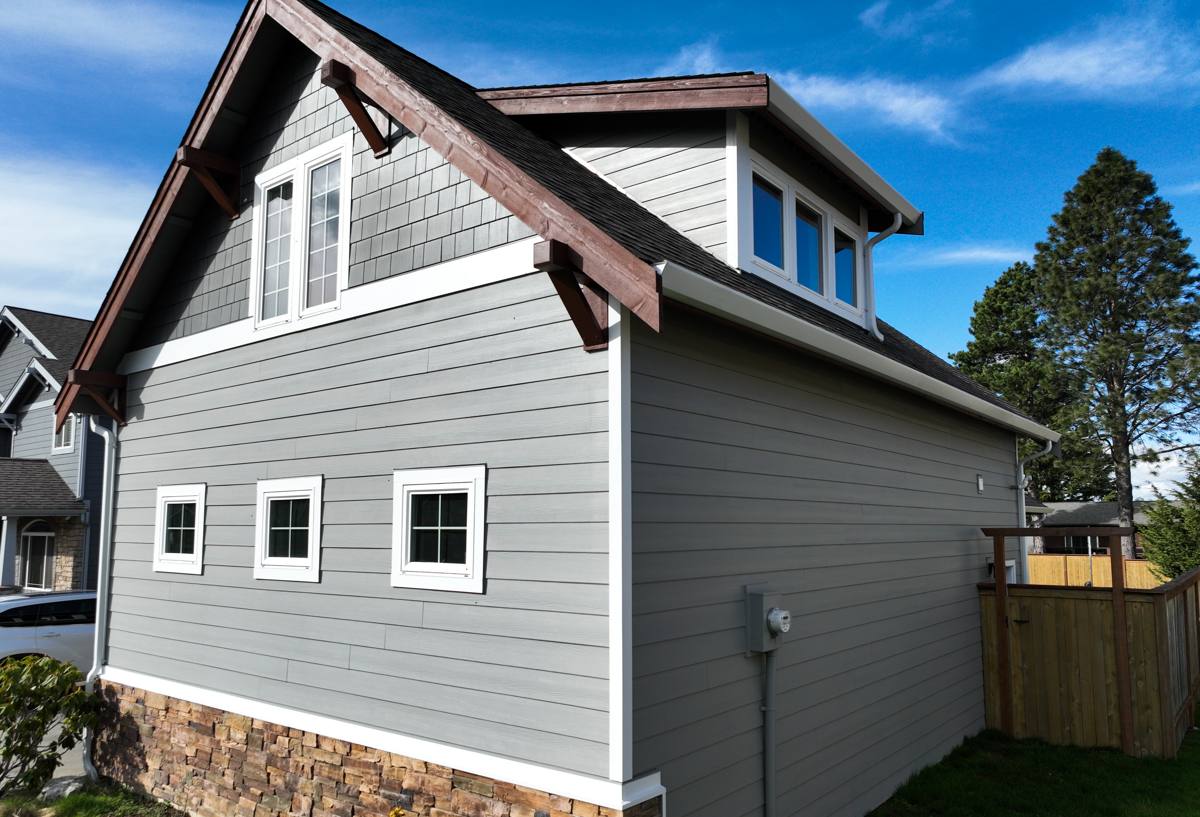
Why We Only Install James Hardie Fiber Cement
We made a deliberate decision as a company to install one siding system — James Hardie fiber cement — and not offer vinyl, LP SmartSide, Cemplank, Allura, primed spruce, or cedar as alternatives. That's not a marketing position; it's a standard we hold because of what we've seen hold up in this climate and what hasn't.
- Non-combustible core: fiber cement doesn't feed a fire the way wood-based products can, which matters as wildfire smoke and dry-season risk have become a bigger part of Pacific Northwest summers.
- Doesn't absorb water like wood fiber products: Hardie's cement composition resists the swelling, delaminating, and edge-softening that plague wood-based siding under sustained damp conditions.
- Factory-applied ColorPlus finish: baked-on color resists fading and chipping far longer than field-applied paint, which matters when salt air and UV are both working against a finish.
- Climate-engineered HZ product lines: Hardie makes region-specific formulations; the HZ5 line is built for exactly the wet, moderate-freeze conditions Whatcom County sees.
- Strong, transferable warranty: backed by decades of real-world performance data, not a newer product still building a track record.
Why We Don't Install the Alternatives
We're not going to tell you these products are junk — that's not fair, and it's not accurate. Each one has a real use case. Here's our honest read on why they're not what we put on a Dakota Creek home.
| Product | What it does well | Why we don't install it here |
|---|---|---|
| Vinyl siding | Low upfront cost, quick installation | Softens and warps in sustained heat, brittles in cold snaps, and seams and channels give wind-driven rain a path behind the panel |
| LP SmartSide | Engineered wood, reasonably priced | Wood-strand core is still moisture-sensitive at cut edges and fastener points; needs disciplined sealing and maintenance to avoid swelling |
| Cemplank / Allura | Fiber cement alternatives, lower price point | Thinner formulations and less consistent factory finishing in our experience, plus a shorter real-world track record in this climate |
| Primed spruce / cedar | Natural look, traditional appeal | Requires ongoing repainting and sealing to survive moss season and salt air; without upkeep, moisture gets in fast |
How Siding Installation Works for Dakota Creek Homes
Every job starts with an honest look at the existing exterior — not just the siding itself, but what's happening behind it. In a wet, tree-covered area like this, we're checking for trapped moisture, compromised sheathing, and flashing that's failed at windows, doors, and roof-to-wall transitions before a single new panel goes up.
What Correct Installation Involves
- Removing old siding and inspecting the water-resistive barrier and sheathing underneath for rot or existing damage
- Repairing or replacing any compromised sheathing before new siding goes on — never siding over a known problem
- Installing or correcting flashing at every window, door, and penetration, since this is where most water intrusion actually starts
- Proper fastening and clearances per Hardie's installation specs — gaps at trim, correct nailing patterns, and clearance from grade and roof lines
- Caulking and sealing only where Hardie's system calls for it — over-caulking can trap moisture instead of shedding it
Roofing, Windows, and Decks: The Rest of the Envelope
Siding is only one piece of how a Dakota Creek home handles this climate. We handle roofing, windows, and decks as well, because a house's weather protection has to work as one connected system.
Roofing
A roof under tree cover in a moss-prone area needs attention to underlayment quality, ventilation, and moss-resistant strategy, not just shingle choice. Roofs that trap moisture under debris and shade age faster than roofs in open, sun-exposed spots elsewhere in Blaine.
Windows
Window flashing and seal quality matter more here than in drier climates, since driving rain finds any weak point around a frame. Replacement windows are also a chance to correct flashing details that may have failed on the original install.
Decks
Outdoor living spaces in shaded, damp lots deal with the same moss and slow-drying conditions as siding. Decking material choice and proper drainage/spacing underneath the boards make a real difference in how long a deck stays safe and presentable.
What This Means for Your Maintenance Schedule
A well-installed fiber cement exterior in Dakota Creek's climate is genuinely low-maintenance, but "low" isn't "zero." A realistic annual routine:
- Rinse siding and trim once or twice a year to clear moss, pollen, and salt residue — a garden hose and soft brush is usually enough
- Walk the exterior each fall and check caulking at windows, doors, and trim joints for cracking or gaps
- Clear gutters and downspouts before the heavy fall rains start, since overflow is a major source of siding and trim damage
- Trim back tree branches and shrubs that keep siding in constant shade and slow drying time
- Have flashing and roof-to-wall transitions checked periodically, since these are the most common failure points regardless of siding material
Why a Local Crew Matters Here
Dakota Creek's mix of tree cover, drainage, and proximity to salt air isn't identical to every neighborhood in Blaine, and it's a meaningfully different exposure than what you'd plan for inland in Whatcom County. A crew that works this area regularly knows where water tends to collect, which sides of a house take the worst wind-driven rain, and how long moss season actually runs here versus on paper. That local knowledge shapes real decisions — flashing details, product line selection, where extra attention is worth the time.
Cost Factors Worth Understanding Upfront
| Factor | Why it affects your quote |
|---|---|
| Existing sheathing condition | Rot or moisture damage found during tear-off adds repair scope before new siding can go on |
| Home size and complexity | Dormers, multiple gables, and trim detail all add labor time |
| Access and site conditions | Tree-covered or tight lots common in Dakota Creek can affect staging and scaffolding needs |
| Product line and color | Hardie's HZ lines and ColorPlus finish options vary in price point |
| Scope of work | Siding-only projects price differently than combined siding, roofing, and window work |
If you're weighing a siding, roofing, window, or deck project for your Dakota Creek home, we're glad to take a look and walk you through what we're seeing — no pressure, no obligation. A free estimate is the easiest way to find out what your home actually needs.