 Blaine
 Why Sandy Point Roofs Age Differently Than Roofs Inland
Sandy Point sits close enough to the water that its homes take on a different set of stresses than roofs even a few miles inland in Whatcom County. The salt-laden air off the water accelerates corrosion on any exposed metal — fasteners, flashing, vent caps — faster than the same materials would wear in a dry, inland neighborhood. Add the wind-driven rain that comes through this part of the county in fall and winter, and you have moisture finding every seam, nail hole, and lapped edge a roof has. Then there's the long moss season: mild, damp winters here give moss and algae months to get established on north-facing slopes and shaded valleys, and once it takes hold it holds water against the roofing material long after the rain has stopped.
None of that means a roof at Sandy Point is doomed to fail early. It means the installation has to account for those three things specifically — salt air, driving rain, and moss — rather than following a generic spec sheet written for a drier climate. That's the difference between a roof that looks fine going on and one that actually performs for its full service life out here.
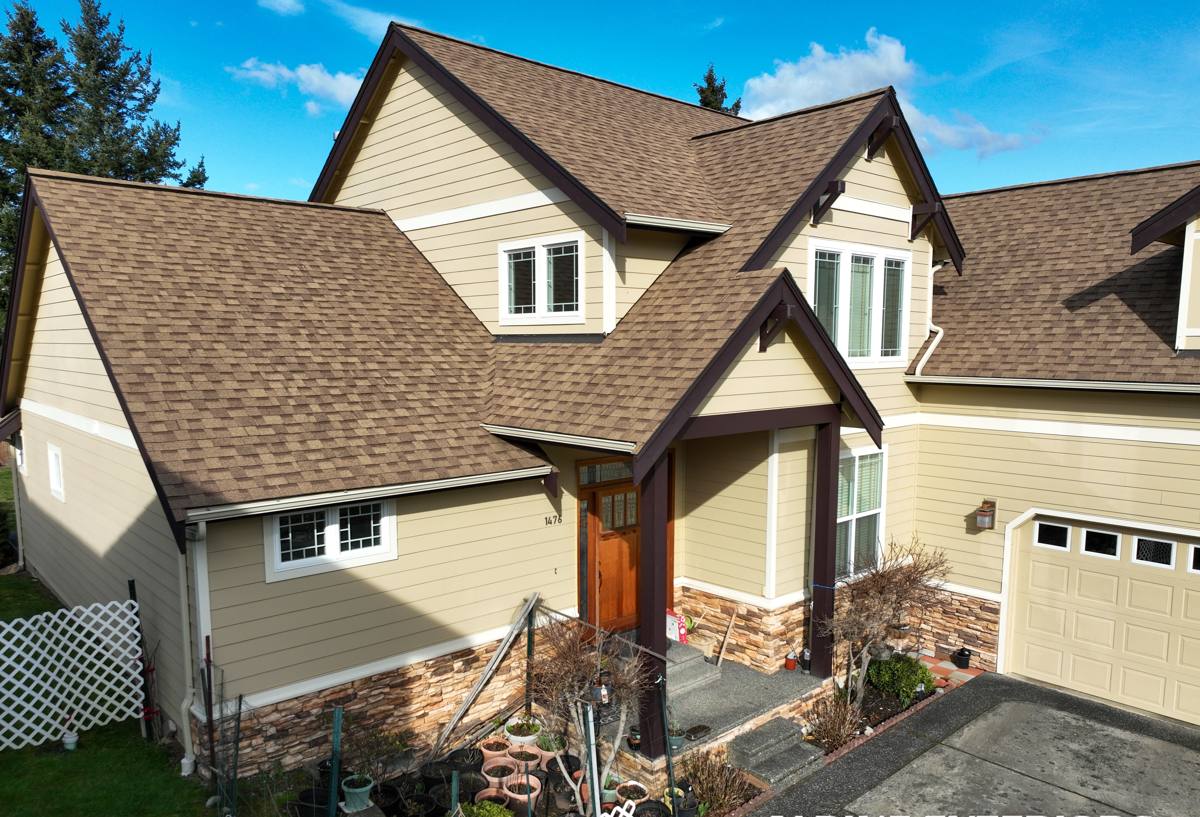
What Salt Air, Rain, and Moss Actually Do to a Roof Over Time
Salt Air and Corrosion
Airborne salt is mildly corrosive to unprotected steel and aluminum. On a roof, that shows up first at fasteners, drip edge, valley metal, and any exposed flashing — the small metal details that hold everything else together. Standard electro-galvanized fasteners can start showing surface rust within a few years in a shoreline environment; that rust weeps down onto the roofing material and, more importantly, weakens the fastener's grip over time.
Driving Rain and Wind-Driven Water
Rain that falls straight down is easy for any roof to shed. Rain that's being pushed sideways by wind off the water behaves differently — it can work up under shingle tabs, around vent boots, and along ridge lines instead of simply running off. A roof built for this kind of weather needs more attention to underlayment coverage, flashing laps, and sealing at penetrations than a roof going up somewhere with calmer weather patterns.
Moss, Algae, and Trapped Moisture
Whatcom County's mild, wet winters are ideal moss-growing conditions, and Sandy Point's tree cover and shoreline humidity add to that. Moss doesn't just look bad — its root structure lifts shingle edges, and the mat it forms holds water against the roof deck. Left long enough, that trapped moisture starts to affect the decking underneath, not just the shingles on top.
Signs a Sandy Point Home May Need a New Roof
Most roofs don't fail all at once — they show warning signs first. If you're seeing several of these together, it's worth having someone look at the whole system, not just patch the symptom.
- Granules collecting in gutters or at downspout outlets, or shingles that look bald in patches
- Shingle edges curling, cupping, or lifting, especially on south- and west-facing slopes
- Moss or algae streaking that comes back within a season of being cleaned off
- Rusty staining below metal flashing, vent caps, or exposed fasteners
- Soft or spongy spots underfoot in the attic, or daylight visible through the roof deck
- Water stains on interior ceilings, especially near chimneys, skylights, or valleys
- A roof that's 20+ years old on standard architectural shingles, even if it "looks okay" from the ground
Any one of these on its own might just mean a repair. Several at once, or a roof already past its expected service life, usually means replacement is the more honest recommendation — patching an aging roof in this climate tends to buy a year or two at best.
Choosing a Roofing System That Actually Suits This Environment
There's no single "best" roofing material for every home — it depends on budget, roof pitch, how much shade and moss pressure the property gets, and how long you plan to own the home. Here's how the common options actually compare for a coastal Whatcom County property like Sandy Point.
| Material | Typical Coastal Lifespan | Moss/Algae Resistance | Salt Air & Wind Durability | Relative Upfront Cost |
|---|---|---|---|---|
| Standard 3-tab asphalt shingle | 12–18 years | Low unless treated | Fair — needs quality fasteners and flashing | Lowest |
| Architectural (laminate) asphalt shingle | 20–25 years | Moderate; algae-resistant lines available | Good with proper coastal-grade fasteners | Moderate |
| Standing seam metal | 40–50+ years | High — sheds moss with proper slope | Very good with marine-grade coatings and fasteners | Highest |
| Synthetic/composite shingle | 25–30 years | Moderate to high depending on product | Good | Moderate to high |
For most Sandy Point homes, an algae-resistant architectural shingle with coastal-grade fasteners and metal is the practical middle ground — it holds up well to the climate without the upfront cost of a full metal system. On homes with heavy tree cover or steep, shaded north slopes where moss is a persistent problem, metal earns its higher price tag by shedding moss almost entirely and shrugging off salt air with the right coatings. We'll walk you through the honest trade-offs for your specific roof rather than pushing one product across the board.
What a Correct New Roof Installation Actually Involves
A new roof is only as good as what's underneath the shingles. In this climate, several steps matter more than they would in a drier region, and skipping or rushing them is where premature failures come from.
Full Tear-Off and Deck Inspection
We don't install over an existing layer of roofing. A full tear-off lets us see the actual condition of the deck — soft spots, moss-related rot, or old damage that a re-roof over the top would simply hide. Any damaged sheathing gets replaced before anything new goes down.
Ice and Water Shield at Vulnerable Points
Valleys, eaves, and roof penetrations get self-adhering waterproof membrane, not just standard felt. This is the layer that protects against wind-driven rain that manages to work past the shingles themselves — the most common failure point in a marine climate.
Synthetic Underlayment Across the Field
A high-quality synthetic underlayment across the full roof gives a second line of defense that standard felt doesn't match for water resistance and durability during the install itself, when the deck is exposed to weather.
Coastal-Grade Flashing and Fasteners
Given the salt air, we use flashing and fasteners rated for corrosion resistance rather than standard-grade hardware. It costs a little more upfront and it's the difference between flashing that lasts the life of the roof and flashing that's rusting and leaking in year eight.
Proper Ventilation
Balanced intake and exhaust ventilation keeps the attic space dry and temperature-stable, which matters for shingle life and for keeping condensation — a real issue in our humid winters — from forming on the underside of the deck.
Ventilation and Moisture Control Matter As Much As the Shingles
It's easy to focus on the roofing material and overlook what's happening underneath it, but in a damp, marine climate the attic environment has a direct effect on how long a roof lasts. Poor ventilation traps humid air against the underside of the deck, which can lead to condensation, mold, and slow rot — problems that show up as "roof failure" years later even though the shingles themselves were fine. Part of every new roof installation is checking that intake vents (usually at the eaves) and exhaust vents (ridge or box vents) are balanced for the size of the attic, not just present. On older Sandy Point homes, we often find ventilation that was adequate when the house was built but has since been blocked by insulation, painted over, or simply undersized for today's standards.
How Our Process Works, Start to Finish
- On-site inspection. We look at the deck condition, current ventilation, flashing details, and any moss or moisture patterns specific to your property's exposure.
- Honest written estimate. You get a clear scope of work and material options — no pressure toward the most expensive system if it's not what your home needs.
- Tear-off and deck repair. Old roofing comes off completely; any compromised decking is replaced before new materials go down.
- Underlayment, flashing, and shingle or metal installation. Built with the coastal-grade materials and detailing described above.
- Ventilation check and correction. Intake and exhaust vents are inspected and balanced as part of the job, not treated as a separate add-on.
- Final walkthrough. We go over the finished roof with you before we consider the job done.
Why Hiring a Crew That Already Works Sandy Point Matters
A roofing crew that regularly works this stretch of Whatcom County already knows which fastener grades hold up to the salt air here, which slopes and tree lines tend to grow moss fastest, and how local wind patterns off the water affect flashing and shingle exposure at the edges and valleys. That's not something you get from a general specification sheet — it's from having repaired and replaced enough roofs in this specific setting to know where they actually fail first. It also means a shorter learning curve on your job: no guessing about whether standard-grade hardware is good enough, because we already know it isn't out here.
Protecting the Investment After Installation
A new roof done right doesn't need much from you, but a little upkeep goes a long way in this climate. Keep gutters clear so water isn't backing up under the shingle edge. Have moss or algae growth addressed early rather than left to spread — a light treatment is far less invasive than what's needed once it's established. And after any major windstorm, a quick visual check for lifted shingles or displaced flashing costs nothing and can catch a small problem before it becomes a leak. We're happy to point out what to watch for on your specific roof during the final walkthrough.
If your Sandy Point roof is showing its age, or you just want an honest read on how much life it has left, we're glad to come take a look. Fill out the form below for a free, no-pressure estimate — we'll tell you what we actually see, not just what's easiest to sell.