 Blaine
 Why Sandy Point's Shoreline Location Puts Extra Stress on a Roof
Sandy Point sits right on the water, and that location is exactly why roofing choices matter more here than they do a few miles inland. Salt-laden air off the Strait of Georgia works on exposed metal fasteners, flashing, and vents year-round, not just during storms. Add in driving rain that comes in sideways during winter systems, and a roof here is being tested from multiple directions at once — not just from above.
Then there's moss. Whatcom County's damp, mild winters and long shoulder seasons give moss and algae months of ideal growing conditions on any roof surface that holds moisture. On a shaded or north-facing slope, that season can stretch from fall through spring. A roof that can't shed water and debris quickly ends up hosting a slow, ongoing moisture problem long before anyone notices a leak.
None of this means a roof in Sandy Point is doomed to fail early. It means the material, the details, and the installation have to be chosen with this specific exposure in mind, rather than treated like any other roof in the region.
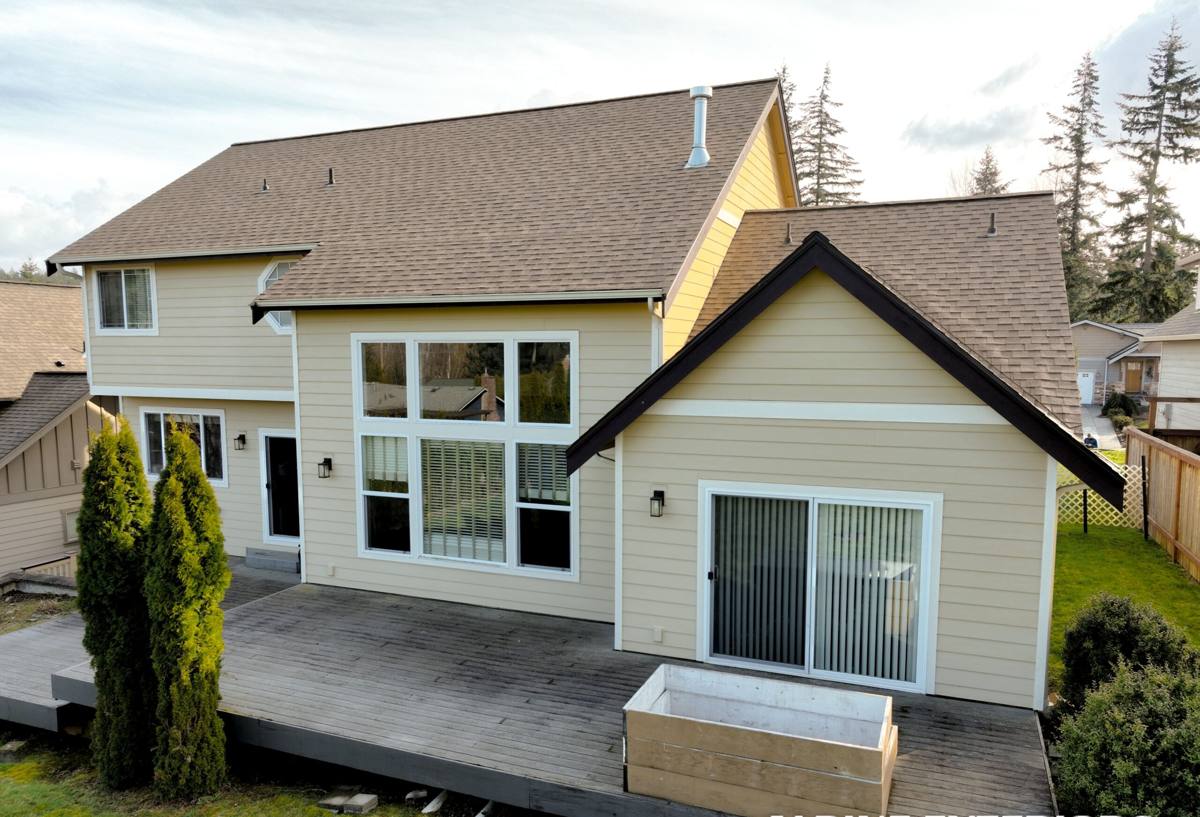
Why Metal Roofing Makes Sense for This Location
Metal roofing isn't the right fit for every home or every budget, but for a waterfront property dealing with salt air, wind, and heavy rain, it solves several problems at once. A properly installed metal roof sheds water fast, gives moss and algae far less to grip onto compared to a textured shingle surface, and holds up to wind uplift better than most other roofing types when it's fastened and detailed correctly.
It's also a long-term play. Homeowners who choose metal are usually doing it because they want to stop thinking about their roof — fewer inspections driven by worry, fewer patch jobs after a windstorm, and a material that isn't slowly absorbing moisture the way some other surfaces can over decades near saltwater.
That said, metal roofing only delivers on those advantages when the installation respects how coastal exposure actually behaves. A metal roof installed with inland assumptions — standard fasteners, minimal flashing detail, no thought to wind-driven rain — can underperform a well-installed asphalt roof. The material isn't magic; the installation is what earns its reputation.
What a Correct Metal Roofing Installation Actually Involves
Underlayment and Moisture Barrier
Metal panels are the visible layer, but the underlayment beneath them is doing a lot of the real work. In a location that sees driving rain and occasional wind-driven moisture intrusion at seams and penetrations, a high-quality synthetic or self-adhered underlayment isn't optional — it's the backup system that keeps the house dry if wind ever pushes water past the panel laps.
Fasteners and Flashing Details
This is where a lot of roofs near saltwater actually fail — not the panels themselves, but the small metal parts holding them together. Flashing around chimneys, vents, skylights, and valleys has to be detailed to shed water in every direction wind can push it, and fastener choice has to account for corrosion resistance, not just cost.
Ventilation
A roof deck that can't breathe traps moisture underneath the metal, which is a slow path to rot and rust from the inside out. Proper intake and exhaust ventilation matters on every roof, but it matters more in a climate where humidity and rainfall are consistently high for much of the year.
Choosing a Metal Roofing System
Not all metal roofing is the same product wearing different colors. The two systems homeowners in this area typically weigh against each other behave quite differently once salt air and years of weather are factored in.
| Factor | Standing Seam | Exposed Fastener |
|---|---|---|
| Fasteners | Concealed, no exposed penetrations | Visible screws through the panel face |
| Long-term maintenance | Lower — nothing exposed to work loose or corrode | Higher — fasteners and washers need periodic checking |
| Upfront cost | Higher | Lower |
| Best fit | Waterfront and high-exposure homes | Outbuildings, budget-driven projects, less exposed sites |
| Appearance | Clean, modern, unbroken panel lines | Traditional ribbed metal look |
For a home directly exposed to salt air and wind the way Sandy Point properties often are, standing seam is generally the stronger long-term choice. Exposed-fastener systems can still be a reasonable option for a detached garage, shop, or a more sheltered structure where the trade-off in maintenance is less consequential.
Coatings, Fasteners, and Materials That Actually Hold Up to Salt Air
Not every "metal roof" is built for a coastal environment. The base metal and its coating matter as much as the panel profile. Steel panels need a quality protective coating designed to resist coastal corrosion — this is a place where cutting corners on material spec shows up years later as rust streaking and premature wear, not immediately. Aluminum is naturally corrosion-resistant and is worth discussing for homes with the most direct salt exposure, though it comes with its own cost and performance trade-offs worth weighing honestly.
Fasteners deserve the same scrutiny. Standard carpentry or general-purpose screws are not built for decades of salt air; stainless or coated fasteners rated for coastal use cost more per piece but are a small fraction of the total project cost and a common point of early failure when skipped. The same logic applies to flashing metal, sealants, and any exposed hardware — matching materials to the environment, not just to the roof color, is what separates a roof built for this location from one that simply happens to be here.
Moss, Algae, and Coastal Debris: Long-Term Maintenance
Metal roofing dramatically reduces moss and algae growth compared to shingles, but it doesn't eliminate the need for maintenance in a climate with this long a moss season. Overhanging trees still drop needles and debris into valleys and around penetrations, and any spot where organic matter can collect and stay damp is a spot where growth can start, even on metal.
The practical difference is how much less work it takes to keep a metal roof clean, and how much less damage a missed cleaning cycle causes compared to an asphalt roof where moss can actually lift and degrade the shingle mat underneath. Periodic gutter and valley clearing, especially heading into the wetter months, keeps a well-installed metal roof performing the way it's supposed to for the long haul.
Our Process for a Sandy Point Metal Roofing Project
- On-site assessment — we look at the existing roof deck, ventilation, flashing points, and how the home is exposed to wind and rain specifically at its location, not just its general area.
- System and material selection — we walk through standing seam versus other options, coatings, and color with the home's actual exposure in mind, not just budget.
- Tear-off or overlay decision — we're honest about whether the existing roof and deck are sound enough to build on, or whether a full tear-off is the right call.
- Installation with attention to detail work — underlayment, flashing, fastening, and ventilation get the same care as the visible panels, because that's what determines how the roof performs in a storm.
- Final walk-through — we go over the finished roof and what routine upkeep looks like so there are no surprises later.
What Affects the Cost of a Metal Roof
Metal roofing typically costs more upfront than asphalt shingles, but the range for any given home depends on several variables that are worth understanding before you compare quotes.
| Cost Factor | Why It Matters |
|---|---|
| Panel system | Standing seam costs more than exposed-fastener panels due to labor and material |
| Roof complexity | Valleys, dormers, and multiple roof planes add flashing work and labor time |
| Tear-off vs. overlay | Removing an old roof adds cost but is often necessary for a sound long-term result |
| Deck condition | Rot or damage found underneath existing roofing adds repair scope |
| Material and coating | Steel, aluminum, and coating quality all price differently |
| Access and site conditions | Steep slopes or difficult site access affect labor and safety requirements |
Because these factors vary so much from one property to the next, we'd rather walk your roof and give you real numbers than quote a range that doesn't mean much for your specific home.
Signs It Might Be Time to Consider a New Roof
- Visible rust streaking, curling, or lifting on an existing metal or shingle roof
- Moss buildup that returns quickly after cleaning, especially on shaded slopes
- Water stains on interior ceilings or in the attic after wind-driven rain
- Loose, missing, or corroded fasteners and flashing around vents and chimneys
- A roof approaching or past its expected service life for its material type
- Noticeable granule loss or bare spots on an aging asphalt roof
Why Local Experience in This Neighborhood Matters
A roofing crew that regularly works waterfront properties in and around Blaine understands wind exposure, moisture patterns, and moss timing in a way that's hard to replicate from a generic spec sheet. That familiarity shows up in small decisions — how flashing is detailed, which fasteners get used, how ventilation is planned — that don't show up on a quote but absolutely show up in how the roof performs ten and twenty years down the road.
It also means fewer surprises during permitting and inspection, since local Whatcom County requirements and typical construction in coastal neighborhoods are already familiar territory rather than something learned on the job.
If you're weighing a metal roof for a Sandy Point home, we're happy to take a look and talk through what your specific property needs — no pressure, no obligation. Reach out using the form below for a free estimate.