 Blaine
 Why Blaine Harbor Siding Takes More Punishment Than Inland Homes
Homes along Blaine Harbor sit in a different weather system than a house ten miles inland in Whatcom County. Salt air rolls off Semiahmoo Bay and the Salish Sea and settles on everything — siding, trim, hardware, window frames. Add driving rain that comes in sideways during winter storms, and a moss season that can run eight or nine months out of the year in this part of the Pacific Northwest, and you have three separate stressors working on a home's exterior at the same time, year-round.
Salt air is corrosive to unprotected fasteners and metal trim, and it accelerates the breakdown of paint films and caulk. Driving rain finds every gap in flashing, trim, and siding laps that a calmer climate would never expose. And moss and algae don't just look bad — they hold moisture against a wall system, which is exactly what you don't want happening behind (or on) your siding for months at a stretch. A siding product and installation method that work fine in a dry inland climate can fall short here, sometimes within a few years rather than a few decades.
This is the environment we're solving for on every Blaine Harbor job — not a generic Pacific Northwest install, but one built around salt exposure, wind-driven rain, and near-constant dampness for a big chunk of the year.
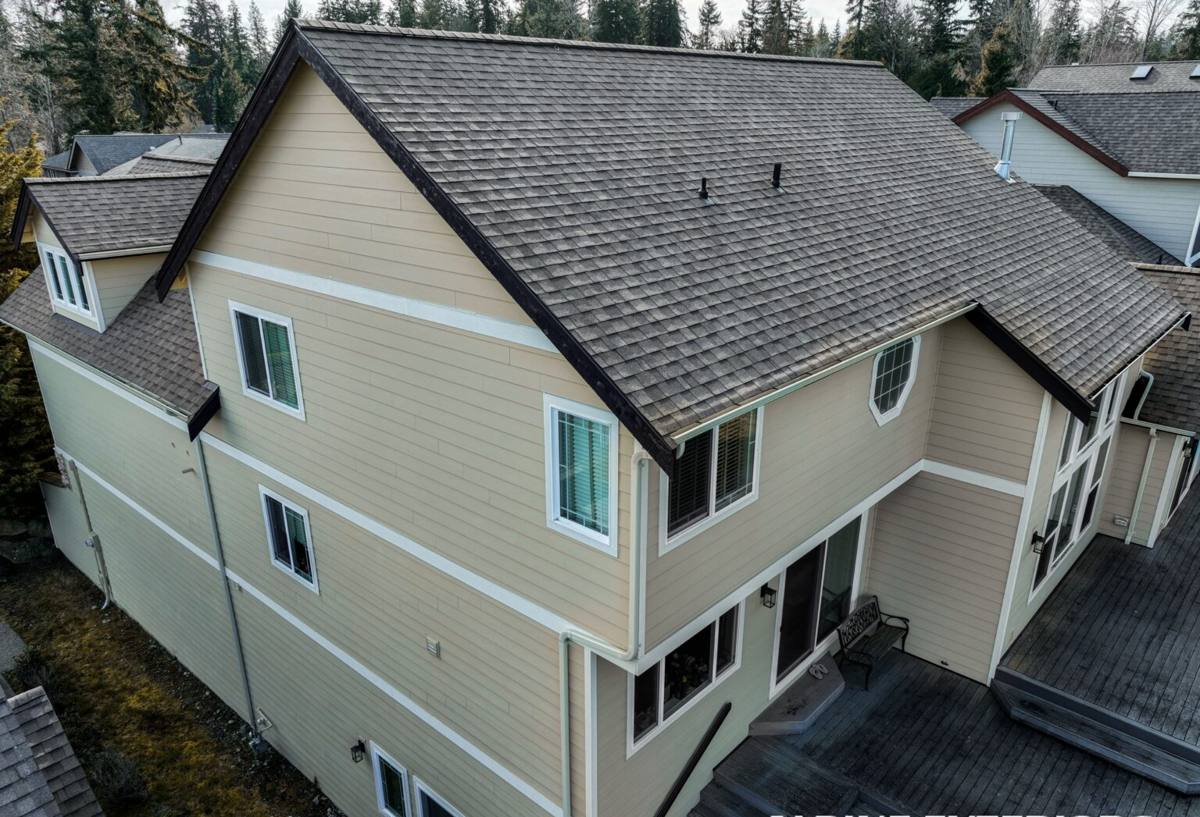
What "Correct" Looks Like: The Install Behind the Finish
Starting With a Dry Wall
Good siding starts before the siding goes on. In a harbor climate, the water-resistive barrier (house wrap) and window/door flashing have to be installed so that any moisture that gets past the cladding drains back out rather than pooling behind it. We lap every layer — wrap, flashing tape, trim, and siding — so water always sheds downward and outward, never into a seam. On a home exposed to sideways rain off the bay, skipping or rushing this step is the single most common reason a siding job fails early, regardless of what material sits on top of it.
Fasteners, Flashing, and the Details That Actually Fail First
Salt air is hard on metal. We use fasteners and flashing rated for corrosion resistance, and we follow James Hardie's fastening specifications exactly — proper nail or screw type, spacing, and depth — because under-driven or over-driven fasteners are a common cause of premature cracking and water intrusion. We also pay close attention to butt joints, inside and outside corners, and anywhere siding meets a window, door, deck, or roofline, since those transitions are where driving rain concentrates and where a shortcut shows up first, sometimes years later as a soft spot or stain.
The Right Hardie Product for a Harbor Property
Panel and Lap Options
James Hardie makes several siding profiles, and the right one for a Blaine Harbor home depends on the style of the house and how much of the exterior faces open water and prevailing wind. HardiePlank lap siding is the most common choice for traditional home styles and gives you the classic horizontal reveal. HardiePanel vertical siding works well for accent areas, gables, or more modern facades. Both are engineered from fiber cement — a mix of cement, sand, and cellulose fibers — which does not absorb and swell with moisture the way wood-based products can, and which will not support the kind of rot that constant dampness eventually causes in untreated wood siding.
ColorPlus vs. Field-Painted
We install James Hardie's ColorPlus Technology finish on the large majority of harbor-area jobs. It's a factory-applied, baked-on finish that resists fading and holds up to UV and salt exposure better than a field-applied paint job, and it carries its own finish warranty separate from the product warranty. Field-painted (primed) Hardie siding is available and sometimes the right call for a very specific custom color, but in a climate that's already hard on paint films, ColorPlus is almost always the better long-term investment for a home this close to the water.
Material Comparison for Blaine Harbor's Salt-Air Climate
We only install James Hardie, but homeowners often ask how it stacks up against the other materials commonly pitched for this area. Here's an honest look at how each behaves under salt air, driving rain, and heavy moss exposure specifically:
| Material | Salt Air / Coastal Wear | Moisture & Moss Resistance | Typical Long-Term Maintenance |
|---|---|---|---|
| James Hardie fiber cement | Non-combustible, dimensionally stable, holds finish well | Does not swell, rot, or feed on organic material | Occasional wash; ColorPlus finish reduces repainting |
| Vinyl siding | Can warp or become brittle with UV and temperature swings | Seams and J-channels can trap moisture behind panels | Low, but panels crack or fade and are hard to color-match later |
| Cedar / primed spruce | Salt air accelerates weathering of exposed wood | Absorbs moisture; prone to rot and moss growth if not maintained | Regular refinishing, caulking, and moisture monitoring |
| LP SmartSide (engineered wood) | Wood-strand core is sensitive to sustained moisture exposure | Edges and cut ends need diligent sealing to prevent swelling | Ongoing caulk and paint upkeep, especially at seams |
This isn't a knock on any of these products in the right climate — it's why, for homes taking on salt spray and near-constant winter rain, we standardized on Hardie rather than offering all four and hoping the wrong one holds up.
Our Process, Start to Finish
Every Blaine Harbor project follows the same sequence, adjusted for the specific house:
- On-site assessment of the existing siding, sheathing condition, and any trouble spots — corners, window returns, deck ledger areas — where past moisture damage is most likely.
- Removal of old siding and inspection of the sheathing underneath, with repairs made before anything new goes up. Covering damaged sheathing is how small problems turn into expensive ones.
- Installation of a new water-resistive barrier and properly lapped flashing at every penetration, window, and door.
- Installation of James Hardie siding to manufacturer fastening and clearance specifications, including correct gaps at grade, decks, and roof lines to keep siding from sitting in standing water or snow.
- Final trim, caulking at appropriate joints only (not as a substitute for proper flashing), and a walk-through with the homeowner.
A Homeowner's Pre-Project Checklist
Before you commit to a siding project on a Blaine Harbor home, it's worth knowing what to ask and look for:
- Ask whether the crew is checking and repairing sheathing, not just re-siding over it.
- Confirm which James Hardie profile and finish (ColorPlus vs. field-painted) is being quoted, in writing.
- Ask how flashing will be handled at windows, doors, and any deck or porch attachment points.
- Get the manufacturer's fastening schedule confirmed — spacing and fastener type matter more than they sound like they should.
- Ask about clearance from grade, roofs, and decks, since tight clearances are a common source of early moisture problems.
- Get the warranty terms for both the siding product and the labor, in writing, before work starts.
Why a Crew That Already Works Blaine Harbor Matters
A contractor who mostly works dry, inland sites can do a technically fine install and still miss the details that matter specifically here — the extra attention flashing needs on a wall that takes direct wind-driven rain, the fastener choices that hold up against salt air, or how much clearance to leave given the moss and moisture that build up on shaded, water-facing walls. Crews who regularly work Blaine Harbor and the surrounding Whatcom County coastline have already seen how homes in this exact exposure hold up — and fail — over time, and they build around that instead of learning it on your house.
Maintenance: Keeping Moss and Salt From Winning
James Hardie siding is low-maintenance, not no-maintenance, especially in a harbor climate. A periodic gentle wash to knock off salt residue, pollen, and moss spores before they take hold goes a long way. Keep gutters clear so water isn't sheeting down the wall face, keep shrubs and trees trimmed back so walls can dry out between rains, and check caulking at trim and penetrations every year or two. None of this is heavy work, but skipping it in a climate this wet lets moss and grime get a foothold faster than it would inland.
If you're weighing a siding project for a home in or near Blaine Harbor, we're happy to take a look and give you a straightforward, no-pressure estimate — what your home actually needs, what it will cost, and why. Use the form below to get started.