 Blaine
 Why Peace Arch Homes Need a Different Approach to Metal Roofing
The Peace Arch area sits about as close to Semiahmoo Bay and the Salish Sea as a Whatcom County neighborhood can get, and that proximity to salt water changes what a roof has to survive. A metal roof installed the same way you'd install one forty miles inland, away from marine air, will corrode faster, hold moisture longer, and grow moss sooner. We treat Peace Arch metal roofing as its own category of work, not a copy-paste of a generic install, because the salt air, the wind-driven rain off the water, and the long shaded moss season here genuinely change the material choices and the details that matter.
This page covers what we actually do differently for a metal roof in this part of Blaine: the panel and coating choices that make sense near salt water, the install details that keep a roof watertight through driving rain, and the maintenance habits that keep moss from taking hold under a marine layer that can linger for months.
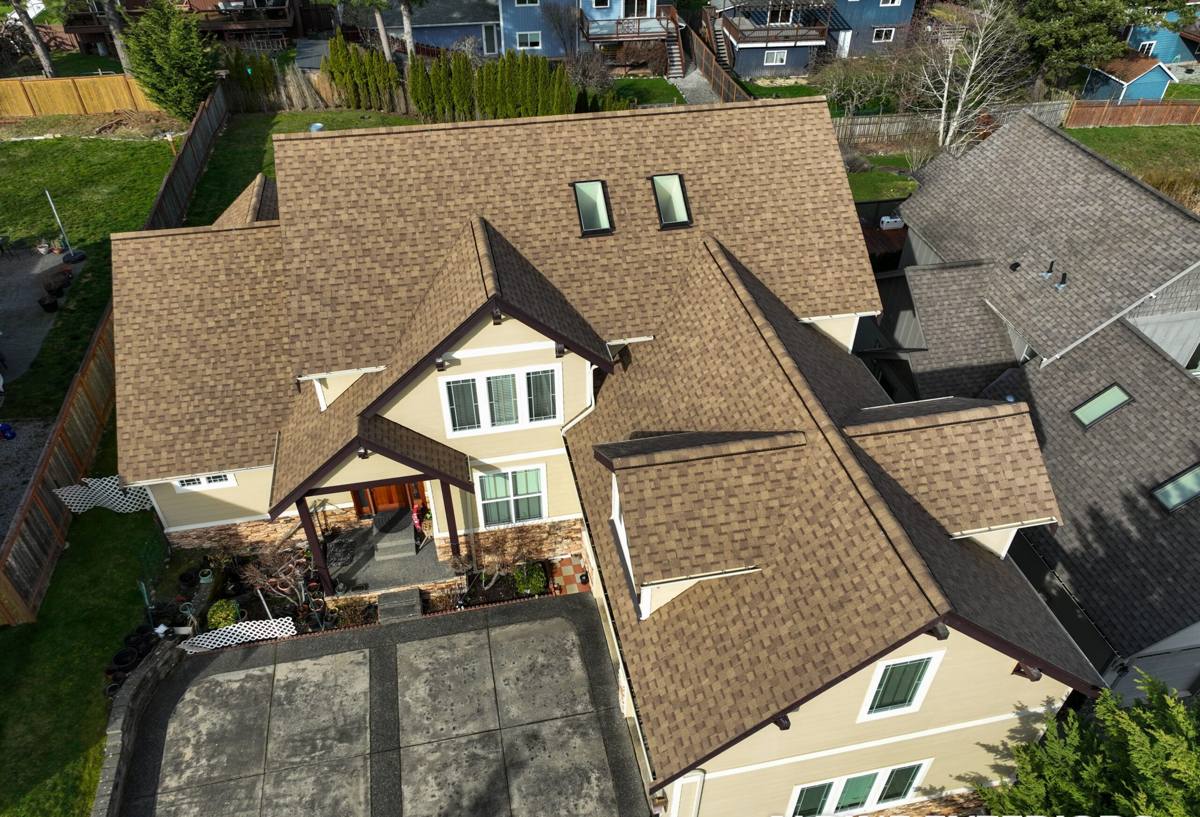
What Blaine's Coastal Climate Does to a Roof Over Time
Salt Air and Corrosion
Airborne salt is corrosive to exposed metal fasteners, cut edges, and any coating that gets scratched during install or by falling debris. It doesn't take a beachfront lot for this to matter — Peace Arch's location near the bay means salt-laden air moves through the whole neighborhood on onshore winds, settling on roof surfaces even on homes several blocks back from the water. Over years, untreated or poorly coated steel will show rust bleed at fastener heads and cut edges long before the rest of the panel shows wear.
Driving Rain and Wind-Driven Moisture
Blaine gets a lot of rain, but the bigger issue for roofs is rain that comes in sideways during winter storms off the water. Wind-driven rain finds any gap in flashing, any under-driven fastener, any lap that wasn't sealed correctly, and pushes water uphill under panels where gravity-only assumptions fail. A metal roof detailed for a calm-weather install can leak in exactly the conditions Peace Arch sees most winters.
Moss and the Long Shade Season
Whatcom County's mild, wet winters and the tree cover common on Peace Arch lots create ideal moss conditions — shaded roof planes that stay damp for weeks at a stretch. Metal sheds moss more easily than asphalt shingles because there's no granule surface for spores to grip, but moss and organic debris can still build up in valleys, around penetrations, and anywhere panels overlap, holding moisture against the metal longer than it should sit.
Panel Types and Finishes That Hold Up Here
Not every metal roofing product performs the same way in a coastal, high-moisture climate. We steer Peace Arch homeowners toward systems that pair a concealed-fastener design with a coating rated for marine exposure, and we're upfront about the trade-offs of cheaper alternatives.
| Panel Type | Fastener Style | Coastal Performance | Typical Trade-Off |
|---|---|---|---|
| Standing Seam Steel | Concealed clips, no exposed screws | Best — no exposed fasteners to corrode or back out | Higher material and labor cost |
| Exposed-Fastener Steel (Ag panel) | Through-screws with rubber washers | Fair — washers degrade over time and need re-torquing or replacement | Lower upfront cost, more long-term maintenance |
| Stone-Coated Steel | Concealed, interlocking | Good — coating adds abrasion resistance but seams need careful detailing | Heavier system, more complex flashing at edges |
| Aluminum Standing Seam | Concealed clips | Excellent — naturally corrosion-resistant, ideal for direct salt exposure | Higher cost, softer material needs careful handling |
For homes closest to the water or with a clear line of sight to Semiahmoo Bay, we'll often recommend aluminum or a marine-grade coated steel over standard galvanized product, simply because the corrosion resistance pays for itself over the life of the roof. For homes set back further, a quality Galvalume or PVDF-coated steel standing seam system is usually the right balance of cost and durability.
What a Correct Metal Roof Install Involves
The panels themselves get most of the attention, but the details underneath and around them are what actually determine whether a metal roof performs through a Blaine winter. A correct install in this area includes:
- A full synthetic underlayment rated as a true secondary water barrier, not a thin slip-sheet — this is the backup when wind-driven rain gets past the panel seams.
- Ice-and-water shield at eaves, valleys, and around every penetration, since these are the spots most likely to see standing or backed-up water during heavy rain events.
- Corrosion-resistant fasteners and clips matched to the panel metal — mixing dissimilar metals (like uncoated steel screws on aluminum panels) sets up galvanic corrosion that eats through fasteners from the inside out.
- Properly lapped and sealed flashing at every wall intersection, chimney, vent, and roof-to-roof transition — this is where most metal roof leaks actually start, not in the field of the panel.
- Ventilation that matches the panel system, so trapped moisture under the metal doesn't condense and rot the decking from below, a problem that's easy to miss until it's expensive.
Skipping any one of these doesn't usually cause an immediate failure — it causes a slow one, showing up as a leak two or five years down the line that's harder to trace back to the original install.
Our Process for Peace Arch Metal Roofing Projects
Assessment
We start with a roof and attic inspection, not just a measurement. We're looking at existing ventilation, deck condition, moss buildup, and how exposed the home is to prevailing wind and salt air off the bay, since that shapes which panel and coating we recommend.
Material Selection
We walk through panel and finish options with the actual trade-offs — cost, maintenance, and corrosion resistance — so the decision matches the home's exposure and the homeowner's budget, not just what's cheapest to install.
Tear-Off and Deck Prep
Old roofing comes off down to the deck so we can check for rot or soft spots, especially around valleys and penetrations where moisture tends to concentrate on older Peace Arch roofs.
Install
Underlayment, ice-and-water shield, panels, and flashing go in following the sequence and fastening spec for that specific panel system — this isn't a one-size-fits-all process, and we follow manufacturer install requirements to keep warranties intact.
Final Walkthrough
We check flashing, fastener seating, and ventilation before calling the job done, and we explain what maintenance (if any) the system needs going forward.
Common Mistakes We See on Existing Metal Roofs in This Area
When we're called out to inspect or repair a metal roof someone else installed, a handful of issues show up repeatedly in this part of Whatcom County:
- Exposed-fastener panels with washers that were never re-torqued or replaced, leading to slow leaks at every screw.
- Flashing that was caulked instead of properly lapped and mechanically fastened — caulk fails long before the metal does.
- Moss and debris left to build up in valleys, holding moisture against the panel finish and accelerating coating breakdown.
- Dissimilar-metal contact (steel fasteners on aluminum, or copper flashing against steel) causing localized corrosion.
- Ventilation that wasn't adjusted when the roof was replaced, leaving condensation issues from the old system unresolved.
Most of these are avoidable with correct install practices up front, and most are also fixable without a full re-roof if they're caught early.
Maintenance Checklist for Peace Arch Metal Roofs
Metal roofing is low-maintenance compared to other materials, but "low" isn't "none," especially with the moss pressure and salt exposure common in this neighborhood. A reasonable annual routine:
- Clear valleys, gutters, and any flat transitions of leaves, needles, and moss buildup before the wet season starts.
- Do a visual check of exposed fasteners (if your system has them) for rust bleed or backing-out screws.
- Look at flashing around chimneys, vents, and wall transitions for gaps, lifted edges, or cracked sealant.
- Rinse off salt residue and organic debris from panels a couple times a year, especially on roof planes facing the water or under tree cover.
- Check attic ventilation isn't blocked by insulation, debris, or pest nests, since trapped moisture is the main threat to deck life under a metal roof.
Why Local Experience in Peace Arch Matters
A metal roof spec that works fine in a drier, inland part of Washington isn't automatically right for a home a few blocks from Semiahmoo Bay. Knowing which streets sit in a heavier wind corridor, which lots stay shaded and damp longest into spring, and which coatings actually hold up against years of marine air isn't something you get from a manufacturer's general install guide — it comes from doing this work repeatedly in Blaine and seeing how roofs here age. That's the difference between a metal roof that looks right on install day and one that's still performing correctly a decade later.
If you're weighing a metal roof for a Peace Arch home, we're happy to walk the roof, talk through panel and finish options honestly, and give you a straightforward, no-pressure estimate using the form below.