 Blaine
 Point Roberts sits in a spot few other Whatcom County communities can claim: a small peninsula cut off by land from the rest of the United States, reachable by car only by driving through Canada. Water wraps around it on three sides — Boundary Bay to the east, the open water of the Strait of Georgia to the west and south — which means homes here take on marine exposure from nearly every direction instead of one prevailing side. That geography is exactly why siding decisions matter more in Point Roberts than in more sheltered, inland parts of the county.
We install James Hardie fiber cement siding exclusively, and Point Roberts is regular territory for our crew. This page focuses specifically on what Hardie siding needs to do in this location, what a correct installation involves here, and why working with a crew that already knows the peninsula — logistics included — makes a real difference on a job like this.
What Point Roberts' Exposure Does to Siding
Salt Air From Nearly Every Direction
Because the peninsula has water on three sides, salt-laden air doesn't come from one consistent direction the way it might in a town with a single shoreline. Homes here can pick up salt exposure from the bay side, the strait side, or both, depending on where they sit. Salt accelerates corrosion in fasteners, flashing, and any exposed metal trim, and it breaks down lower-grade paints and finishes faster than a drier, more sheltered site ever would. On a peninsula this exposed, the siding material and the hardware behind it both need to be chosen with that corrosion risk in mind from day one.
Driving Rain With Very Little Windbreak
A narrow peninsula with open water on multiple sides doesn't offer much in the way of a windbreak. Storms push rain sideways into wall assemblies, window flashing, and roof-to-wall transitions with more force than the same storm would produce a few miles inland. That sideways-driven moisture is harder on a house than straight-down rainfall, and it's exactly the kind of load that finds any gap a rushed installation left behind. Point Roberts' open exposure means this pattern shows up often, not just during the occasional big storm.
A Moss Season That Runs Most of the Year
Mild temperatures and near-constant moisture add up to a moss and mildew season across this part of Whatcom County that barely takes a break. North-facing walls, shaded lots, and anything that stays damp longest are the first places it takes hold, and any siding material with even modest surface porosity becomes a growth surface over time. On a peninsula surrounded by water, that dampness has fewer dry stretches to interrupt it.
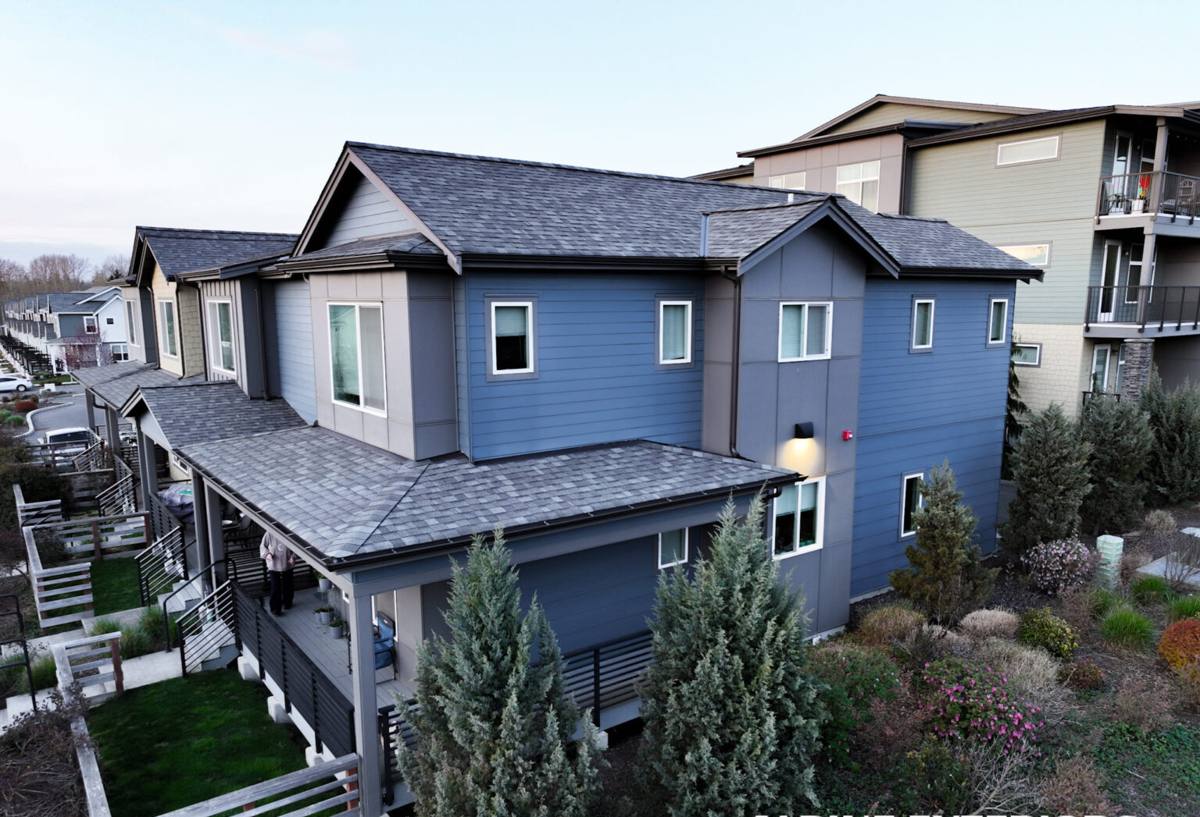
Why James Hardie Is the Right System for This Exposure
We used to install a broader range of siding products before standardizing on James Hardie fiber cement. That change came from watching how different materials actually held up on exposed, high-moisture properties like the ones in Point Roberts — not from a supplier relationship or a sales angle.
- Non-combustible core: Fiber cement doesn't feed a fire the way wood-based siding products can, which matters for both household safety and, in many cases, insurance considerations.
- Factory-applied ColorPlus finish: The color is baked on under controlled factory conditions instead of brushed on in the field, so it holds up longer against fading, chalking, and the finish breakdown that salt-laden moisture accelerates.
- Climate-engineered HZ5 formulation: Hardie's HZ5 product line is built for regions with sustained moisture exposure and freeze-thaw cycling, which describes exposed, waterfront Whatcom County well.
- Dimensional stability: Fiber cement doesn't swell, cup, or warp the way engineered wood products can after repeated wetting off open water.
- Strong transferable warranty: Hardie backs the product with one of the stronger warranty structures in the industry, provided the installation follows their published spec.
We won't install LP SmartSide, vinyl siding, Cemplank, Allura, primed spruce, or cedar. Each has a place in the market and homeowners elsewhere who are satisfied with them. But on an exposed peninsula like this, we've made a professional call to install and stand fully behind one system rather than offer something cheaper that quietly shifts maintenance risk onto the homeowner a few years down the road.
What Correct Hardie Installation Requires in Point Roberts
Fiber cement performs the way it's engineered to only when it's installed to spec, and on an exposed peninsula, the installation details carry more weight than they would somewhere calmer. A few basics we won't shortcut:
Rain Screen and Drainage
A small drainage cavity behind the siding lets any moisture that does get past the exterior surface drain and evaporate instead of sitting against the wall sheathing. On a property that's already dealing with near-constant marine humidity, that drainage path is what keeps incidental moisture from turning into a long-term problem.
Fastener Type and Spacing
Hardie specifies fastener placement and corrosion-resistant fastener types for a reason. Loose spacing or the wrong fastener grade is one of the more common causes of early siding failure we find on tear-offs, and salt exposure on a peninsula like this speeds up whatever corrosion a lower-grade fastener was already prone to.
Flashing and Joint Sealing
Every seam, joint, and penetration needs to shed water downward and outward, especially on walls catching wind-driven rain with no windbreak to slow it down. Open or poorly sealed butt joints and trim transitions are where salt-laden moisture finds its way behind the siding first, and they're also the spots a rushed job is most likely to shortcut because they take real time to do right.
None of this is exotic work. It's the manufacturer's own installation spec, followed consistently rather than cut on the parts that are hardest to see once the job is finished.
Siding for Seasonal and Vacation Homes
A meaningful share of the housing in Point Roberts is used seasonally rather than lived in full-time, which changes how siding problems tend to get discovered. A leak or a section of failing siding on a home that's occupied every day usually gets noticed quickly — a stain on a ceiling, a draft, a soft spot underfoot. On a property that sits empty for stretches at a time, the same problem can run for weeks or months before anyone sees it, and moisture intrusion doesn't pause just because the owner isn't there to catch it early.
That's part of why we lean toward materials and installation details that fail slowly and visibly rather than ones that can hide a moisture problem behind an intact-looking surface. Fiber cement's dimensional stability and resistance to swelling mean that when something is wrong, it tends to show — cracking, staining, or a section that's clearly out of plane — rather than quietly rotting from the inside the way a wood-based product can. For a home that isn't checked on daily, that visibility matters.
Getting a Crew and Materials to the Peninsula
Crossing the Border for the Job
Because Point Roberts is only reachable by road through Canada, every siding delivery and every day a crew works on the peninsula involves a border crossing in both directions. That's a routine part of the job for a crew that already works this area regularly, but it's a real scheduling factor — material deliveries, crew travel, and equipment all need to account for crossing times rather than treating it like driving to any other job site in the county.
Permitting Still Runs Through Whatcom County
Despite the geography, Point Roberts is part of Whatcom County, Washington, and building permits and inspections follow the same county process as anywhere else in the county. A contractor working here needs to be current on Washington state contractor licensing and familiar with the same permitting requirements they'd follow on a job in Blaine or Ferndale — the border crossing changes the logistics, not the regulatory framework.
Cost Factors for a Point Roberts Siding Project
| Factor | What It Affects | Point Roberts Consideration |
|---|---|---|
| Home size and siding profile | Material quantity and labor hours | Same as any Hardie install elsewhere in the county |
| Tear-off vs. overlay | Labor scope and disposal | Substrate repair is more likely if moisture already got behind older siding on an exposed lot |
| Trim and joint complexity | Labor time on flashing and sealing | More critical here given salt exposure from multiple directions |
| Delivery and crew logistics | Scheduling and mobilization | Border crossing adds a planning step most job sites don't require |
| Occupancy status | Access scheduling and coordination | Seasonal homes often need remote coordination with an off-peninsula or out-of-country owner |
These are general drivers, not a quote. Every home on the peninsula sits at a slightly different distance from open water and under different tree cover, so we walk the property before putting a real number on the work. Two houses on the same street can need very different scopes once we're actually pulling old siding, which is also why we're cautious about estimates given sight unseen.
Our Process for a Point Roberts Siding Project
- On-site assessment — we look at the existing siding, substrate condition, and how the home is currently exposed to wind and water off both sides of the peninsula.
- Honest scope and written estimate — a clear breakdown of what the job requires, including any substrate repair we expect to find once old siding comes off.
- Scheduling around border logistics — material delivery and crew mobilization planned with crossing times built in, not treated as an afterthought.
- Installation to Hardie's published spec — rain screen, fastener type and spacing, flashing, and joint sealing handled to the manufacturer's requirements, not shortcuts.
- Final walkthrough — a review of the finished work with the homeowner, whether that's in person or coordinated remotely for an owner who isn't on the peninsula full-time.
Signs a Point Roberts Home Needs Siding Attention
- Moss or dark staining that returns quickly after cleaning, especially on north-facing or shaded walls
- Soft or spongy siding, particularly low on the wall or around window and door trim
- Rust staining or visibly corroded fasteners and trim, more common this close to open water on multiple sides
- Peeling paint, chalking, or visible warping on siding that isn't Hardie's factory-finished product
- Gaps opening up at butt joints or trim transitions
- Any musty smell or interior staining on a wall that borders the exterior, which can point to moisture that's been working its way in unnoticed
Why a Crew That Already Works Point Roberts Matters
A contractor who only occasionally makes it out to the peninsula treats every trip as a special case — extra planning, unfamiliar logistics, and less certainty about how the local exposure actually behaves on a given lot. A crew that works Point Roberts regularly already has the border crossing built into normal scheduling, already understands that permitting runs through Whatcom County despite the geography, and has seen firsthand how salt air and wind-driven rain from multiple directions wear on siding here compared to more sheltered inland towns. That familiarity shows up in practical decisions on install day — which walls need extra flashing attention, where fastener corrosion resistance matters most, and how to plan a project around an owner who may not be on the peninsula every week to answer questions in person.
If your Point Roberts home needs new siding or you're dealing with signs of moisture damage on an existing wall, we're glad to take a look and give you a straightforward, honest assessment. Reach out using the form below to schedule a free, no-pressure estimate.