 Blaine
 Everson's Climate Puts Real Stress on Siding
Homes in and around Everson deal with a combination most siding products were never engineered for. You've got salt-laden air drifting in off the Strait and Puget Sound, long stretches of driving rain that come sideways more often than straight down, and a moss season that can run from late fall well into spring. Individually, any one of those is manageable. Together, they wear through cheap or improperly installed siding faster than most homeowners expect.
Salt air is corrosive to fasteners and hardware, and it accelerates the breakdown of finishes that aren't formulated for coastal exposure. Driving rain finds every gap in flashing, every under-caulked seam, and every place where siding was nailed too tight against the sheathing. And moss doesn't just sit on a roof — it takes hold in shaded, damp-prone wall sections, particularly on north-facing elevations and anywhere siding stays wet longer than it should. Whatcom County's climate isn't extreme in the way a hurricane zone is, but it is relentless, and relentless is what actually wears siding out over a 20- or 30-year span.
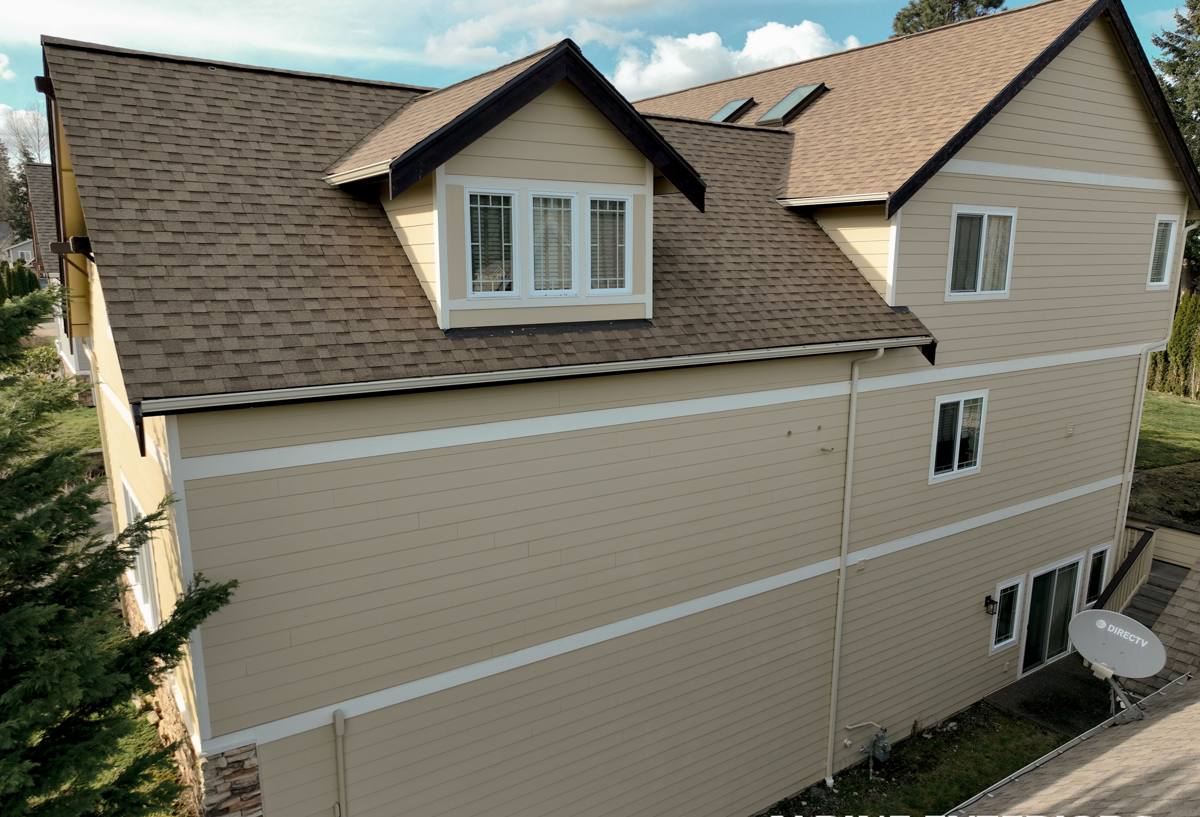
Why James Hardie Is the Only Siding We Install Here
We made a decision a long time ago to install James Hardie fiber cement siding exclusively. We don't install vinyl, LP SmartSide, Cemplank, Allura, primed spruce, or cedar. That's not a marketing position — it's a practical one based on what holds up in this specific climate when installed correctly.
Fiber cement doesn't rot, it doesn't feed moss growth the way wood-based products can, and it's non-combustible, which matters more every year given regional wildfire smoke and ember exposure concerns. James Hardie's ColorPlus factory-applied finish is baked on under controlled conditions rather than field-painted, which gives it a more consistent, longer-lasting bond than site-applied paint on primed wood substrates. For a home that's going to sit through decades of Whatcom County winters, that difference compounds.
We're not saying every other product is worthless — cedar has real character, vinyl is inexpensive, and LP SmartSide has its fans. But each of those comes with a maintenance burden or moisture vulnerability that we're not willing to put our name behind when driving rain and salt air are part of the daily environment. Hardie is the one product line where we can stand fully behind the long-term performance.
Choosing the Right Hardie Product for This Job
James Hardie makes climate-specific product lines, and the HZ5 formulation is engineered for wetter, more humid climates like the Pacific Northwest. It's manufactured to resist moisture-related damage better than a generic formulation meant for drier regions. For an Everson-area home, that's the baseline we work from — not an upgrade, but the correct starting point.
Beyond the climate engineering, there are real choices to make on profile and texture:
- HardiePlank lap siding — the most common choice for traditional home styles, available in multiple exposure widths and smooth or cedarmill textures
- HardiePanel vertical siding — often used for accent sections, gables, or a more modern look, sometimes paired with board-and-batten trim
- HardieShingle — for homes wanting a shingled or shake-style appearance without the moisture issues of real wood shakes
- HardieTrim — matched trim boards so the whole exterior envelope, not just the field siding, is fiber cement
We walk through these options during the estimate based on the home's existing architecture, HOA or neighborhood expectations if applicable, and what's actually going to perform best on the elevations that take the worst weather.
What a Correct Installation Actually Involves
The siding material only performs as well as the installation underneath it. This is where most siding failures actually originate — not from the product itself, but from shortcuts taken during the install. A correct James Hardie job includes:
Water Management First
Before a single piece of siding goes up, the water-resistive barrier and flashing details need to be right — window and door flashing integrated with the barrier in the correct shingle-lap order, kick-out flashing at roof-to-wall intersections, and proper flashing above any horizontal trim. Driving rain will find any mistake here eventually.
Correct Clearances
Hardie siding needs proper clearance from grade, roof lines, decks, and patios — typically a minimum gap to prevent constant moisture wicking. Installers who butt siding tight to a walkway or let it sit too close to soil are setting up a problem that won't show up for a year or two, by which point it's a repair, not a fix.
Fastening to Spec
Fasteners need to be corrosion-resistant, sized correctly, and driven flush — not overdriven, which cracks the material's edge, and not underdriven, which leaves it loose and prone to rattling or working itself out over time. Given the salt air in this area, fastener quality isn't optional.
Joints and Caulking
Butt joints need to be sealed or flashed correctly, and caulking has to be a paintable, high-quality sealant applied at the right joints — not everywhere, and not nowhere. Over-caulking traps moisture just as badly as under-caulking lets it in.
How Hardie Compares to Other Siding Options in This Climate
| Factor | James Hardie Fiber Cement | Vinyl | LP SmartSide / Wood-Based | Cedar |
|---|---|---|---|---|
| Moisture resistance in driving rain | Strong when installed to spec (HZ5 line) | Can warp or gap at seams over time | Vulnerable at cut edges and joints if seal fails | Requires ongoing sealing to resist moisture |
| Moss and organic growth resistance | Does not feed organic growth; cleans off surface | Doesn't feed growth but can trap moisture behind panels | Wood-based core can be vulnerable if surface is compromised | Natural wood is more prone to moss and mildew |
| Salt air / coastal exposure | Factory finish holds up well; fasteners are the key detail | Can become brittle and discolor faster near coast | Finish and edges need diligent maintenance | Needs frequent refinishing near salt air |
| Fire resistance | Non-combustible | Combustible, can melt/deform | Combustible wood-based product | Combustible |
| Typical maintenance | Occasional wash; repaint only when owner chooses a color change | Low but limited to what it is; no repainting option | Regular inspection of seams and finish | Regular refinishing, sealing, and moisture checks |
None of these products are automatically "bad" — but when you weigh them against what Everson's weather actually does to a wall over 20-plus years, fiber cement installed correctly comes out ahead on the factors that matter most for long-term ownership cost.
What Influences the Cost of a Hardie Project in Everson
Every home is different, so we're not going to throw out a number that doesn't mean anything without seeing the house. But the real cost drivers on a James Hardie project are consistent:
| Cost Factor | Why It Matters |
|---|---|
| Existing wall condition | Rot or sheathing damage found during tear-off adds repair scope before new siding can go up |
| Product line and profile | Lap, panel, and shingle profiles have different material and labor costs |
| Home complexity | Cut-up walls with lots of corners, dormers, and trim take more labor than simple rectangular elevations |
| Trim and accent scope | Full HardieTrim packages cost more than field siding alone but unify the whole exterior |
| Access and site conditions | Steep lots, limited staging area, or landscaping that needs protection all affect labor time |
A few questions worth asking any contractor before you commit, on this project or any other:
- Is the water-resistive barrier being replaced, repaired, or reused, and why?
- What's the plan for flashing at windows, doors, and roof intersections?
- Are fasteners corrosion-resistant and sized to Hardie's published specifications?
- What clearance will siding have from grade, decks, and roof lines?
- Is the crew certified or specifically trained on Hardie installation requirements?
Our Process, Start to Finish
- On-site inspection — we look at the existing siding, sheathing condition where visible, trim, and problem areas like north-facing walls or spots with moss staining
- Written estimate — product line, profile, color, and trim scope laid out clearly, with an honest look at what tear-off might reveal
- Tear-off and sheathing check — old siding comes off and we assess for hidden rot or moisture damage before closing the wall back up
- Water-resistive barrier and flashing — installed or repaired to current standards before any new siding goes on
- Hardie installation — fastened, spaced, and sealed to manufacturer specification
- Final walkthrough — we go over the finished job with the homeowner and cover basic care
Moss Season Maintenance and Long-Term Care
Correctly installed Hardie siding doesn't need much. It won't rot if moss sits on it, and it doesn't need refinishing every few years the way wood does. That said, a few habits keep it looking right through Whatcom County's long wet season:
- Rinse siding with a garden hose periodically, especially shaded north-facing walls where moss and algae collect
- Avoid pressure washing directly into joints and seams — a gentle rinse is enough
- Trim back landscaping that keeps siding shaded and damp longer than the rest of the house
- Check caulking at joints and around trim every year or two and have any cracked sealant redone
- Watch for any staining near ground level, which can signal a clearance or drainage issue rather than a siding defect
Why Hire a Crew That Already Works This Area
Installation quality is the single biggest variable in how long siding lasts, and the details that matter most here — flashing sequencing for driving rain, fastener choice for salt air, clearance planning around moss-prone shaded walls — are exactly the details a crew learns by working this specific climate repeatedly, not by installing siding in a dry inland market and assuming the same approach applies. A crew that already works Everson and the wider Blaine area knows which elevations on a typical home take the worst weather and plans the water management accordingly before the first piece of siding ever goes up.
James Hardie backs its ColorPlus finish and substrate with a strong transferable warranty, but that warranty depends on the product being installed to spec. A local crew with Hardie-specific experience is what protects that warranty in practice, not just on paper.
If you're considering a siding replacement or want a second opinion on a quote you've already received, we're happy to walk your property and give you a straightforward, no-pressure estimate using the form below.