 Blaine
 Ferndale sits in the part of Whatcom County where Pacific storms come ashore, salt-laden air drifts in off the water, and the sun disappears behind moss-friendly cloud cover for months at a time. Siding here doesn't get a break between weather events the way it might further inland. It's asked to shed driving rain, resist salt corrosion on fasteners and trim, and stay clean in an environment where moss and algae have every advantage. We install fiber cement siding on homes in this area because it's the one product category we trust to hold up to all three of those pressures at once — and we install James Hardie specifically because it's the version of fiber cement engineered for exactly this climate zone.
What Ferndale's Climate Does to Siding Over Time
Before talking about products or installation methods, it helps to understand what's actually working against a home's exterior here year-round.
Driving rain and moisture cycling
Whatcom County doesn't just get a lot of rain — it gets wind-driven rain that hits siding at an angle instead of falling straight down. That matters because it pushes water into laps, seams, and fastener penetrations that a calmer climate would never test. Siding and the water-resistive barrier behind it need to manage that moisture as a system, not rely on the face material alone to keep water out.
Salt air and coastal exposure
Proximity to the Strait of Georgia and Puget Sound means airborne salt is part of daily life for homes in and around Blaine and Ferndale. Salt accelerates corrosion on fasteners, flashing, and any metal trim components, and it can degrade lower-quality coatings faster than a homeowner would expect. Materials and hardware need to be chosen with that exposure in mind, not just picked for looks.
A long moss and algae season
Shade, moisture, and mild temperatures make this region ideal for moss, lichen, and algae growth on north-facing walls, under eaves, and anywhere air doesn't circulate well. Left unmanaged, that growth holds moisture against the siding surface for extended periods, which shortens the life of paint and, eventually, the substrate underneath it.
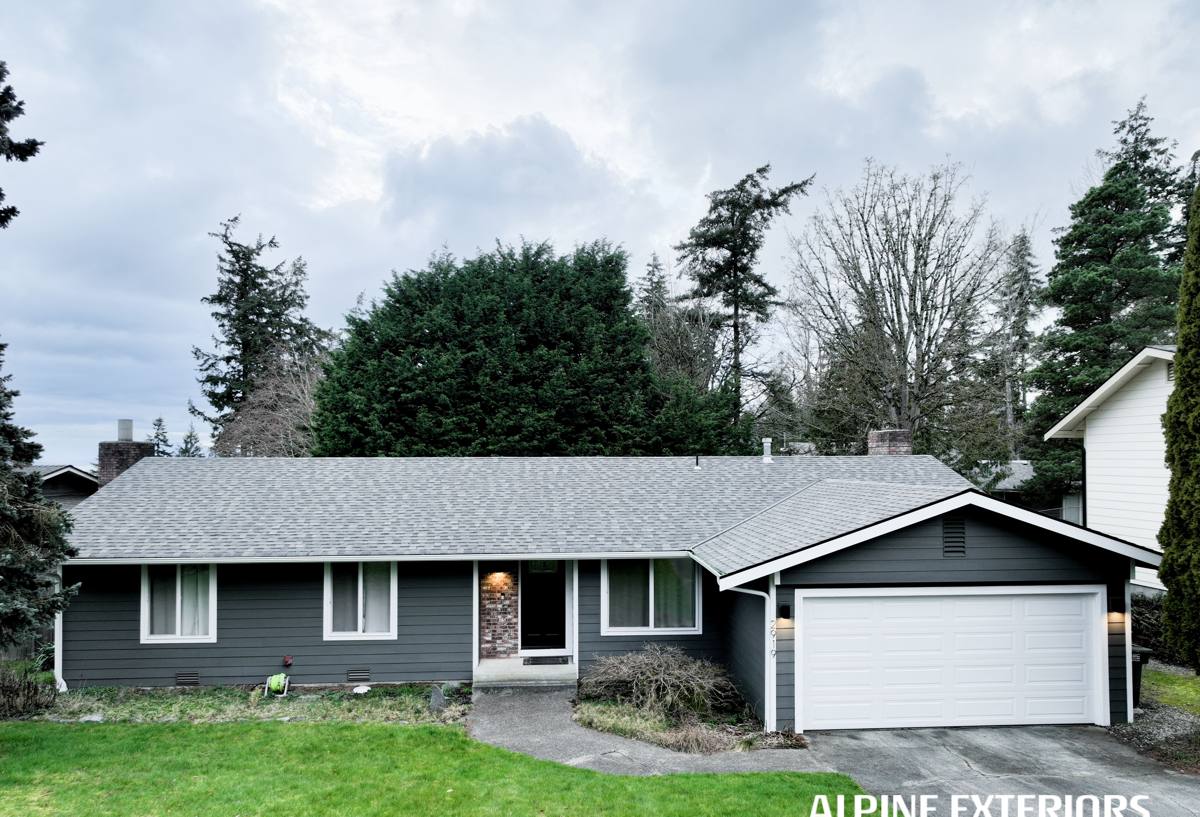
Why We Only Install James Hardie Fiber Cement
We don't install vinyl, LP SmartSide, primed spruce, cedar, or other fiber cement brands like Cemplank or Allura. That's a deliberate standard, not a sales pitch. Vinyl expands and contracts with temperature swings and can warp or crack in the kind of wind-driven rain and temperature cycling this region sees. Wood products, even engineered ones, are organic material in a climate that's extremely good at growing organic material on exterior surfaces. We've watched enough of these products struggle in coastal Washington conditions to stop offering them as an option, even when they cost less upfront.
James Hardie fiber cement is non-combustible, dimensionally stable, and manufactured in HZ (HardieZone) formulations engineered specifically for wetter climates like ours. The factory-applied ColorPlus finish is baked on and warranted separately from the substrate, which matters in an area where field-applied paint takes a beating from moisture and UV. It's not a magic material — it still needs to be installed correctly and maintained — but it gives Ferndale homes the best starting point we've found for this specific climate.
What a Correct Fiber Cement Installation Involves
Fiber cement siding is only as good as the assembly behind it. A lot of the problems we get called out to fix on other contractors' work aren't failures of the siding material itself — they're shortcuts taken during installation that only show up years later, usually right around the areas most exposed to rain and salt air.
Water-resistive barrier and flashing
Correct installation starts with a continuous water-resistive barrier behind the siding, properly lapped so water sheds downward and outward rather than getting trapped. Flashing at windows, doors, and any horizontal trim needs to integrate with that barrier — not just sit on top of it — so wind-driven rain has nowhere to collect.
Fastening and clearances
Fiber cement needs the correct fastener type, spacing, and depth to perform as engineered — over-driven or under-driven nails are one of the most common causes of premature siding failure. Clearance from grade, roof lines, decks, and other siding terminations also needs to follow manufacturer spec; tight clearances trap moisture against the bottom edge of the board, which is exactly where salt air and standing moisture do the most damage over time.
Finish and caulking
ColorPlus prefinished boards need factory-matched caulk at joints and penetrations, applied in a way that stays flexible through temperature swings. Field-painted trim and cut edges need proper sealing so raw fiber cement isn't left exposed to the weather.
Our Process for a Ferndale Fiber Cement Project
Every project follows the same disciplined sequence, adjusted for the specific home:
- On-site assessment — we look at existing siding condition, moisture damage, moss patterns, and exposure on each elevation before quoting anything.
- Removal and substrate check — old siding comes off and we inspect sheathing and framing underneath for rot or hidden moisture damage before covering it back up.
- Water-resistive barrier and flashing repair — any compromised house wrap or flashing gets replaced, not patched over.
- Fiber cement installation — HardiePlank, HardiePanel, or HardieShingle installed to manufacturer fastening and clearance specifications, chosen based on the home's style and exposure.
- Trim, caulking, and detail work — corners, window and door trim, and all penetrations sealed correctly the first time.
- Final walkthrough — we go over the finished work with the homeowner before calling the job done.
Comparing Siding Options for This Climate
Homeowners in Ferndale often ask how fiber cement stacks up against the alternatives they're considering. Here's an honest comparison based on how these materials generally behave in a wet, salt-air, high-moss environment:
| Material | Moisture behavior | Moss/algae resistance | Maintenance burden here |
|---|---|---|---|
| James Hardie fiber cement | Dimensionally stable, doesn't rot or swell | Non-organic surface, easier to keep clean | Periodic washing, caulk checks |
| Vinyl | Can warp or crack under wide temperature swings and wind-driven rain | Prone to green staining in shaded, damp areas | Low, but limited repair options once damaged |
| Cedar / primed spruce | Organic material, absorbs moisture over time | Naturally attractive to moss and mildew in shade | Frequent refinishing and moisture monitoring |
| LP SmartSide | Engineered wood, sensitive to sustained moisture exposure at cuts and edges | Requires diligent edge sealing to resist growth | Ongoing edge and seam maintenance |
What Drives Cost on a Fiber Cement Project
We don't quote pricing without seeing the home, but the factors that move the number are consistent across most Ferndale projects:
| Factor | Why it matters |
|---|---|
| Existing siding removal | Tear-off, disposal, and any substrate repair add labor before new siding goes on |
| Home size and elevation count | More square footage and more architectural detail mean more material and labor hours |
| Product line selected | HardiePlank lap, HardiePanel, and HardieShingle differ in material and installation time |
| Trim and detail complexity | Multiple gables, window trim styles, and accent details add labor |
| Site access | Difficult access, tall walls, or limited staging area can affect scheduling and labor |
Maintenance Ferndale Homeowners Should Expect
Fiber cement is low-maintenance compared to wood, but "low" doesn't mean "none" in this climate. A short annual routine keeps a Hardie installation performing the way it's supposed to:
- Rinse siding annually, focusing on north- and east-facing walls where moss and algae take hold first
- Check caulking at trim joints, window and door surrounds, and penetrations for cracking or separation
- Keep gutters and downspouts clear so water isn't overflowing onto siding below the roofline
- Trim back vegetation and shrubs that trap moisture or shade siding for extended periods
- Inspect clearance points near grade, decks, and patios to make sure nothing has been built up against the bottom edge of the siding
- Watch for any bubbling, peeling, or color change in field-painted trim, which usually signals moisture getting underneath the finish
Why Local Experience in Ferndale Matters
A crew that's worked this stretch of Whatcom County already knows which elevations take the worst of the driving rain, how far moss will creep before it needs attention, and how salt air affects fastener and trim choices over a few winters — not in theory, but from having gone back to check on past work. That local knowledge shapes real decisions: which HZ10 product configuration to spec, where to add extra flashing attention beyond the minimum, and how to sequence a project around this region's rain patterns instead of fighting them. It also means we're not guessing at Whatcom County permitting or inspection expectations — we've been through them before.
If you're weighing a siding replacement or repair for a Ferndale-area home, we're happy to take a look and walk you through what your home specifically needs — no pressure, no obligation. A free estimate is the easiest way to find out what a correctly installed James Hardie fiber cement system would look like on your house.