 Blaine
 Fiber Cement Siding Built for Cherry Point's Exposure
Cherry Point sits along the water on the same stretch of Whatcom County coastline as Blaine, and homes here deal with a version of the marine climate that's a step more exposed than what you'd find further inland. Open shoreline, fewer windbreaks on some lots, and near-constant moisture off the water put real, sustained pressure on whatever material is covering the walls. That's the context this page is written for: not siding in general, but fiber cement siding specifically, for homes in and around Cherry Point.
We install James Hardie fiber cement exclusively, and we already work this part of the county regularly. This page covers what Cherry Point's climate actually demands from a siding system, what a correct fiber cement installation involves, how our process runs on a job out here, and why the local familiarity matters more than it might seem.
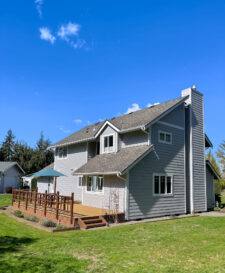
What Cherry Point's Climate Puts Siding Through
Salt Air Off the Water
Homes close to the shoreline around Cherry Point take on salt-laden air as a routine, daily condition rather than an occasional one. Salt accelerates corrosion in exposed metal — fasteners, flashing, trim hardware — and it works faster the closer a property sits to open water and the less it's shielded by trees or neighboring structures. Material and hardware that would perform fine twenty miles inland can show wear noticeably sooner out here.
Driving, Wind-Pushed Rain
Storms moving through this part of the coastline rarely drop rain straight down. Wind carries it sideways into siding joints, under trim, and into any gap in the water management system behind the cladding. On a more open, less sheltered lot, that wind-driven rain load can be more direct than what a similar home would see a few miles inland, which makes flashing and joint detail the difference between siding that holds up for decades and siding that starts letting moisture in behind the wall within a few wet seasons.
A Long Moss Season
Mild temperatures and consistent moisture give moss and mildew a growing season that runs close to year-round on shaded or north-facing walls in this area. Any siding surface that's even slightly porous, or that holds moisture against the substrate instead of shedding it, becomes a growth surface over time. Properties with mature tree cover or limited sun exposure on one side of the house tend to see this first and worst.
Why Fiber Cement Is the Right Call for This Exposure
Not every siding material handles that combination of salt, wind-driven rain, and sustained moisture the same way. Fiber cement's core is cement, sand, and cellulose fiber — an inorganic mix that doesn't absorb and swell with water the way wood-based products can, and doesn't degrade under UV and salt exposure the way some vinyl formulations do over time. That's the baseline reason fiber cement is the material we recommend for a Cherry Point home in the first place, before getting into which brand.
| Material | How it holds up in this exposure |
|---|---|
| Vinyl siding | Can become brittle or warp under sustained UV and salt-air exposure; panel seams give wind-driven rain a path in |
| Engineered wood (LP SmartSide-type) | Wood-strand core is sensitive at cut edges and fastener points; performance depends on an intact factory coating staying that way for decades |
| Primed spruce or cedar | Needs ongoing paint and caulk maintenance to avoid rot; salt air shortens the repaint cycle |
| James Hardie fiber cement | Inorganic core resists swelling and moisture absorption; factory-baked finish holds color under sustained salt and UV exposure |
Why We Install Only James Hardie
Fiber cement as a category is the right direction for this climate, but not every fiber cement product is engineered the same way, and that's where we draw a hard line. We install James Hardie exclusively, for reasons specific to this coastline:
- Climate-engineered HZ formulation: Hardie's HZ5 product line is built for regions with heavy moisture exposure and freeze-thaw cycling, which lines up closely with what Cherry Point and the rest of coastal Whatcom County actually see.
- Factory-applied ColorPlus finish: Baked on in a controlled process rather than brushed on after installation, holding color and adhesion longer under sustained salt air than a field-applied paint job.
- Non-combustible core: Fiber cement doesn't feed a fire the way wood-based siding products can, which factors into both safety and insurance underwriting.
- Dimensional stability: It doesn't cup, swell, or warp the way engineered wood siding can after repeated wetting-and-drying cycles.
- A strong, typically transferable warranty: Backed with real weight, provided the installation follows Hardie's published spec, which is why our installation process is built around that spec as a baseline rather than an upsell.
We don't install LP SmartSide, vinyl, Cemplank, Allura, primed spruce, or cedar. Each has a legitimate place in the broader market, and that's a fair statement — plenty of homeowners elsewhere are satisfied with them. Our position is about this specific climate: given the salt and moisture load a Cherry Point home carries, we'd rather stand fully behind one system than offer a cheaper option that quietly shifts maintenance risk onto the homeowner five or ten years down the road.
What a Correct Fiber Cement Installation Involves
Substrate Check Before Anything Goes Up
Once old siding comes off, the sheathing underneath gets checked for rot or soft spots before new siding goes on. Covering damaged sheathing with a fresh layer of siding just hides a problem that keeps getting worse behind the wall. On a Cherry Point job, where sustained moisture exposure makes existing damage more likely than it would be further inland, this step matters more, not less.
Weather Barrier and Flashing Detail
Most coastal siding failures trace back to water getting behind the cladding, not through the panel face itself. That makes the house wrap, window flashing, and every wall penetration the part of the job that determines whether the siding actually performs to spec over twenty or thirty years. It's also the part that's easiest to rush and hardest to inspect once the siding is up, which is why we treat it as non-negotiable rather than a line item that can be shortened to save time.
Fastening and Clearances
James Hardie's warranty is conditioned on installation following their published specifications — correct fastener type and spacing, minimum clearances above grade, deck, and roofline, and proper technique at every field cut. On a Cherry Point property closer to open water, we also pay closer attention to fastener corrosion resistance, since standard hardware wears faster in sustained salt air than it would on a more sheltered inland lot.
Field Cuts and Finish Touch-Up
Every cut made on site exposes raw material at that edge. With ColorPlus-finished Hardie board, that means sealing and, where needed, touching up the cut edge correctly before the piece goes on the wall — a step that's easy to skip and hard to notice once the house is buttoned up, but one that matters over the long run on a home taking on this much moisture.
Choosing a Product Line and Color for This Property
James Hardie offers several siding profiles — lap siding in a few width and texture options, vertical panel, and board-and-batten among them — plus a HardieZone-matched formulation and a ColorPlus palette designed to hold up under UV and weather exposure without fading the way field-applied paint typically does over the same span. For a Cherry Point home, the practical questions we walk through with a homeowner are how much of the property faces open water versus a more sheltered side, how much shade and tree cover the lot has, and what look fits the house and the neighborhood. There's no single right answer across every property here — a shaded, tree-lined lot and an open waterfront lot can reasonably land on different product and color choices even a few hundred yards apart.
Signs a Cherry Point Home's Siding Needs a Look
- Moss or dark staining that comes back quickly after cleaning, especially on shaded or north-facing walls
- Soft or spongy siding, particularly low on the wall or around window and door trim
- Peeling paint or visible warping, most common on older wood-based or engineered wood siding
- Rust staining running down from fasteners, flashing, or trim hardware
- Cracked, buckled, or missing panels after a windstorm off the water
- Musty smells or staining on interior walls that back up to exterior siding
- Siding installed more than 20-25 years ago with no documented replacement or major repair
None of these automatically means a full re-side is necessary, but each is worth a professional look before the next wet season adds to whatever's already started.
What Affects Cost on a Job Out Here
Every estimate is specific to the house, but a handful of factors consistently move the number on a Cherry Point property: total square footage and number of stories, how much trim and detail work surrounds windows and rooflines, the condition of the sheathing once old siding comes off, how exposed the lot is to open water and wind, and which Hardie product line and color fit the home. A more exposed lot can mean additional attention to flashing and fastener grade, which shows up as line items in the estimate rather than a vague markup — we walk through those specifically rather than handing over a flat number with no explanation behind it.
| Cost factor | Why it matters here |
|---|---|
| Sheathing condition after tear-off | Sustained moisture exposure makes hidden rot more likely than on a sheltered inland home |
| Exposure and wind loading | More open, water-facing lots may need additional fastening and flashing attention |
| Trim and detail complexity | Windows, corners, and rooflines multiply the field cuts and seal points that need doing right |
| Product line and finish selection | Lap, panel, and board-and-batten profiles carry different material and labor costs |
Why a Crew That Already Works Cherry Point Matters
A crew that mostly builds elsewhere in the county can still install fiber cement competently, but a property this close to open water has variables that don't come up as often on a more sheltered inland job — fastener corrosion grade, flashing detail sized to real wind-driven rain rather than a textbook average, and moss pressure that runs longer here than it does a few miles back from the shoreline. Working this stretch of coastline regularly means those aren't unfamiliar conditions on your job; they're the normal starting point. That familiarity also means that if a warranty question or maintenance issue comes up years later, it's a call to a crew still working in the same area, not one that's moved on somewhere else entirely.
If your Cherry Point home needs new siding, or you'd just like a straight opinion on what your current siding actually needs, we're glad to walk the property and give you a specific answer. Reach out using the form below for a free, no-pressure estimate.