 Blaine
 Siding Replacement in Ferndale: Knowing When Repair Isn't Enough
Ferndale homes sit in a demanding stretch of Whatcom County — close enough to the water to pick up salt-tinged air, exposed enough to catch wind-driven rain that hits walls sideways instead of falling straight down, and shaded enough in places to grow moss for most of the year. That combination wears on siding differently than it would in a drier, calmer climate, and it's the reason so many replacement calls we get in Ferndale aren't about a single damaged board. They're about a wall system that's been absorbing moisture for years and has finally reached the point where patching it stops making sense.
This page is specifically about full siding replacement — tearing off failing siding and installing new James Hardie fiber cement in its place — not general siding repair or maintenance. If you're trying to figure out whether your Ferndale home needs a patch job or a full re-side, this is the page that walks through that decision and what the replacement project itself actually involves.
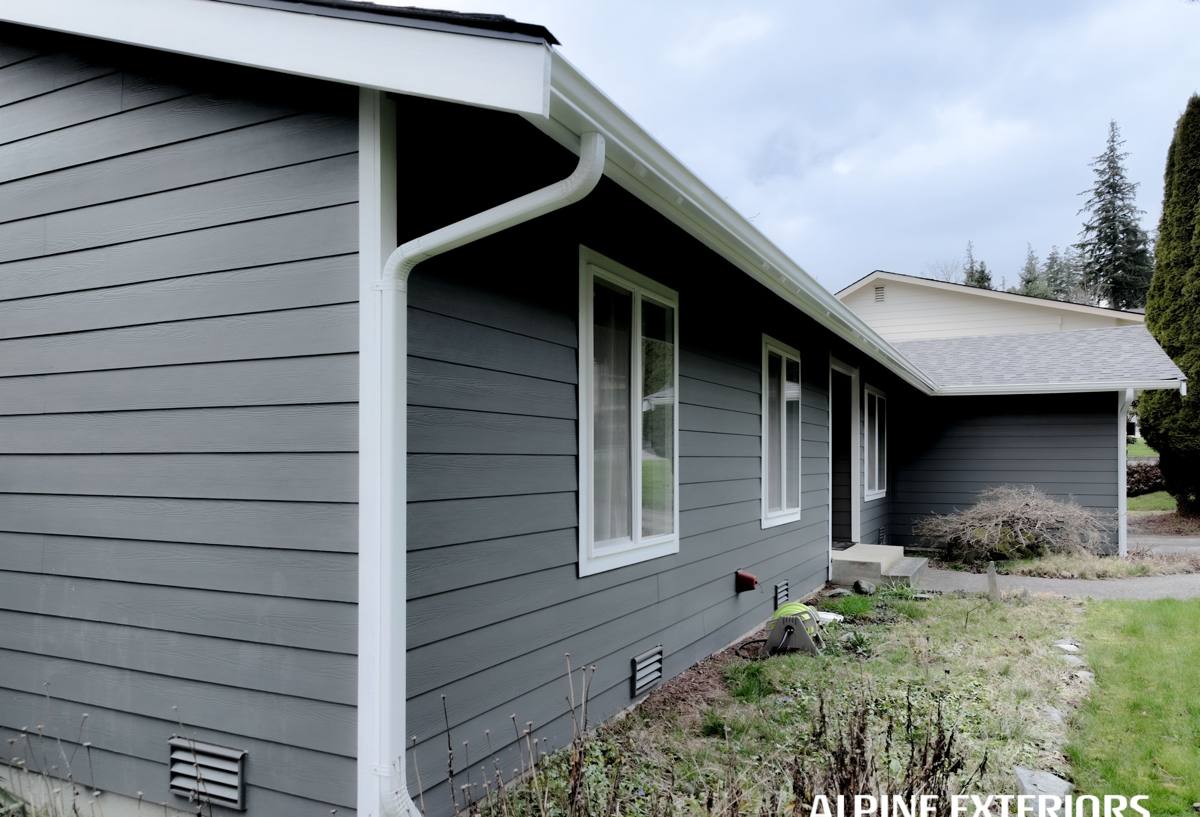
Repair or Replace? How We Make the Call
Not every siding problem justifies tearing a house down to the studs. A cracked panel from storm impact, a section of trim that failed around a window, or an isolated area of damage can often be repaired and matched into the existing siding without touching the rest of the wall. But there's a point where repair becomes a temporary patch on a bigger problem, and in Ferndale's climate that point tends to arrive earlier than homeowners expect.
Signs You're Past the Repair Stage
- Soft, spongy, or crumbling siding in multiple areas rather than one isolated spot
- Moss or dark staining that returns within weeks of cleaning, especially on north-facing or shaded walls
- Visible warping, cupping, or delamination across more than a section or two
- A musty smell inside near exterior walls, which often points to moisture that's already reached the sheathing
- Siding that's an older product — untreated wood, older masonite, or aging vinyl — nearing or past its realistic service life
- Rot discovered once one area is opened up, which usually means the same conditions exist elsewhere on the wall
When we find one or two of these, repair is often still the right call. When we find several at once, or when opening up a damaged section reveals rot that clearly didn't happen overnight, we'll tell you honestly that a full replacement is the more responsible path — not because it's the bigger job for us, but because a patch on a compromised wall usually costs more in the long run than doing it right once.
What's Actually Happening Behind Failing Siding
The siding itself is often the least of the problem by the time a homeowner calls. Wind-driven rain that's been finding its way behind lap joints or around poorly sealed trim for years doesn't just sit on the surface — it tracks down behind the siding and into the house wrap, sheathing, and framing underneath. In a climate like Ferndale's, where wet weather is frequent and moss holds moisture against the wall even longer, that process can run for a long time before it shows up as a visible problem on the outside.
That's part of why full replacement matters more here than in a drier region: a tear-off is the only way to actually see what's happening behind the siding. Repainting or overlaying new siding on top of an already-compromised wall just seals the moisture in. We won't recommend that, even when it would be the cheaper, faster option in the moment.
What a Full Replacement Project Involves
1. Tear-Off and Inspection
The old siding comes off down to the sheathing. This is the step that matters most, because it's the only point in the project where we can see the actual condition of the wall — sheathing, framing, and the existing weather barrier — rather than guessing at it from the outside.
2. Substrate Repair
Any rotted sheathing or framing gets cut out and replaced before anything new goes back on. Installing new siding over compromised substrate is one of the most common ways a siding job fails early, and it's not something we skip to save a day of labor.
3. Weather-Resistive Barrier and Flashing
A correctly lapped house wrap, along with properly integrated flashing at windows, doors, and roof lines, is what actually keeps wind-driven rain out of the wall assembly. Hardie siding is only as good as the water management system underneath it, and this is where a lot of the real protection against Ferndale's weather gets built in.
4. James Hardie Installation
New fiber cement siding goes on with correct fastening patterns, proper clearances from grade and roofline, and lapped, sealed joints. We spec Hardie's HZ5 product line for this area — it's engineered for regions with heavy moisture exposure and freeze-thaw cycling, which fits coastal Whatcom County better than the formulations built for warmer, drier climates.
5. Trim, Caulking, and Final Detail
Trim, corner details, and caulking at penetrations get finished last. These are small details, but they're often where callbacks originate if they're rushed, so we treat them as part of the core installation rather than an afterthought.
Why We Only Install James Hardie for Replacement Projects
We install James Hardie fiber cement siding exclusively. We don't install LP SmartSide, vinyl siding, Cemplank, Allura, primed spruce, or cedar. Each of those has a legitimate place in the market and plenty of satisfied owners elsewhere, but for a full replacement — where we're making a long-term bet on what goes back on a Ferndale wall — we standardized on one system for practical reasons:
- Non-combustible core: fiber cement doesn't feed a fire the way wood-based siding products can.
- Factory-applied ColorPlus finish: color is baked on under controlled conditions rather than brushed on-site, so it resists fading and moisture damage far longer than field-applied paint.
- Climate-engineered HZ5 formulation: built specifically for heavy moisture exposure and freeze-thaw cycling.
- Dimensional stability: fiber cement doesn't swell, cup, or warp the way engineered wood siding can after repeated wet-season cycles.
- Strong transferable warranty: backed by Hardie provided the installation follows spec, which matters on a full replacement where the whole wall is riding on correct technique.
On a replacement project specifically, the stakes are higher than on a repair — you're committing to a product for decades, not patching a small area. That's exactly the situation where we're least willing to compromise on material.
Replacement vs. Repair: A Side-by-Side Look
| Factor | Repair | Full Replacement |
|---|---|---|
| Scope | Isolated section or trim area | Entire wall system, tear-off to sheathing |
| Substrate visibility | Limited to the opened area | Full wall exposed and inspected |
| Best for | Storm damage, isolated trim failure, otherwise sound Hardie siding | Widespread moisture damage, aging or failing original siding, recurring problems |
| Timeline | Days | One to a few weeks depending on size and complexity |
| Long-term outcome | Extends the life of otherwise sound siding | Resets the wall system with a known, correctly installed product |
Cost Factors Specific to a Replacement Project
| Factor | Why It Affects Cost | Relevance to Ferndale |
|---|---|---|
| Tear-off and disposal | Full removal of old siding adds labor and dumpster costs beyond an install-only job | Older siding common in the area often means more material to remove and haul |
| Substrate repair | Rotted sheathing or framing found during tear-off has to be replaced before re-siding | Years of wind-driven rain tracking behind failing siding makes hidden rot more likely here than in drier regions |
| Wall complexity | More corners, dormers, and trim mean more joints and labor | Complex rooflines create more places for water to intrude if not detailed correctly |
| Weather barrier upgrade | Older homes may have outdated or missing house wrap that needs replacing | A modern, correctly lapped barrier matters more given the volume of wind-driven rain here |
| Site access and staging | Larger lots, tree cover, or tight access affect labor time | Common on wooded or larger Ferndale properties |
These numbers vary enough from house to house that we don't quote off a generic price sheet. We walk the property, look at what tear-off is likely to reveal based on the age and condition of the current siding, and give a real number from there.
Timeline and What to Expect
A full replacement on an average single-family Ferndale home typically runs one to a few weeks from tear-off to final trim, depending on size, wall complexity, and how much substrate repair the tear-off uncovers. Weather is a real factor in the schedule here — we plan around wet stretches rather than pushing installation in conditions that compromise the weather barrier or fastening. During the project, expect the exterior to be opened up in stages rather than the whole house stripped at once; that limits how much of the wall is exposed to weather on any given day.
Before work starts, we'll walk you through what to expect: how landscaping and exterior fixtures near the work area are protected, how debris and old siding are handled and disposed of, and a realistic day-by-day sense of progress rather than a vague completion date.
A Pre-Replacement Checklist for Ferndale Homeowners
- Get a written scope that specifies tear-off to sheathing, not an overlay, if that's what your home needs
- Ask what happens if substrate damage is found once the old siding comes off, and how that's priced
- Confirm the specific Hardie product line being installed (we spec HZ5 for this area) and the color/finish system
- Ask about house wrap and flashing details, not just the visible siding product
- Get the contractor's Washington contractor license and insurance in writing
- Ask for a realistic timeline that accounts for weather delays rather than a best-case-only estimate
Why Hiring a Crew That Already Works Ferndale Matters
A full replacement is a bigger commitment than a repair, and the margin for error is smaller — mistakes in flashing, fastening, or clearances don't show up on day one, they show up two or three winters later. A crew that already works Ferndale and the surrounding Whatcom County area has seen how salt air, wind-driven rain, and moss actually behave on real walls here over full seasons, not just how a product performs on a spec sheet. That translates into practical decisions during the tear-off and rebuild: which wall orientations tend to hide the most moisture damage, where extra flashing attention pays off, and which shortcuts simply don't hold up in this specific climate. That's a different level of judgment than a crew installing the same product in a dry inland climate would bring to the same job.
Get a Free, No-Pressure Estimate
If you're trying to figure out whether your Ferndale home needs a repair or a full siding replacement, we're glad to take a look and give you an honest answer either way. Reach out using the form below to schedule a free estimate — no pressure, no upsell script.