 Blaine
 Semiahmoo's Waterfront Climate and What It Does to Siding
Semiahmoo sits out on the water at the far northwest corner of Whatcom County, close enough to the Canadian border and Semiahmoo Bay that homes here take on weather most inland siding never has to deal with. Salt-laden air moves off the bay and settles on exterior surfaces year-round. Wind-driven rain doesn't just fall straight down — it gets pushed sideways into laps, trim joints, and corner boards. And the mix of marine humidity, tree cover, and long gray stretches of the year keeps north- and shade-facing walls damp enough, long enough, for moss and mildew to take hold.
None of that is unusual for a Whatcom County waterfront property. But it does mean siding here is under more sustained stress than the same product would face twenty miles inland. Salt air accelerates corrosion on fasteners and metal trim. Driving rain finds weak seams and pushes water behind panels instead of shedding it. And moss doesn't just look bad — it holds moisture directly against whatever it's growing on, which is a slow, steady problem for any siding material that isn't built to tolerate sustained dampness.
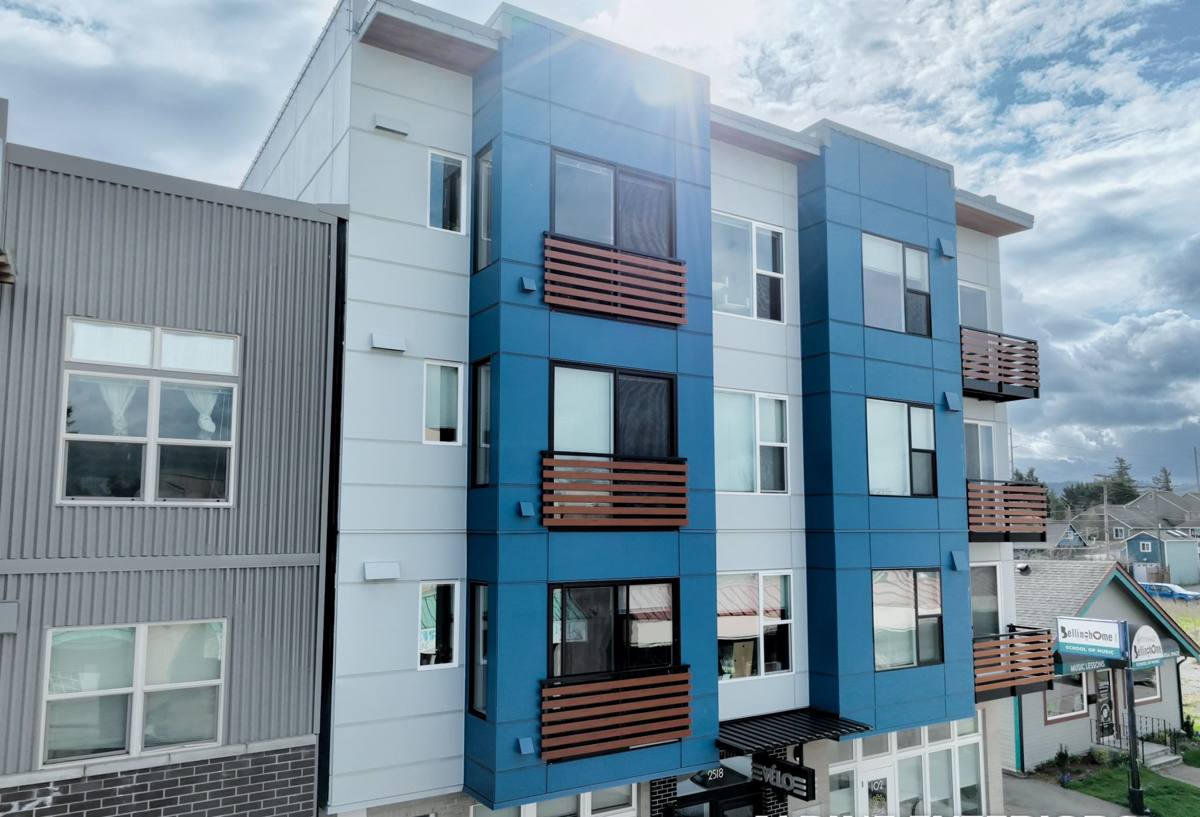
Why We Only Install James Hardie Fiber Cement Here
We install James Hardie fiber cement siding exclusively. We don't install vinyl, LP SmartSide, Cemplank, Allura, primed spruce, or cedar, and in a climate like Semiahmoo's, that's not a marketing position — it's a practical one built around how each of those materials actually behaves when it's wet more often than it's dry.
Vinyl siding is affordable and low-maintenance in a lot of climates, but it's a thin plastic product that expands and contracts with temperature swings and relies almost entirely on lap overlap — not a sealed seam — to keep water out. In wind-driven coastal rain, that overlap can let moisture behind the panels, where it has nowhere to go but into the wall assembly. Vinyl also becomes more brittle in cold snaps, which this area does get on and off through the winter.
Wood-based products — cedar, primed spruce, and engineered wood siding like LP SmartSide — are organic materials at their core. They can look great and perform well for years, but they depend on an intact paint or coating film to keep moisture out. Once that film is compromised at a cut edge, a nail hole, or a spot where moss has been sitting against the surface, the substrate underneath can start absorbing water. In a climate with this much sustained dampness, that's a maintenance commitment we don't think most homeowners want to sign up for, and it's the main reason we don't install those products.
James Hardie fiber cement is cement, sand, and cellulose fiber — it doesn't rot, it doesn't support moss growth the way bare wood does, and it isn't combustible. It's also engineered specifically for climates like this one, which is why it's the only siding we put on homes.
The Right Hardie System for a Semiahmoo Home
HZ5 Formulation for the Pacific Northwest
James Hardie makes region-specific formulations, and the Pacific Northwest falls under their HZ5 engineering zone, built around exposure to sustained moisture and freeze-thaw cycling rather than extreme heat. For a Semiahmoo property sitting directly in the path of bay winds and rain, that's the formulation that makes sense — it's designed around exactly the conditions this location deals with, not a generic national spec.
ColorPlus Factory Finish
We generally recommend Hardie's ColorPlus finish for waterfront and near-water properties. It's a baked-on, factory-applied finish rather than a coat of paint applied on site, and it carries its own finish warranty separate from the substrate warranty. In a salt-air environment where a field-applied paint job takes more of a beating, starting with a factory finish engineered to hold color and resist fading gives a longer runway before repainting is even a conversation.
Panel and Lap Profile Choices
Most Semiahmoo homes we work on end up in either a traditional lap siding profile or a shingle-style panel, depending on the home's architecture and what the homeowner wants for curb appeal. Both are available in the HZ5 formulation, so the choice comes down to look and budget rather than one being more weather-appropriate than the other — the material system underneath is the same either way.
What Correct Installation Looks Like on a Coastal Whatcom County Home
Fiber cement siding only performs as well as its installation. Hardie's own warranty terms make correct installation a condition of coverage, and in a high-moisture location like Semiahmoo, cutting corners here shows up as problems faster than it would somewhere drier.
Water Management and Flashing
Every horizontal transition — window heads, door heads, roof-to-wall intersections, deck ledgers — needs proper flashing and a water-resistive barrier behind the siding, not just caulk at the surface. Caulk is a backup, not a water management plan. On a home taking direct wind-driven rain off the bay, a flashing detail that's slightly off is one of the most common reasons siding fails early, regardless of what material is on the wall.
Fastening and Clearances
Hardie specifies fastener type, spacing, and how far siding needs to sit above grade, decks, roof lines, and other horizontal surfaces. Those clearances exist so water can drain and air can circulate behind the bottom edge of the siding instead of wicking straight up into it. Skipping the clearance to save an inch of wall height is a shortcut that causes problems specifically in wet climates like this one.
Caulking and Joints
Butt joints, corner boards, and trim intersections need the right sealant, applied correctly, at every seam — and in a salt-air environment, sealant choice and fastener material both matter more than they would inland, since standard hardware corrodes faster here.
Comparing Siding Materials for a Semiahmoo Property
| Factor | James Hardie Fiber Cement | Vinyl | Wood / LP SmartSide |
|---|---|---|---|
| Moisture behavior | Won't rot or swell; engineered for sustained damp exposure | Seams can pass water behind panel in driving rain | Organic substrate vulnerable once coating is compromised |
| Salt air / corrosion | Fiber cement itself doesn't corrode | Plastic is stable but trim fasteners still corrode | Fasteners and trim hardware corrode over time |
| Moss and mildew | Doesn't feed organic growth like bare wood does | Surface growth is cosmetic, cleanable | Growth against damp wood can accelerate decay |
| Fire rating | Non-combustible | Combustible plastic | Combustible |
| Typical maintenance | Occasional wash, repaint only if not ColorPlus | Occasional wash | Regular repainting/resealing to protect substrate |
| Warranty structure | Long-term, transferable, factory-backed | Varies widely by manufacturer and grade | Often shorter or substrate/finish split |
Our Process, Start to Finish
On-Site Assessment
We start by walking the exterior and looking at how the specific home sits relative to prevailing wind and rain — which walls take the most direct weather, where moss and staining are already showing up, and whether there's existing moisture damage behind the current siding that needs to be addressed before anything new goes on.
Prep and Tear-Off
Old siding comes off and we check the sheathing and water-resistive barrier underneath. Any soft or damaged sheathing gets replaced before a single piece of new siding goes up — installing over a compromised substrate just hides a problem instead of fixing it.
Installation
Flashing, house wrap, and fastening are done to Hardie's published specifications for the HZ5 zone, with attention to the clearances and joint details that matter most in a wind-driven-rain environment.
Final Walkthrough
We walk the finished job with the homeowner, check caulk lines and trim details up close, and go over basic care so the siding performs the way it's supposed to for the long haul.
Living With Hardie Siding in a Salt-Air, Moss-Heavy Climate
Hardie siding is genuinely low-maintenance, but "low-maintenance" isn't "no-maintenance," especially this close to the water. A periodic rinse-down keeps salt residue and surface grime from building up, and keeping vegetation and tree branches trimmed back from the walls cuts down on the shade and moisture that feed moss growth in the first place. If ColorPlus finish was installed, repainting generally isn't part of the routine — the factory finish is built to go a long time without it. If a field-painted finish was used instead, expect a repaint on a normal exterior paint cycle, same as any other painted surface exposed to this much marine weather.
What to Ask Before You Hire a Siding Contractor in Semiahmoo
- Do they install to the manufacturer's published specs for this climate zone, not just "how we always do it"?
- Will they check and repair sheathing and the water-resistive barrier before new siding goes on, not just over it?
- Do they use the correct HZ5-rated Hardie products for a Pacific Northwest coastal property?
- Can they explain their flashing and clearance details at windows, decks, and roof lines?
- Do they have experience specifically with waterfront or near-water properties in Whatcom County?
- Is the warranty they're offering tied to correct installation, and will they put the installation details in writing?
Why Local Experience in Semiahmoo Matters
A siding job that's technically correct on paper can still underperform if it wasn't built around how weather actually hits a specific property. Crews who work Semiahmoo and the surrounding Blaine waterfront regularly already know which walls take the worst of the wind-driven rain, how much moss pressure to expect on shaded sides of a home, and why cutting flashing or clearance details close isn't worth the risk this near the bay. That local pattern recognition, paired with a siding system engineered for this exact climate zone, is what keeps a job looking and performing right for the long term instead of needing early repairs.
If you're planning a siding project on a Semiahmoo home, we're happy to walk the property, look at what your walls are actually dealing with, and put together a free, no-pressure estimate — no obligation, just a straight answer on what your home needs.