 Blaine
 Why Blaine Harbor Is a Tough Place to Get Siding Wrong
Blaine Harbor sits right where Drayton Harbor meets the open water of the Salish Sea, and that location shapes everything about how a home's exterior ages here. Homes close to the water take on salt-laden air almost year-round, driving rain comes in sideways off the water during winter storms, and the shade from the Pacific Northwest's tree cover keeps siding damp long after a storm has passed. Add in a moss and algae season that can run eight or nine months out of the year in Whatcom County, and you've got an exterior that's under constant low-grade attack from three directions at once: salt, water, and organic growth.
None of that is unusual for coastal Whatcom County. But it does mean that siding decisions that work fine forty miles inland — away from the salt air and the harbor-driven wind patterns — don't always hold up the same way in Blaine Harbor. We install exclusively James Hardie fiber cement siding, and a big part of why is that it's built to handle exactly this combination of conditions when it's installed correctly. The installation part matters as much as the product.
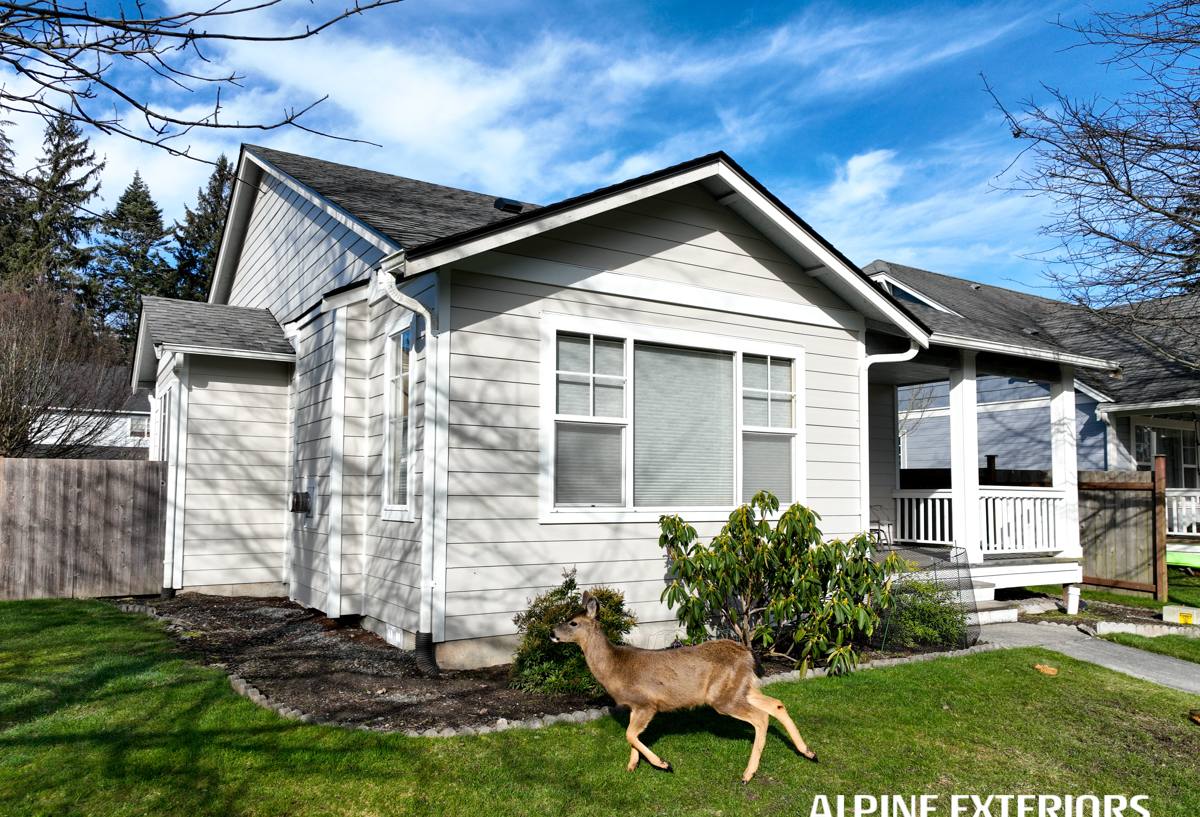
What Salt Air and Moss Actually Do to a Home's Exterior
Salt Air
Airborne salt from the harbor settles on every exterior surface, including siding, trim, and fasteners. On materials that aren't engineered to resist it, salt accelerates corrosion of metal components and can contribute to premature breakdown of paint films and caulking. Over years, homes close to the water show wear patterns that homes even a mile or two inland don't.
Driving Rain
Storms rolling in off the water don't just fall straight down — wind pushes rain sideways into wall assemblies, testing every seam, joint, and piece of flashing on a home. A siding system that isn't installed with the right gaps, flashing details, and drainage plane behind it will eventually let that water find a way in, regardless of how good the siding material itself is.
Moss and Algae
Shade, moisture, and mild temperatures are exactly what moss and algae need to establish themselves on exterior surfaces. Once established, moss holds moisture against the siding surface far longer than it would otherwise sit, which compounds the water exposure problem. Some siding materials also give moss and algae more to grip and grow on than others.
What Fiber Cement Siding Needs to Do in This Environment
For a Blaine Harbor home, siding has to manage moisture without trapping it, resist the slow corrosive effect of salt air on its own components, and hold its finish and shape through repeated wet-dry cycles without cupping, swelling, or losing adhesion at the seams. Wood-based products are more vulnerable to moisture absorption and swelling over time. Vinyl can warp or become brittle with temperature swings and doesn't offer the same fire resistance. Fiber cement, when it's the right product line and it's installed correctly, is dimensionally stable and non-combustible, and it doesn't feed moss and algae growth the way some organic siding materials can.
That's the baseline reason we standardized on James Hardie fiber cement rather than the alternatives. But the product alone isn't the whole story — installation quality is what determines whether that resistance actually shows up on your wall for the next several decades.
The James Hardie Product Lines We Use Here
James Hardie engineers its siding to different regional climate zones under its HZ5 and HZ10 systems, which account for freeze-thaw cycling, humidity, and moisture exposure specific to the Pacific Northwest. That climate-engineering is one of the reasons we don't substitute other fiber cement brands or budget alternatives — the formulation and factory finish are built for the conditions Whatcom County homes actually face, not a generic national average.
James Hardie's ColorPlus factory-applied finish is baked on and cured under controlled conditions before the boards ever reach a job site, which gives a more consistent, durable finish than field-painted siding typically achieves. For a home exposed to salt air and heavy rain, that finish quality directly affects how long the siding looks good and how well it resists fading, chalking, and moisture intrusion at the surface.
What Correct Installation Actually Involves
Most siding failures we see on coastal homes aren't failures of the material — they're failures of installation. Fiber cement siding is unforgiving of shortcuts in a way that becomes obvious over years, not days, which is exactly why it's easy for a rushed or inexperienced crew to leave problems behind that don't show up until a home has been through several wet seasons.
- A properly installed weather-resistant barrier and drainage plane behind the siding, so any moisture that does get past the surface can drain and dry out instead of sitting against the sheathing
- Correct flashing at every window, door, and roofline intersection — the single most common source of water intrusion behind siding
- Manufacturer-specified gaps at butt joints and trim to allow for expansion and drainage, rather than tight-fitted joints that trap water
- Corrosion-resistant fasteners driven to the correct depth and pattern, since over- or under-driven nails compromise both the seal and the board's ability to move as designed
- Proper caulking at the right joints only — not as a substitute for correct flashing and gapping
- Field-cut edges primed or sealed per manufacturer specification, since raw cut edges are more vulnerable to moisture absorption
Every one of those details is inspectable during installation but becomes very expensive to fix once the siding is up and the home has been through a winter. That's why our process is built around getting each of them right the first time, not around speed.
Our Process on a Blaine Harbor Home
We start with a walk-around assessment of the existing exterior, looking specifically at moisture history, existing flashing conditions, and any areas where past water intrusion or moss buildup point to underlying problems that need to be addressed before new siding goes on — not just covered over. Siding installed over compromised sheathing or unresolved moisture issues will fail regardless of how good the siding itself is.
From there, we handle removal of the old siding, repair or replacement of any damaged sheathing or framing found underneath, installation of the weather-resistant barrier and flashing system, and then the Hardie siding itself, followed by trim, caulking, and a final inspection walk-through. Homes directly along the harbor or with significant tree shade get extra attention to drainage detailing and gap spacing, since those are the homes that see the most sustained moisture exposure.
Cost Factors on a Blaine Harbor Project
| Factor | Why It Affects Cost |
|---|---|
| Existing siding removal & disposal | Tear-off complexity varies with layers, material, and access |
| Sheathing or framing repair | Water-damaged substrate found during tear-off must be addressed before re-siding |
| Home size & wall complexity | Dormers, multiple stories, and cut-up wall lines add labor and material waste |
| Siding profile & ColorPlus color | Lap width, shingle-style panels, and trim details vary in material cost |
| Flashing & window/door detailing | More openings mean more critical flashing work per square foot |
| Site access & harbor-area logistics | Tight lots, seawalls, and limited staging space near the water can affect labor time |
We give real numbers after that walk-around assessment, not a rough guess off square footage alone — two homes of the same size can have very different scopes once you factor in what's actually underneath the existing siding.
Why It Matters That We Already Work in Blaine Harbor
A crew that regularly works this stretch of Whatcom County has already seen how homes here behave through multiple wet seasons — which orientations take the worst of the driving rain, where moss tends to establish first, and which older flashing details tend to fail. That's not something you can fully substitute with general fiber cement experience from a drier or more inland market. Familiarity with the harbor's specific wind and moisture patterns shapes real decisions on-site: where to add extra flashing attention, how tight to run gaps on a shaded north wall versus a sun-exposed side, and which trim details hold up best against salt air over time.
It also means we're a known, local point of contact if a warranty question or maintenance question comes up years down the road, rather than a crew that did one job in the area and moved on.
Maintaining Fiber Cement Siding in a Coastal Moss Climate
- Rinse siding periodically to remove salt residue and organic buildup, especially on shaded or water-facing walls
- Keep gutters clear so overflow doesn't run down and sit against siding seams
- Trim back vegetation and tree cover that keeps siding shaded and damp longer than necessary
- Inspect caulking at trim and window joints yearly and have gaps re-sealed before they become entry points
- Address any moss growth early with gentle, non-pressure-washer methods that won't drive water behind the boards
- Have flashing and joints checked after major storm seasons, particularly on homes with direct harbor exposure
None of this is heavy maintenance — fiber cement is a low-maintenance material by design — but a little seasonal attention goes a long way in an environment that's actively working against your exterior twelve months a year.
Get an Assessment for Your Blaine Harbor Home
If your siding is showing moss staining, chalking, gaps, or you're just planning ahead for a home this close to the water, we're happy to take a look and walk you through what we find — no pressure, no obligation. Fill out the form below for a free estimate.