 Blaine
 Why Roofs in the Bellingham Area Take a Different Kind of Beating
Homes in and around Bellingham sit close enough to Bellingham Bay and the Strait of Georgia that salt-laden air is a constant, low-grade stressor on every exposed roof surface. Add Whatcom County's driving rain, which tends to arrive sideways off the water during fall and winter storms, and a roofing system has to do more than just shed water straight down — it has to resist wind-driven moisture working sideways and upward under shingle tabs and flashing. Then there's the shade. Mature conifers and the persistent marine cloud cover that keep this corner of Washington green also keep roof surfaces damp for long stretches of the year, which is exactly what moss and algae need to take hold.
None of this means asphalt shingle roofing is the wrong choice here — it remains one of the most practical, cost-effective roofing systems available, and it performs well in this climate when it's installed with these specific conditions in mind. The problems we see on Bellingham-area roofs almost always trace back to a shortcut somewhere in the install, not a flaw in the shingle itself.
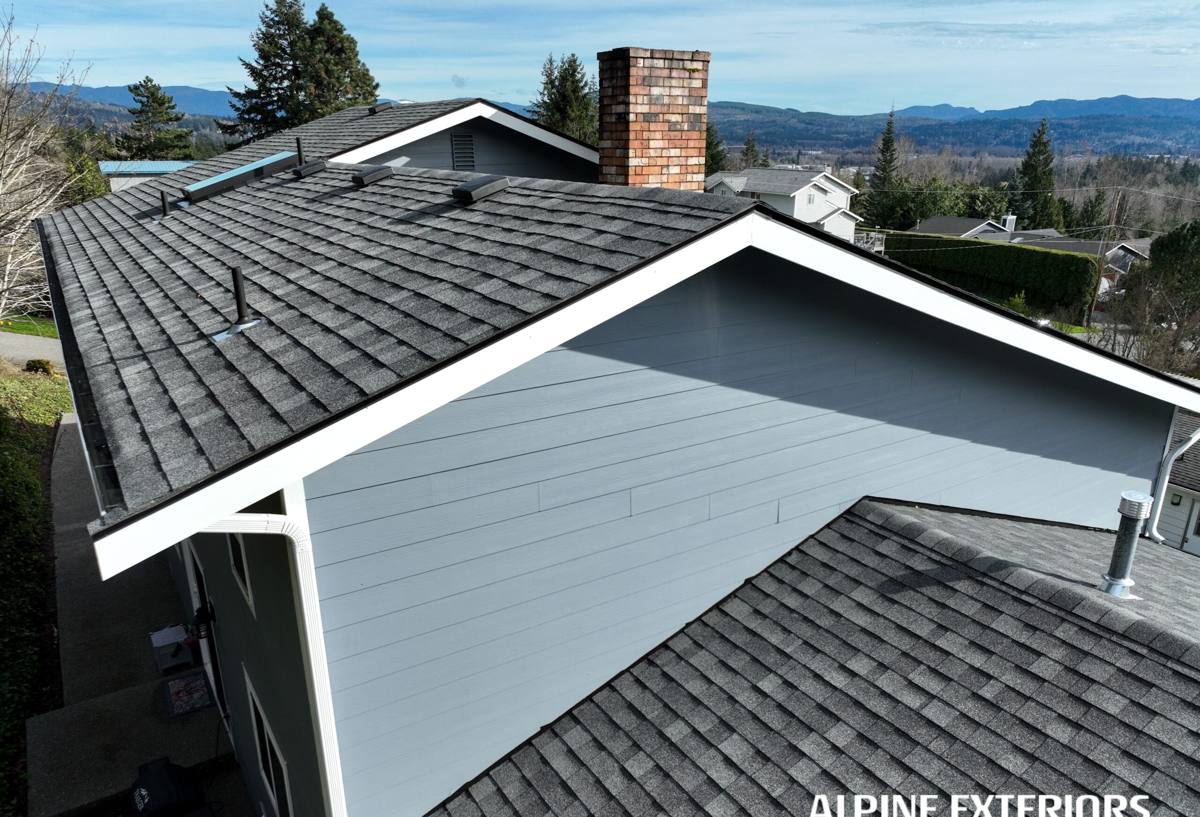
What a Correct Asphalt Shingle Roof Needs to Include Here
Underlayment and Ice-and-Water Protection
In a climate that sees sustained, wind-driven rain rather than occasional downpours, underlayment choice matters more than in drier regions. We use synthetic underlayment as the primary water-resistive layer across the full roof deck, with self-adhering ice-and-water shield membrane at the vulnerable points: eaves, valleys, roof-to-wall transitions, and around every penetration. That membrane seals around fastener holes, which is what actually stops the slow, hidden leaks that show up as ceiling stains months after a storm rather than during it.
Ventilation That Actually Balances
A shingle roof is a system, not a single layer, and the attic underneath it is part of that system. Balanced intake at the soffits and exhaust at the ridge keeps moist air moving out instead of condensing on the underside of the roof deck — a real risk in a marine climate where indoor and outdoor humidity are both high for much of the year. Under-ventilated attics are one of the most common reasons we see premature shingle aging and deck rot on roofs that otherwise look fine from the ground.
Flashing Details
Step flashing at walls and chimneys, and properly lapped flashing in valleys, has to be installed in the correct sequence with the shingle courses — not caulked over the top as an afterthought. Caulk fails; correctly lapped metal doesn't rely on a sealant bead to keep water out. This is one of the fastest ways to tell a rushed roof job from a correct one.
Moss, Algae, and Bellingham's Long Wet Season
Whatcom County's moss season is long, and on a north-facing slope or a roof shaded by evergreens it can be nearly year-round. Moss isn't just a cosmetic problem — its root structures lift shingle edges and hold moisture directly against the roofing material, which accelerates granule loss and can eventually work moisture under the shingle mat. Algae streaking, the dark stains that run down a roof slope, is a separate issue: it's a bacteria that feeds on limestone filler in shingles and doesn't structurally damage the roof, but it does shorten the roof's visual life and can affect resale curb appeal.
We address both with a two-part approach. First, at the install stage, we recommend algae-resistant shingles with copper- or zinc-infused granules along the exposed field, which release trace metal ions with every rain to inhibit algae growth over the life of the roof. Second, for moss, no shingle product prevents it entirely on a heavily shaded, low-slope section — the real defense is proper ventilation to reduce the damp microclimate at the roof surface, keeping overhanging branches trimmed back, and scheduling a soft wash and gutter clearing on a regular interval rather than waiting until moss is visibly established. We can walk through a maintenance interval that fits your specific lot and tree cover during your estimate.
Choosing the Right Shingle Line for This Climate
Not every asphalt shingle product is built the same way, and the right choice depends on your roof's slope, exposure, and how long you plan to stay in the home. Here's how the common categories compare for a Bellingham-area install:
| Shingle Type | Wind Resistance | Algae Resistance | Typical Lifespan | Best Fit |
|---|---|---|---|---|
| 3-tab | Moderate, lower wind rating | Only with treated line | Shorter, thinner mat | Budget-driven projects, secondary structures |
| Architectural / dimensional | Strong, higher wind rating with proper fastening | Available with copper/zinc granules | Longer than 3-tab, thicker laminated mat | Most Bellingham-area homes — the standard we recommend |
| Impact-resistant (Class 4) | Strong, plus resists hail and debris impact | Available with copper/zinc granules | Comparable to architectural, often with better warranty terms | Homes under heavy tree cover with falling branch risk |
For most homes in this area we steer people toward a laminated architectural shingle with algae-resistant granules as the baseline. The thicker mat holds up better to wind-driven rain at the tab edges, and the impact rating on Class 4 lines is worth discussing if your roof sits under mature conifers that drop branches and cones through the wet season.
How Our Bellingham Roofing Process Works
A siding crew that also handles roofing correctly treats the roof as part of the whole building envelope — flashing at wall intersections, water management at the eaves, and how the roof edge ties into your siding and trim all have to work together. Here's the sequence we follow on a shingle roof replacement:
- On-site inspection of the existing roof, deck, and attic ventilation, with photos of anything that affects the estimate.
- A written estimate that separates tear-off, deck repair allowance, underlayment, ventilation upgrades, and shingle material so you can see exactly what you're paying for.
- Full tear-off to bare deck — we don't install a new layer over old shingles, since that traps moisture and voids most manufacturer warranties.
- Deck inspection and repair of any soft or delaminated sheathing before anything new goes down.
- Ice-and-water shield at eaves, valleys, and penetrations, followed by synthetic underlayment across the field.
- Drip edge, starter strip, and shingle courses installed to manufacturer nailing pattern and exposure specs — not shortcut spacing.
- Flashing and ventilation components installed or upgraded, then ridge cap to finish the roof line.
- Full site cleanup, including a magnetic sweep for stray nails around the foundation and driveway.
Signs Your Roof Is Telling You It's Time
Because Whatcom County's wet season is long, roof problems here tend to develop quietly over several rainy seasons before they show up as an active leak. Watch for these signs:
- Granules collecting in gutters or at the base of downspouts, especially after a wind event
- Shingle tabs that are curling, cupping, or lifting at the edges
- Visible moss growth along ridge lines or on shaded slopes
- Dark streaking running down the roof face (algae staining)
- Soft or spongy feeling decking near eaves when walked on during an inspection
- Daylight visible through the roof deck from inside the attic
- Interior ceiling stains, especially near chimneys, skylights, or valleys
- A roof that's approaching or past the age range for its shingle type
What Drives the Cost of a Bellingham Asphalt Shingle Roof
We don't publish fixed prices online because roof cost depends on real variables specific to your house, but the main cost drivers are consistent across every job we quote in this area:
- Roof size and complexity — square footage, plus the number of valleys, dormers, and roof planes, which all add labor and flashing.
- Deck condition — how much sheathing needs to be replaced once the old roofing is off, which we can't fully confirm until tear-off.
- Shingle tier — 3-tab versus architectural versus impact-resistant Class 4 shingles carry different material costs.
- Ventilation upgrades — adding or correcting soffit and ridge ventilation if the current system is undersized.
- Steepness and access — steep or hard-to-access roofs take longer and require different safety setups.
- Tear-off layers — removing one layer of old shingles versus two adds disposal and labor time.
A straightforward, moderately sized roof on a single-story home will land toward the lower end of the range for this type of project; a steep, multi-valley roof with deck repairs needed will run higher. We give you the real number, broken down by these factors, at the estimate — not a rough guess pulled from a national average.
Why Hiring a Crew That Already Works This Area Matters
A roofing crew that's worked roofs throughout Blaine and the Bellingham area already knows how local conditions affect the install schedule and material choices — when the wet season makes tear-off timing risky, which slopes and tree lines tend to hold moss longest, and how Whatcom County's coastal wind patterns affect fastening and flashing decisions. That local pattern recognition is different from what you get from a crew that mostly works inland or in a drier climate and treats every roof the same way.
It also matters for accountability. A local crew is easy to reach if a question comes up after the job, and has a reputation in the community worth protecting — which shows up in how carefully the work gets done the first time, not just in the sales pitch.
If your roof is showing any of the signs above, or you're simply due for a straight answer about its condition, we're glad to take a look. Estimates are free, there's no pressure to book on the spot, and you'll get a written breakdown of exactly what your roof needs and why.