 Blaine
 Why Birch Point Windows Take More Punishment Than Most
Birch Point sits close enough to the water that salt-laden air is a daily fact of life, not an occasional nuisance. That air carries fine salt particles that settle on glass, frames, and hardware, where they hold moisture against the surface longer than a dry inland breeze ever would. Add Whatcom County's wind-driven rain — storms here rarely fall straight down, they come in sideways off the water — and you've got water actively pressed into every gap, joint, and seam around a window opening, not just resting on the sill waiting to drain off.
Then there's moss season, which in this part of Washington is really most of the year. Shaded north- and west-facing walls near the trees stay damp long after a storm passes, and that dampness feeds moss and algae on siding, trim, and window frames alike. None of this means Birch Point homes need exotic materials or gimmicks. It means the basics — flashing, sealant, drainage, and material choice — have to be done right, every time, because there's very little margin for a shortcut to go unnoticed.
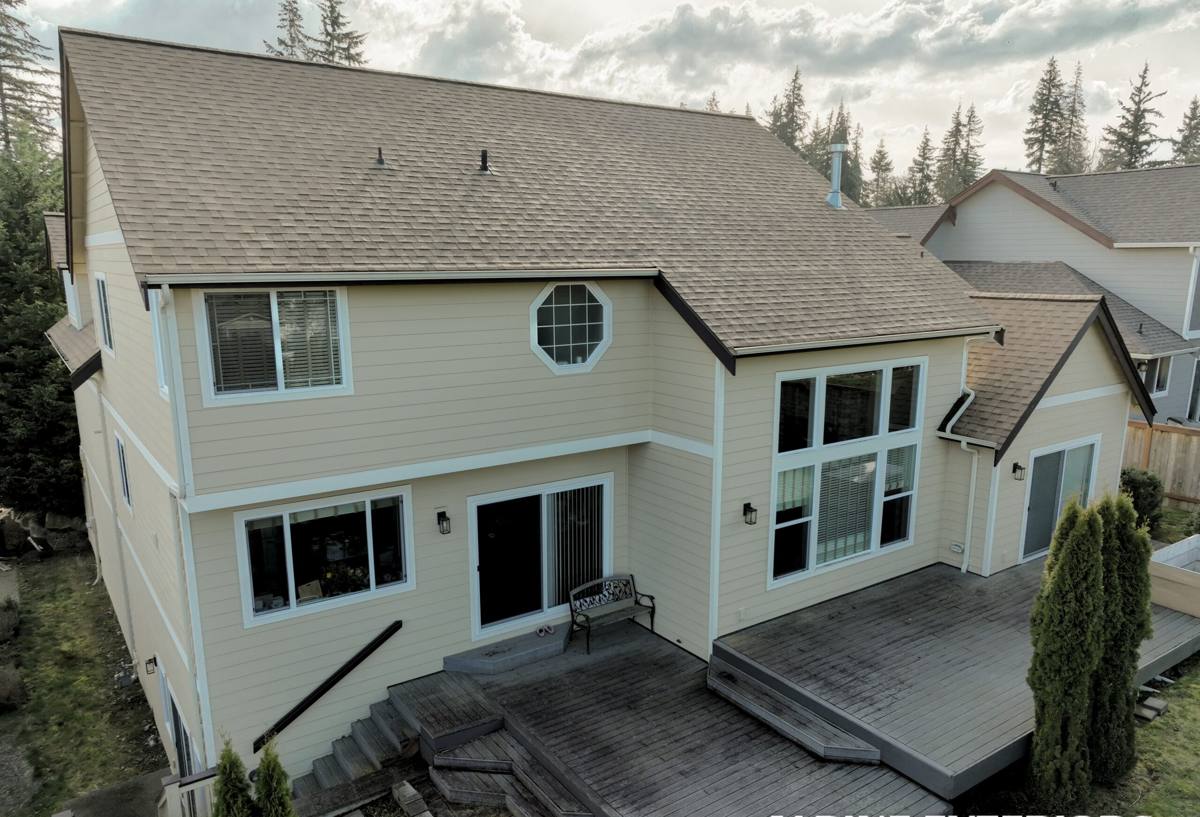
What a Correct Installation Actually Involves
A window is only as good as the opening it's set into. Most of the window failures we see in this area aren't the glass or the frame — they're water finding a path behind the window through a flashing detail that was skipped or done out of order.
Flashing and Water Management
Every window opening needs to shed water down and out, never in. That means flashing tape and building paper (or house wrap) integrated in the correct shingle-lapped order — top piece over the one below it — so water draining down the wall face is directed over the window, not behind it. On a home exposed to wind-driven rain, this sequencing matters more than the brand of tape used.
Sill Pans and Back Dams
A sloped sill pan under the window, with a back dam at the interior edge, catches any water that does get past the exterior seal and routes it back outside before it reaches the framing. This is inexpensive to do at install time and expensive to add later, which is why we treat it as standard, not an upgrade.
Sealant Selection and Placement
Not every exterior sealant is meant to stay flexible in a cold, damp, UV-exposed marine climate for years at a time. We use sealants rated for that kind of exposure, and just as important, we leave weep paths open at the sill so any incidental water can still escape — a fully sealed sill with no way out just traps moisture instead of shedding it.
Signs Your Current Windows Are Losing the Battle
Because water damage around windows happens slowly and mostly out of sight, it's worth checking for these signs at least once a year, especially heading into the wet months:
- Fogging or a hazy film between the panes of a double-pane window (a broken seal, not a cleaning problem)
- Soft, spongy, or discolored wood at the sill or the trim directly below it
- Black or green streaking, or visible moss, collecting in the corners of the frame or under the sill
- A noticeable draft near the frame even when the window is fully latched
- Windows that have become hard to open, close, or lock — often a sign the frame has shifted from moisture
- Peeling paint or bubbling on interior trim near the window, which usually points to moisture getting in from outside
Any one of these on its own might be minor. Two or more on the same window usually means water has already reached the framing, and it's worth having someone look at it before the next round of fall storms.
Choosing a Window Material for a Coastal Whatcom County Home
There's no single "best" window material — each has a real trade-off, and the right call depends on the specific wall, exposure, and budget. Here's how the common options actually perform in salt air and constant damp:
| Material | Salt air / moisture behavior | Maintenance | Notes |
|---|---|---|---|
| Vinyl | Won't corrode or rust; handles salt air well | Low — occasional rinse | Most cost-effective; good standard choice for most Birch Point homes |
| Fiberglass | Excellent — very stable, resists warping and doesn't corrode | Low | Higher upfront cost; holds up well over decades in marine exposure |
| Aluminum-clad wood | Good exterior protection, but any breach in the cladding exposes wood to rot | Moderate to high | We're selective about where we recommend this near the water — it can be a great look, but it's less forgiving of a maintenance gap |
| Bare aluminum frame | Prone to pitting and corrosion from salt over time; conducts cold and can condense heavily | Higher | We generally steer homeowners away from this near the water unless it's matching an existing architectural style |
We're not against wood-framed or aluminum windows on principle — they have their place — but on a home this close to salt air, we'll always tell you honestly if a material is going to demand more upkeep than most homeowners want to sign up for.
Our Installation Process for Birch Point Homes
- Assessment. We check the existing openings for hidden rot or moisture before quoting anything, since that changes both the scope and the price.
- Careful removal. Old windows come out without tearing up siding or trim that doesn't need to be replaced.
- Sheathing inspection. If the framing or sheathing underneath is soft or damaged, we repair it before anything new goes back in — installing a new window over a rotten opening just hides the problem.
- Flashing and sill pan installation. Done in the correct sequence, every time, not as an optional add-on.
- Window set and shimmed level. A window that isn't plumb and level will operate poorly and stress the seals over time.
- Sealing and insulation. Gaps are insulated and sealed on both the exterior and interior side, with weep paths left clear.
- Final check. We test operation, look for any daylight or drafts, and walk the job with you before we call it done.
What Affects the Cost of the Job
Every home is different, so we won't quote a number without seeing the openings, but these are the factors that actually move the price:
| Factor | Why it matters |
|---|---|
| Number and size of openings | More straightforward math, but larger or custom-sized windows cost more per unit |
| Hidden rot or water damage | Sheathing or framing repair adds labor and material that can't be known until the old window is out |
| Material choice | Vinyl, fiberglass, and clad-wood carry different price points, as outlined above |
| Full-frame vs. insert replacement | A full-frame job (removing down to the framing) costs more than an insert replacement but is the right call when the opening has damage |
| Access and site conditions | Second-story openings, tight setbacks, or difficult siding removal add time |
| Permitting | Some scopes of work in Whatcom County require a permit, which adds a modest fee and lead time |
Why Local Experience in Birch Point Matters
A crew that's already worked this stretch of Blaine knows which walls take the worst of the wind-driven rain, which sides of a house tend to hold onto moss longest, and roughly what to expect before pulling the first window out. That's not a marketing point — it changes real decisions, like where a sill pan detail needs extra attention, or whether a particular material is worth the added maintenance on a given exposure.
It also means fewer surprises with scheduling. We plan window work around the wetter stretches of the year when we can, and we know how to sequence a job so an opening isn't left exposed to the weather any longer than necessary. That familiarity comes from doing this kind of work in this specific climate repeatedly, not from a general playbook applied the same way everywhere.
Caring for New Windows in a Marine Climate
A properly installed window in a good material still benefits from a little upkeep in this environment. Rinsing salt film off glass and frames periodically keeps it from etching the glass or holding moisture on the surface. Clearing debris and moss out of tracks and weep holes keeps drainage working the way it's designed to. And a quick yearly look at the exterior sealant — checking for cracking or gaps — catches small issues long before they become a water intrusion problem. None of this is intensive, but skipping it is how a good installation slowly becomes a bad one.
If you're seeing any of the warning signs above, or you're just ready to stop fighting drafts and fogged glass through another wet Whatcom County winter, we're happy to take a look. Reach out for a free, no-pressure estimate — we'll walk your windows with you and tell you plainly what we find.