 Blaine
 Why Sumas Homes Need Siding Built for This Climate
Sumas sits close enough to the Strait of Georgia and Boundary Bay that salt-laden air reaches homes here even without a direct waterfront view, and it sits far enough inland that fog, cloud cover, and standing damp linger longer than they do along the open coast. That combination — salt exposure plus persistent moisture — is a harder test on exterior siding than either factor alone. Add Whatcom County's driving rain, which comes in sideways off frequent winter storms rather than falling straight down, and you have a wall assembly that has to shed water horizontally, not just vertically, for months at a time.
Then there's moss. The long, mild, wet stretch that runs roughly October through April gives moss, algae, and lichen an extended runway to establish on any siding material that holds surface moisture or has seams and textures where spores can settle. On a lot of siding products, that shows up as green-black staining on north-facing walls, under eaves, and anywhere shade keeps a wall from drying out between rain events. None of this is exotic or unusual for the area — it's just the baseline a siding product has to survive, year after year, without babysitting.
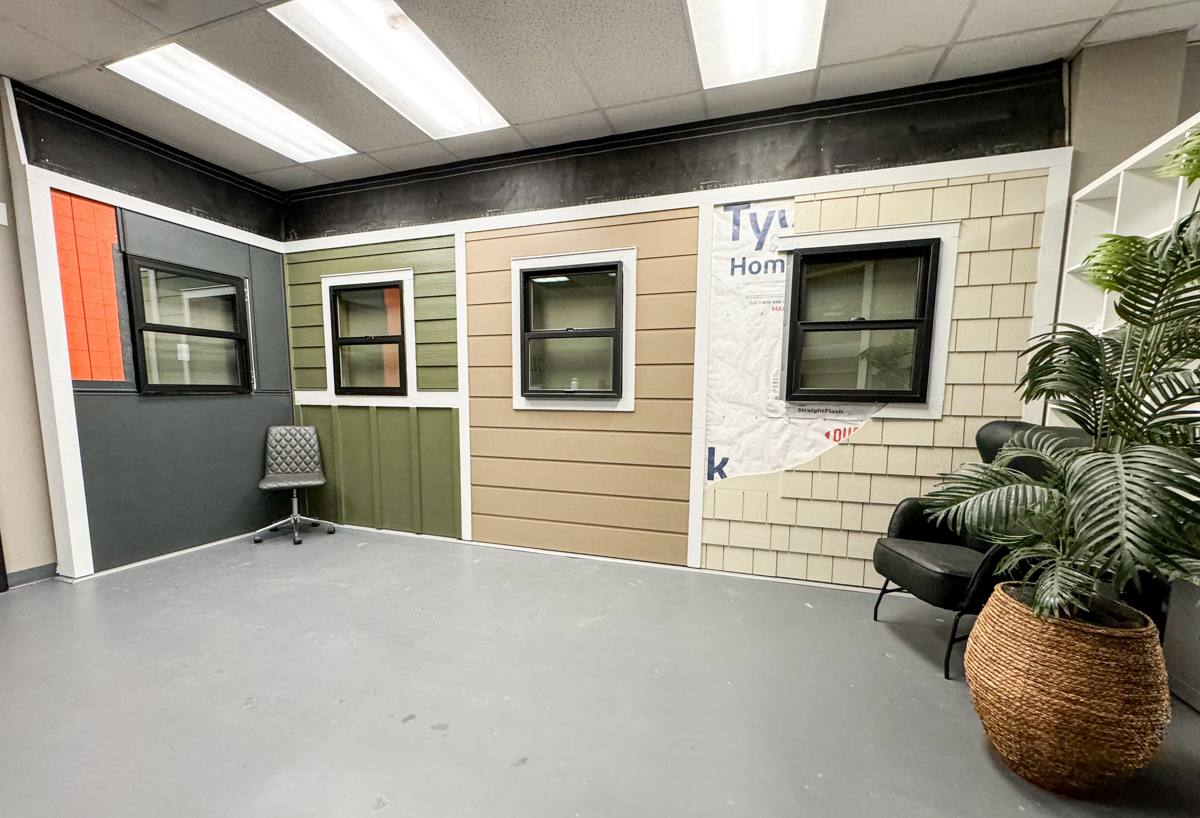
What Actually Fails on Sumas Homes
We see the same failure patterns repeat on older homes in this part of Whatcom County, and they're worth naming plainly because they explain what a correct siding job is actually solving for:
- Moisture-trapped panel siding — engineered wood and OSB-based products that swell, delaminate, or soften at butt joints and bottom edges where water sits longest.
- Chronic moss and algae staining — especially on shaded north and east walls, where a wet product never gets a real drying window between storms.
- Caulk-dependent seams that fail early — vinyl and lower-grade products that rely on caulking at joints and trim, which degrades faster under this region's UV-to-rain cycling than most homeowners expect.
- Paint film breakdown — field-painted wood and primed products losing adhesion where salt air and moisture cycling attack the paint bond, not just the substrate.
- Fastener corrosion — the wrong fastener metal reacting with coastal-influenced air over years, staining the face of the siding or loosening the hold.
Every one of these is a material-selection or installation-detail problem, not bad luck. A siding system chosen and installed for this specific climate doesn't have to fight these issues.
Why We Install Only James Hardie Fiber Cement Here
This company installs James Hardie fiber cement siding exclusively — not LP SmartSide, not vinyl, not Cemplank or Allura, not primed spruce or cedar. That's a deliberate standard, not a sales preference, and it matters more in a climate like Sumas's than it would somewhere dry and mild.
Fiber cement is non-combustible and doesn't rely on an engineered-wood core that can swell or soften when it takes on water at a cut edge or fastener point. James Hardie's HZ5 product line is formulated specifically for climates with freeze-thaw cycling and sustained damp, which describes a Whatcom County winter well. The factory-applied ColorPlus finish is baked on under controlled conditions and backed by its own finish warranty — that's a meaningfully different proposition than a field-applied paint job trying to bond and hold in salt air and near-constant humidity. We're not against every alternative product across the board; we're specific about why we don't put them on homes in this climate, and we'd rather explain that honestly than pretend there's no trade-off at all.
Moss and Algae Resistance in Practice
Fiber cement's dense, cementitious composition doesn't provide the same food source or moisture-holding surface that wood fiber and some engineered products do, and it doesn't have the porous cut edges that let water wick in the way OSB-core products can. That doesn't mean a wall in constant shade will never see any biological growth — nothing fully escapes that in this climate — but it means the siding itself isn't accelerating the problem, and a wash-down actually restores the surface instead of revealing damage underneath.
What a Correct Fiber Cement Job Involves
Fiber cement siding is only as good as its installation, and that's especially true in a wet, wind-driven climate where every seam and penetration is a potential water path. A correct job on a Sumas home includes:
- Water-resistive barrier and flashing first. The house wrap or weather barrier goes on correctly lapped, and flashing is integrated at every window, door, and roof-to-wall transition before a single piece of siding goes up. This is the layer that actually keeps water out — siding is the second line of defense, not the first.
- Rainscreen or proper drainage gap. Furring strips or a drainage mat behind the siding give bulk water and incidental moisture a path to drain and the wall a chance to dry, which matters far more here than in a dry climate.
- Correct fastener spacing and type. Hardie's install specs call for specific fastener placement, and using the wrong fastener material invites the corrosion staining we see on older coastal-influenced homes.
- Proper clearances. Siding held off the roofline, deck, and grade at the manufacturer-specified minimums so it isn't sitting in standing water or splash-back.
- Sealed and primed cut edges. Factory edges are protected, but every field cut needs to be sealed per spec — skipping this is one of the most common corner-cutting mistakes on fiber cement jobs.
- Joint and trim detailing. Minimizing caulk-dependent joints where possible, and using the right sealant and technique where caulk is unavoidable, since caulk is the first thing to fail under UV and moisture cycling.
Skip any one of these steps and you can end up with a premium material performing like a budget one — trapped moisture behind the panel, staining at the joints, or fastener bleed within a few years.
Our Process on a Sumas Project
| Step | What Happens |
|---|---|
| Site walk and assessment | We look at existing siding condition, wall orientation, shade patterns, and any moisture or rot already present before quoting anything. |
| Tear-off and substrate check | Old siding comes off and sheathing is inspected — this is where hidden moisture damage from a previous product often shows up. |
| Barrier and flashing install | Weather-resistive barrier, window and door flashing, and drainage plane go in before any Hardie product is installed. |
| Hardie panel or plank installation | Installed to manufacturer spec — fastener pattern, clearances, sealed cuts, joint treatment. |
| Trim, caulking, and final detail | Trim work and any necessary sealant applied with attention to the joints most likely to see wind-driven rain. |
| Walkthrough | We go over the finished work with the homeowner before calling the job done. |
Cost Factors for a Sumas-Area Fiber Cement Project
Every project is different, but the main variables that move the price on a fiber cement siding job in this area are consistent:
| Factor | Why It Matters |
|---|---|
| Tear-off scope | Removing failed wood or vinyl siding, and dealing with any rot found underneath, adds labor before new siding goes up. |
| Home size and wall complexity | More corners, gables, and dormers mean more cuts, more trim, and more labor hours. |
| Product line and profile | Lap siding, panel systems, and shingle-style Hardie products carry different material and labor costs. |
| Drainage plane needs | Homes without an existing rainscreen may need one added, which is additional but worthwhile labor in this climate. |
| Trim and accent work | Trim boards, soffit, and fascia work bundled into the project add scope beyond the field siding itself. |
| Access and site conditions | Multi-story walls, tight lot lines, or landscaping that limits staging area affect labor time. |
We give straightforward, itemized estimates rather than a single number pulled out of the air — you should be able to see what you're paying for.
Why Local Installation Experience Matters
Siding manufacturers write installation specs for a general climate range, but there's real judgment involved in applying those specs correctly to a specific site — how much clearance to leave given a particular roofline, where a rainscreen matters most on a given wall, which side of a house needs the most attention to moss and drainage. A crew that has worked on homes throughout the Blaine and Sumas area has already seen how local wind direction, shade patterns, and rainfall behave on real walls, not just in a manual. That local pattern recognition is part of what keeps a fiber cement installation performing the way it's supposed to for decades instead of just for the first few dry summers.
It also matters for warranty follow-through. James Hardie's product warranty is strong, but it's paired with installation requirements — if a job isn't installed to spec, warranty claims can get complicated. Working with a crew that installs Hardie products regularly and understands the spec in detail protects that warranty coverage for the life of the siding.
Maintenance Once It's Installed
Fiber cement is genuinely lower-maintenance than most alternatives, but "low-maintenance" doesn't mean "no-maintenance" in a climate like this one. A simple annual routine keeps a Hardie installation looking and performing the way it should:
- Rinse the exterior annually, focusing on shaded north and east walls where moss and algae are most likely to establish.
- Keep gutters clear so overflow isn't running down the wall face and holding water against the siding.
- Trim back vegetation and tree limbs that keep a wall shaded and slow to dry.
- Walk the exterior once a year to check caulking at trim joints and around penetrations, and re-seal as needed.
- Repaint per the ColorPlus warranty schedule if you want to change color — the factory finish itself is not something you need to maintain like field-applied paint.
Get an Estimate for Your Sumas Home
If you're dealing with staining, swelling, or aging siding on a home in the Sumas or greater Blaine area, we're happy to take a look and walk you through what a correctly installed James Hardie fiber cement system would involve for your specific house. The estimate is free, there's no pressure, and you'll get a straight answer about scope and cost before you decide anything.