 Blaine
 Siding Repair for Sumas Homes
Sumas sits inland from Blaine, out toward the Whatcom County border country, but the exterior of a house here still answers to the same weather system that shapes every job we run closer to the water. Driving rain, a moss season that stretches across most of the calendar, and — closer to Blaine's coastline and Drayton Harbor — a steady dose of salt-tinged air all add up to siding that ages faster than most homeowners expect. When that siding starts to fail, the question is rarely "replace everything" — it's usually a specific section, a specific problem, and a specific fix. That's what this page covers: siding repair, done correctly, for Sumas properties specifically.
We install James Hardie fiber cement siding exclusively, and that carries through to repair work. When we patch, replace a damaged course, or rework a failing section, we're matching into or upgrading toward the one product system we stand behind — not stretching a repair budget to keep a lesser material limping along.
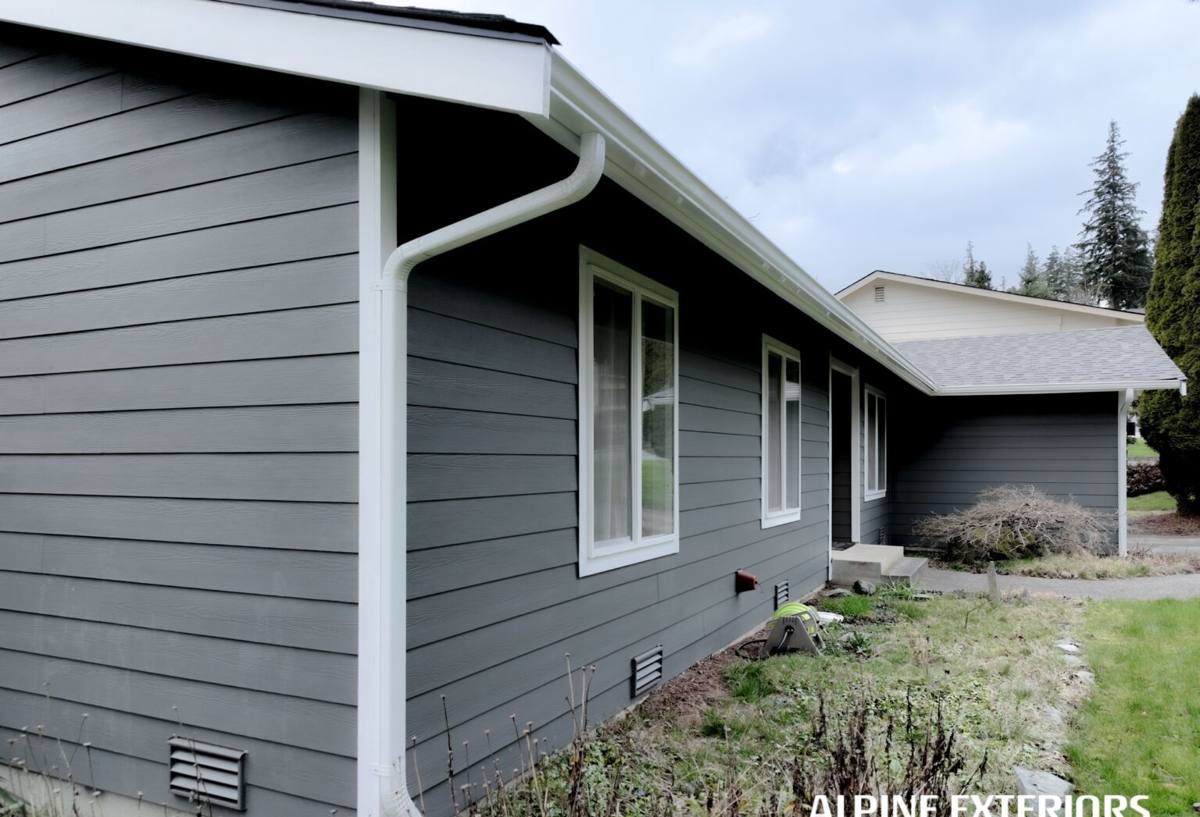
What Sumas Properties Are Actually Up Against
Driving Rain
Rain in this part of Washington doesn't fall straight down as often as homeowners think. Wind pushes it sideways into seams, corners, and anywhere flashing is doing less than it should. On a repair job, that's usually where we find the actual damage starting — not on the open face of a wall, but tucked into a joint or a butt seam that's been taking on water for longer than it looks like from the ground.
A Long Moss and Mildew Season
Mild temperatures and consistent moisture across Whatcom County add up to a moss season that runs longer here than in drier parts of the state. Shaded and north-facing walls are usually the first to show it. Moss and mildew aren't just cosmetic — sustained organic growth holds water directly against a wall, and that's the exact condition that turns a surface stain into hidden rot if it's left alone through another wet season.
Inland but Not Immune to Salt Air
Sumas is well inland from Drayton Harbor and Semiahmoo Bay, so it doesn't take the same direct salt spray that homes right along Blaine's coastline do. But this is still flat, low-lying country with strong wind events moving through, and salt-carrying air doesn't stop cleanly at a line on a map — it just gets diluted the farther inland it travels. Fasteners, trim hardware, and any exposed metal on a Sumas home can still see more corrosion over the years than the same materials would inland in a drier part of the country, even if the effect is less pronounced than it is right on the water.
Freeze-Thaw Swings
Sumas sees colder winter snaps and more frequent frost than towns right on the coast. Water that's already worked its way into a seam or a soft spot doesn't just sit there through a cold night — it freezes, expands, and pries the damage open further. That's part of why a small, ignored gap in siding or trim tends to get worse faster here than in a milder microclimate closer to the water.
Signs It's a Repair Job — and Signs It's Bigger
Most homeowners call about siding repair after noticing one specific thing, but the real scope often depends on how far water has already traveled behind the wall. Here's what we check before quoting anything:
- Soft, spongy, or bulging siding — usually low on the wall, around window trim, or near a deck ledger
- Cracked, split, or missing boards from impact, age, or storm damage
- Persistent moss or dark staining on shaded walls that comes back quickly after cleaning
- Gaps opening up at seams, corners, or where trim meets siding
- Peeling paint or visible swelling, which usually points to a non-Hardie material already failing underneath
- Rust staining running down from fasteners or trim hardware
- Interior signs — a musty smell, a soft spot on an interior wall, or a spike in energy bills that suggests the wall assembly isn't sealing the way it should
A single cracked board or a storm-damaged corner is almost always a straightforward repair. Soft sheathing behind multiple sections, or staining that's been ignored for more than a season, usually means the repair needs to start with cutting back further than the visible damage to find where the wood is actually still sound.
Repair vs. Replacement: How We Make That Call
| Situation | Usually Points To | Why |
|---|---|---|
| Isolated impact damage, one or two boards, siding otherwise sound | Targeted repair | Damage hasn't spread, and matching new boards into existing Hardie siding is straightforward |
| Recurring moisture at one specific detail (a window, a ledger, a corner) | Localized repair plus a flashing fix | Fixing the water source is what actually stops the damage from coming back |
| Soft or stained siding across multiple walls, older non-Hardie product | Partial or full re-side | Patching an aging, moisture-sensitive material just delays the real cost while rot keeps spreading underneath |
| Original siding is near the end of its practical service life | Full replacement | Repeated patch repairs on a failing material rarely pencil out better than one correct re-side over time |
What a Correct Siding Repair Actually Involves
Finding the Real Cause First
Cutting out a damaged board and nailing up a new one without figuring out why it failed is a good way to be back at the same spot in two years. Before we touch the siding, we trace the damage back to its source — a flashing gap, a caulk joint that's failed, a grade issue holding moisture against the wall, or simple age and weather exposure. If we don't fix what actually let the water in, the new material fails the same way the old material did.
Matching Material and Profile
If the home already has James Hardie siding, a repair usually means matching the existing plank width, profile, and ColorPlus finish as closely as current product lines allow, so the repaired section reads as part of the wall rather than an obvious patch. If the home has a different material — vinyl, LP SmartSide, cedar, or another product — we'll talk through whether the honest move is a like-for-like patch or a section-by-section transition toward Hardie, especially if the surrounding material is already showing its own signs of age.
Flashing and Water Management
Most of the repairs that actually last come down to what's happening behind the siding, not just the new boards themselves. That means correct step flashing at any wall-to-roof transition, proper head flashing over window and door trim, and house wrap that's lapped correctly rather than just taped over a gap. On a repair, this is the part that's easy to skip and the part that determines whether the fix holds through the next wet season or fails again in the same spot.
Fastening and Sealant Details
Fiber cement repair work calls for the correct fastener type, spacing, and depth — over-driven or under-driven nails are a common cause of early failure around a patched section. Sealant gets used at transitions and penetrations, not as a substitute for proper flashing and lap details. Used correctly, in the right places, sealant is a backup layer. Used to cover a shortcut, it's a maintenance problem waiting for the next hard rain.
Our Process for a Sumas Repair Job
- Inspection: We walk the affected area and the wall assembly around it, checking for how far moisture has actually traveled — not just the visible damage.
- Diagnosis: We identify the actual cause, whether that's a flashing failure, a grade issue, storm damage, or simple material fatigue.
- Honest scope and quote: We tell you plainly whether this is a contained repair, a larger localized fix, or something that's really pointing toward a bigger job — and put a real number on it before any work starts.
- The repair itself: Damaged material comes out, the substrate underneath gets checked and repaired if needed, flashing and house wrap get corrected, and new material goes in fastened and sealed to spec.
- Finish and cleanup: Trim, paint touch-up where needed, and a final check that the repaired section is weathertight before we call the job done.
Why James Hardie Is the Right Match for Repair Work
Repairing a wall is a bad time to introduce a material that behaves differently from what's already there — different moisture absorption, different expansion, different long-term color stability all show up eventually as a visible seam between old and new. Fiber cement's dimensional stability makes it a more forgiving material to patch into an existing wall than an engineered wood product that swells and shrinks with the season, or vinyl that can visibly mismatch in color within a few years of sun exposure. We don't install LP SmartSide, vinyl siding, Cemplank, Allura, primed spruce, or cedar, on new work or repairs. Each has its place in the broader market, but we made a professional call that repairing a wall with a material we don't fully trust just moves the same problem a few years down the road — and on a home already dealing with driving rain and a long moss season, that's not a trade worth making.
Cost Factors for Siding Repair in Sumas
| Factor | What It Affects | Why It Matters Here |
|---|---|---|
| Extent of hidden rot | How much sheathing or framing needs repair before new siding goes on | Long-standing moisture behind a wall in this climate rarely stays contained to what's visible |
| Matching existing product and color | Whether new material blends in or needs a broader color-matched section | Older Hardie ColorPlus runs and discontinued colors sometimes require repainting a wider area to blend |
| Number of separate repair zones | Mobilization and labor time | Several small isolated repairs across a home can cost more in labor than one consolidated section |
| Flashing and substrate work required | Scope beyond the visible siding damage | Fixing the actual water source is what makes a repair last through the next wet season |
| Site access | Equipment and staging needs | Rural Sumas properties can have longer driveways or different access than an in-town lot |
We won't quote a repair over the phone from a description alone — too much of the real cost depends on what's actually happening behind the visible damage, and we'd rather walk the property and give you an accurate number than a low estimate that grows once we open the wall.
What to Have Ready Before We Come Out
- A general sense of when you first noticed the damage or staining
- Any history of leaks, water intrusion, or prior repairs in the same area
- Access to the affected section, including any interior walls it backs onto if relevant
- Photos if the damage is seasonal or hard to see on the day of the visit
Why a Local Crew That Already Works Sumas Matters
Sumas sits far enough from Blaine's coastline that its exposure is a little different — less direct salt spray, more valley damp, more sustained winter cold. A crew that only works close to the water can miss how those differences change a repair: which wall orientations actually stay wet longest out here, how much of a role freeze-thaw plays in a given season, and where extra flashing attention actually pays off versus where it's overkill. We work this stretch of Whatcom County regularly enough to know the difference, and that shapes real decisions on repair day rather than applying the same fix to every property regardless of where it sits.
It also means less guesswork on scheduling and access. A crew unfamiliar with the area can underestimate drive time, rural site access, or how weather moves through this part of the county on a given week. We plan around it because we're out here often enough to know what to expect.
If you've got a section of siding in Sumas that's cracked, staining, gone soft, or just aging faster than it should, we're glad to take a look and give you an honest read on what it actually needs. Reach out using the form below to schedule a free, no-pressure estimate.