 Blaine
 Why Semiahmoo Siding Takes a Different Kind of Beating
Homes around Semiahmoo sit about as close to the water as a Whatcom County property can get. That shoreline position is the whole appeal of the neighborhood, but it also means the siding on these homes is working against conditions that inland Blaine properties simply don't face in the same combination: salt-laden air rolling off Semiahmoo Bay, wind-driven rain that hits walls sideways instead of falling straight down, and a moss season that, in this part of the Pacific Northwest, can run nine or ten months out of the year. Any one of those factors is manageable on its own. Together, and over years, they explain almost every siding repair call we get from this part of town.
This page is specifically about repairing siding on Semiahmoo homes — not a general "siding repair" page. The diagnosis, the materials, and the process all change when salt exposure and moss are part of the picture, and a repair that doesn't account for them tends to fail again within a season or two.
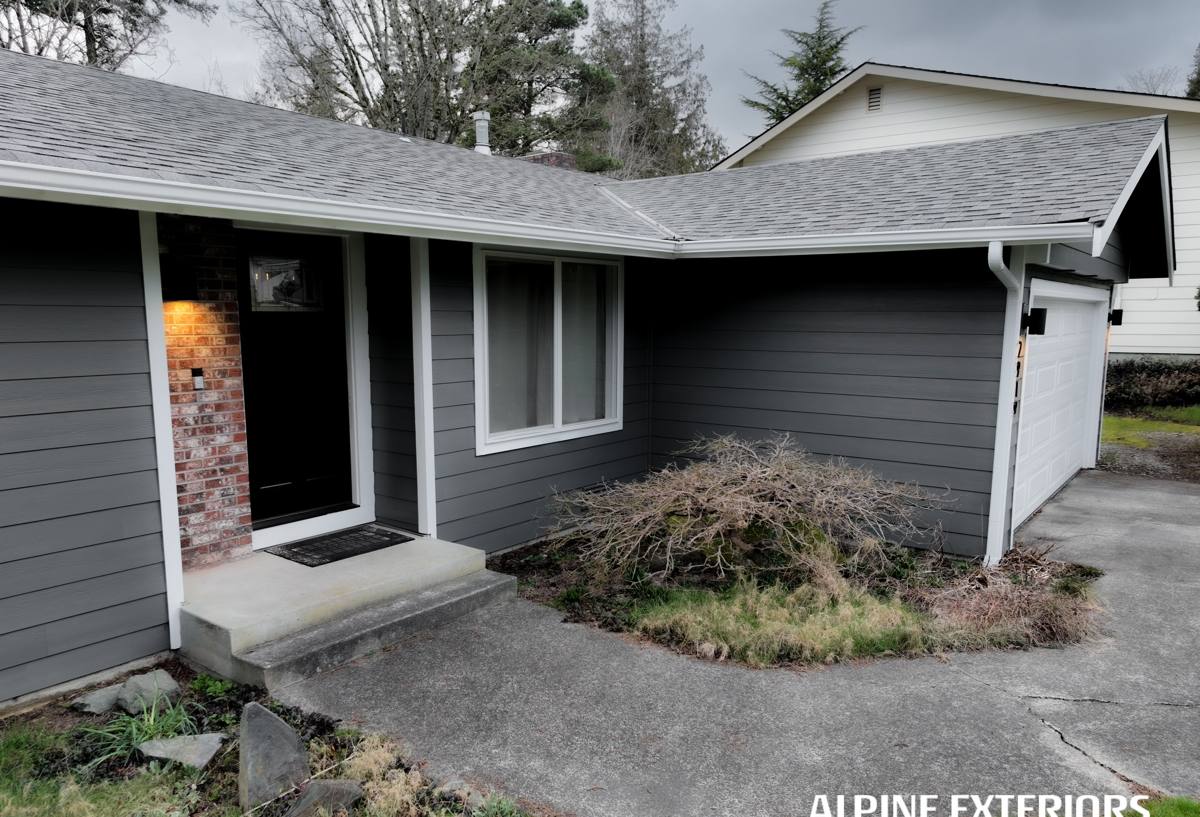
How Salt Air, Rain, and Moss Actually Damage Siding
Salt-laden air
Airborne salt doesn't just sit on the surface of siding — it works into fasteners, seams, and any exposed cut edges. Over time it accelerates corrosion on nails and metal trim, and it can degrade paint and factory finishes faster than the same product would wear a few miles inland. Homes with a direct or partially open view of the bay see this first, usually on the windward-facing walls.
Wind-driven rain
Rain that comes in at an angle, pushed by wind off the water, doesn't behave like ordinary rainfall. It gets forced up under laps, into butt joints, and around penetrations like hose bibs and light fixtures — places that stay dry in a calmer climate. If the flashing and water-resistive barrier behind the siding aren't detailed correctly, this is exactly the kind of rain that finds the gap.
Moss and prolonged moisture
Shaded, north-facing, and tree-lined walls around Semiahmoo hold moisture longer than open, sun-exposed elevations. Moss and algae take hold in that dampness, and once established they keep the siding surface wet even between rain events. Constant dampness is what actually causes damage — swelling, paint failure, and eventually rot in the substrate behind the panel — not the moss itself.
Signs Your Semiahmoo Home Needs Siding Repair
Most siding problems in this neighborhood show up gradually, and homeowners often notice the cosmetic symptom without realizing what's happening structurally behind it. Walk your exterior and look for:
- Soft or spongy spots when you press on siding, especially near the bottom courses
- Paint that's bubbling, peeling, or chalking unevenly across the wall — not the whole house
- Dark streaking or persistent moss/algae growth that comes back within weeks of cleaning
- Visible gaps, warping, or buckling at seams and corners
- Rust staining running down from nail heads or metal trim
- Soft trim or window casings adjacent to siding, which often signals water is already behind the wall assembly
- A musty smell or interior wall discoloration on an exterior wall, which points to moisture that's traveled all the way through
Any one of these on its own might be minor. Several together, especially on a bay-facing wall, usually means water has been getting behind the siding for a while.
What a Correct Siding Repair Actually Involves
A surface-level patch — cutting out the damaged piece and nailing in a new one — is the fastest repair to do and the least reliable one in a climate like this. Done right, a repair starts with figuring out why that section failed in the first place, not just what it looks like now.
That means checking the condition of the water-resistive barrier and flashing behind the removed section, inspecting the sheathing and framing for hidden rot before anything new goes back on, and confirming that fasteners and any exposed metal are suited to a salt-air environment. Only after that diagnosis is complete does the visible repair happen — matching the replacement piece's profile, exposure, and finish closely enough that it doesn't stand out as a patch, and re-flashing any window, door, or penetration in that section so it sheds water correctly going forward.
Skipping the diagnosis step is the single most common reason a "repaired" section fails again within a year or two — the new piece looks fine, but the same moisture path behind it was never addressed.
Repair or Replace? A Cost-Factor Comparison
| Factor | Leans toward repair | Leans toward replacement |
|---|---|---|
| Extent of damage | Isolated to one or two sections or elevations | Spread across multiple walls or the whole exterior |
| Age of existing siding | Siding is well within its expected service life | Siding is old or already near end of life |
| Moisture behind the wall | Localized, tied to a specific flashing or seam failure | Found in multiple areas, suggesting a systemic barrier problem |
| Material match | Existing product is still available or closely matchable | Product is discontinued or was never a good fit for this climate |
| Cost trajectory | One repair resolves the issue for years | Repeated repairs are adding up to near replacement cost anyway |
Why We Recommend James Hardie for the Panels We Replace
We only install James Hardie fiber cement siding — we don't install vinyl, LP SmartSide, Cemplank, Allura, primed spruce, or cedar. When a Semiahmoo repair calls for new panel material, that standard shapes what we bring to the job.
If your home is already sided in James Hardie, repairs are straightforward: we match the existing HZ product line and ColorPlus factory finish so the patched section blends in and holds color the same way the rest of the wall does. If your home is sided in a different material and the damage is limited, we'll do an honest, correctly detailed repair in a compatible material — we're not going to talk you into a full re-side for a problem that a proper patch will solve.
But when the damage is widespread, or when the underlying product simply hasn't held up to this coastline's combination of salt air and moisture the way it needs to, we'll say so plainly. In that situation, replacement with James Hardie is what we recommend: it's non-combustible, engineered in HZ formulations for different climate exposures, backed by a factory finish that resists the fading and peeling that salt air accelerates on painted wood and vinyl, and covered by a strong transferable warranty. We'd rather tell you that a repair is the right call today, and that a full re-side is the smarter move down the road, than oversell either one.
Our Siding Repair Process for Semiahmoo Homeowners
We keep the process the same regardless of how small or large the repair is, because skipping steps is how repairs fail in this climate:
- On-site inspection of the damaged area and a check of the rest of the exterior for related issues, especially on bay-facing and shaded walls
- Removal of affected siding and inspection of the water-resistive barrier, flashing, and framing underneath
- Repair or replacement of any compromised sheathing or framing before new siding goes back on
- Correct re-flashing and moisture-barrier detailing at the repair area
- Installation of matched replacement siding, fastened with hardware suited to a coastal environment
- Final walk-through so you can see exactly what was found and what was done
Maintenance That Extends the Life of a Repair
A correct repair holds up a lot longer with a little upkeep in between visits:
- Rinse salt residue and grime off exterior walls, especially bay-facing sides, a couple of times a year
- Keep gutters clear so overflow doesn't run down and pool against siding
- Trim back vegetation and tree cover that keeps a wall shaded and damp longer than it needs to be
- Address new moss growth early rather than letting it establish and hold moisture against the surface
- Have any new soft spots, gaps, or paint failure checked before the next wet season, not after
Why Hiring a Crew That Already Works Semiahmoo Matters
A contractor who mostly works drier, inland neighborhoods can still do competent general carpentry, but they won't necessarily know to check the specific things that fail first on a Semiahmoo home — which elevations take the worst of the wind-driven rain, how fast moss re-establishes on the shaded side of a lot near the water, or which fastener and flashing choices actually hold up against this level of salt exposure. A crew that already works this stretch of Blaine has seen the failure patterns repeat house after house and knows what to check before deciding whether a repair or a replacement is the right call.
That local familiarity also means faster, more accurate estimates — we're not guessing at how Whatcom County's coastal conditions affect your specific wall assembly, we're confirming what we've already seen nearby.
If you're seeing soft spots, persistent moss, peeling paint, or any of the other signs above on your Semiahmoo home, we're glad to take a look and give you a straight answer on repair versus replacement. Reach out below for a free, no-pressure estimate.