 Blaine
 Building Decks for Semiahmoo's Coastal Conditions
Semiahmoo sits right on the water, and that location shapes everything about how a deck should be built here. Salt-laden air off Semiahmoo Bay and the Strait of Georgia works differently on wood and fasteners than the inland air a few miles east. Add Whatcom County's long wet season — steady, driving rain from fall through spring, followed by a cool, damp spring that keeps moss and algae growing on any shaded or north-facing surface — and you have a climate that is genuinely harder on a deck than most parts of the country. A deck built with generic, catalog-standard methods will show it within a few years: rust bleeding from fastener heads, boards cupping, railings loosening, and a slick green film on anything that doesn't get sun or airflow.
None of that is inevitable. It comes down to material choice, fastener choice, framing details, and drainage — the parts of a deck most homeowners never see once it's finished, but that determine whether the deck still looks and performs well in ten or fifteen years. This page covers what a custom deck built for Semiahmoo actually needs, and what our process looks like when we build or replace one here.
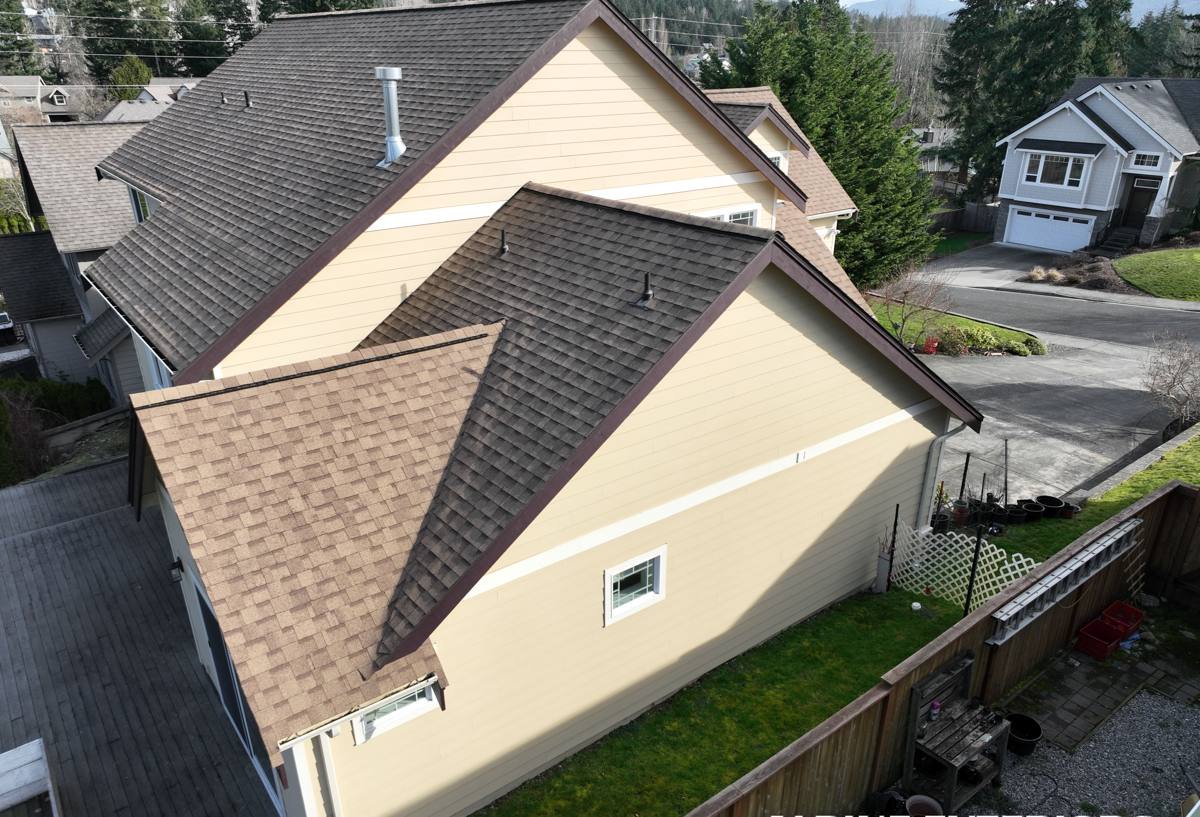
What Salt Air and Rain Actually Do to a Deck
It helps to understand the specific failure modes we're building against, rather than treating "coastal climate" as a vague concern.
Salt Air and Metal Fasteners
Airborne salt accelerates corrosion on any exposed metal — screw heads, joist hangers, bolts, and railing hardware. Standard electro-galvanized fasteners, which are fine in drier inland areas, can start rusting within a couple of seasons this close to the water. Rust stains bleed into the surrounding wood or composite, and corroded structural hardware is a real safety issue, not just a cosmetic one.
Driving Rain and Water Intrusion
Rain here doesn't just fall straight down — wind-driven rain gets pushed sideways into ledger connections, stair stringers, and any spot where two deck members meet. Water that gets trapped in those joints, rather than shedding off, is what causes rot in the framing long before the surface boards show any problem.
Moss, Algae, and Shade
Whatcom County's long wet, mild season is ideal moss-growing weather, and a lot of Semiahmoo properties have mature trees or homes close enough together to keep parts of a deck shaded most of the day. Moss and algae hold moisture against the decking surface, and on wood that moisture accelerates rot; on any material it makes the surface slippery and needs to be managed, not ignored.
Decking Material: What Holds Up Here
There's no single "best" decking material for every situation — it depends on budget, how much maintenance the homeowner wants to do, and how much sun or shade the deck gets. Here's how the common options actually perform in this specific climate.
| Material | Coastal/moisture performance | Maintenance | Typical lifespan here |
|---|---|---|---|
| Pressure-treated wood | Good if properly sealed and re-sealed on schedule; end grain and cut edges are vulnerable | Annual cleaning and re-sealing recommended | 15-20 years with upkeep |
| Cedar | Naturally rot- and insect-resistant, but still needs sealing against driving rain and salt spray | Regular cleaning, periodic oil or sealer | 15-25 years with upkeep |
| Composite decking | Doesn't rot or absorb water into the board itself; performs well in salt air | Periodic washing to keep algae/moss film from building on the surface | 25-30+ years, manufacturer-dependent |
| PVC decking | Fully synthetic, most resistant to moisture and salt exposure | Lowest maintenance; occasional washing | 25-30+ years, manufacturer-dependent |
Composite and PVC decking have become popular in Semiahmoo and along the Blaine waterfront for good reason — they take the salt air and rain out of the equation as an ongoing maintenance burden. That said, we still install real wood decks when that's what a homeowner wants; it just means being upfront that the maintenance schedule matters more here than it would inland, and that skipping a season of sealing shows up faster on a shaded, salt-exposed deck than it would elsewhere.
A Note on Hidden Fastener Systems
Composite and PVC boards are often installed with hidden fastener clips instead of face screws. That's a good match for this climate — fewer exposed metal points means fewer places for rust staining to start, and a cleaner surface for water to shed off of. We use fastener systems rated for coastal/marine exposure rather than the standard-grade hardware that ships as a generic default with some product lines.
What Happens Underneath: Framing and Structure
The decking surface is the part everyone sees, but the framing underneath is what actually determines how long the deck lasts — and it's where driving rain does the most damage if it's not detailed correctly.
- Ledger board flashed and sealed where it meets the house, so wind-driven rain can't work its way behind it
- Joists protected with a flashing tape or coating on the top edge, not just left as raw cut lumber under the decking
- Stainless or heavy hot-dip galvanized hardware (joist hangers, structural screws, bolts) rated for coastal exposure — not standard electro-galvanized hardware
- Proper spacing and slope so water sheds off the deck surface instead of pooling against the house or in low spots
- Adequate airflow underneath the deck so framing can dry out between rain events instead of staying damp
These details cost more up front than building to the bare minimum code requirement, but they're the difference between a deck that needs structural repair in eight years and one that's still sound in twenty-five.
Railings, Stairs, and Hardware
Railings and stairs take a lot of the same coastal punishment as the deck surface, plus they're a safety component, so corrosion resistance matters even more here. We build railing posts with proper structural attachment (not just surface-mounted brackets that rely on a handful of screws into the rim joist), and we spec hardware rated for the exposure the railing will actually see — a railing facing open water gets treated differently than one tucked against the house.
For stairs, we pay close attention to stringer protection and to how water sheds off each tread, since horizontal or near-horizontal surfaces on a stair are where standing water and moss tend to collect first.
Our Process for a Semiahmoo Deck Project
Every deck starts with an honest look at the site, not a generic proposal.
1. On-Site Assessment
We look at sun exposure, prevailing wind and rain direction, tree cover, proximity to the water, and — for a replacement — the condition of the existing framing and ledger connection. This tells us where moss and moisture are going to be a recurring issue and how exposed the structure is to salt air.
2. Material and Layout Discussion
We walk through the material options above in the context of the homeowner's budget and maintenance preferences, and design the layout, railing style, and stair placement around how the space will actually be used.
3. Permitting
Deck projects in Blaine and unincorporated Whatcom County generally require a building permit, and requirements can vary depending on deck height, attachment to the house, and proximity to shoreline setback lines — which matters for a lot of Semiahmoo properties given the waterfront location. We handle the permit process as part of the job.
4. Construction
Framing first, with all the moisture-management details above built in from the start — not added as an afterthought. Decking, railings, and stairs go on last, with fastener systems matched to the material and exposure.
5. Walkthrough
We go over basic care for the specific material installed, including what a realistic cleaning and maintenance schedule looks like given the deck's sun exposure and how close it sits to the water.
Living With a Deck in This Climate
Even a well-built deck needs some ongoing attention in Semiahmoo's conditions. A few signs it's time to look closer at your existing deck:
- Green or black film building up on shaded boards, especially near the house or under trees
- Rust streaks running down from screw heads or hardware
- Boards that feel spongy, or gaps that have widened or narrowed unevenly
- Railing posts that flex or feel loose when pushed
- Standing water that doesn't drain within an hour or two after rain stops
- Peeling or graying finish on wood that hasn't been resealed in the last year or two
Any of these are worth a look before they turn into a structural problem rather than a maintenance one.
Why Local Experience Matters for This Job
A deck built to a generic national spec sheet can still fail early in a spot like Semiahmoo, because the spec sheet doesn't know about the salt air rolling in off the bay or how long moss season really runs in Whatcom County. Building here means defaulting to coastal-rated hardware, detailing framing for driving rain rather than just vertical rain, and setting realistic expectations about material maintenance from the start — not discovering the gaps three years in when the rust stains or the rot shows up. That's the standard we build every custom deck to in this area, whether it's a full waterfront-facing structure or a smaller deck off the back of the house.
If you're planning a new deck or need to replace one that's showing its age, we're happy to come take a look and put together a straightforward, no-pressure estimate. Use the form below to get started.