 Blaine
 Sandy Point's Waterfront Setting Puts Real Stress on Siding
Sandy Point sits close to the water in Whatcom County, just outside Blaine, and that location comes with a specific set of exterior problems that homes a few miles inland simply don't deal with in the same way. Wind off the water carries salt spray onto exterior walls. Driving rain hits siding at an angle instead of falling straight down, working its way into laps, seams, and trim joints that a calmer climate would never test. And the shaded, damp conditions that stick around for much of the year here create a long moss and algae season that can start creeping across north-facing walls and anything shaded by trees or roof overhangs.
None of that is unusual for coastal Whatcom County. But it does mean siding installation for a Sandy Point home isn't a job you want treated the same as a standard installation in a drier, more sheltered neighborhood. The material matters, and so does the way it's installed — the flashing details, the gaps, the fastening, and the finish all need to account for what this specific location throws at a wall year after year.
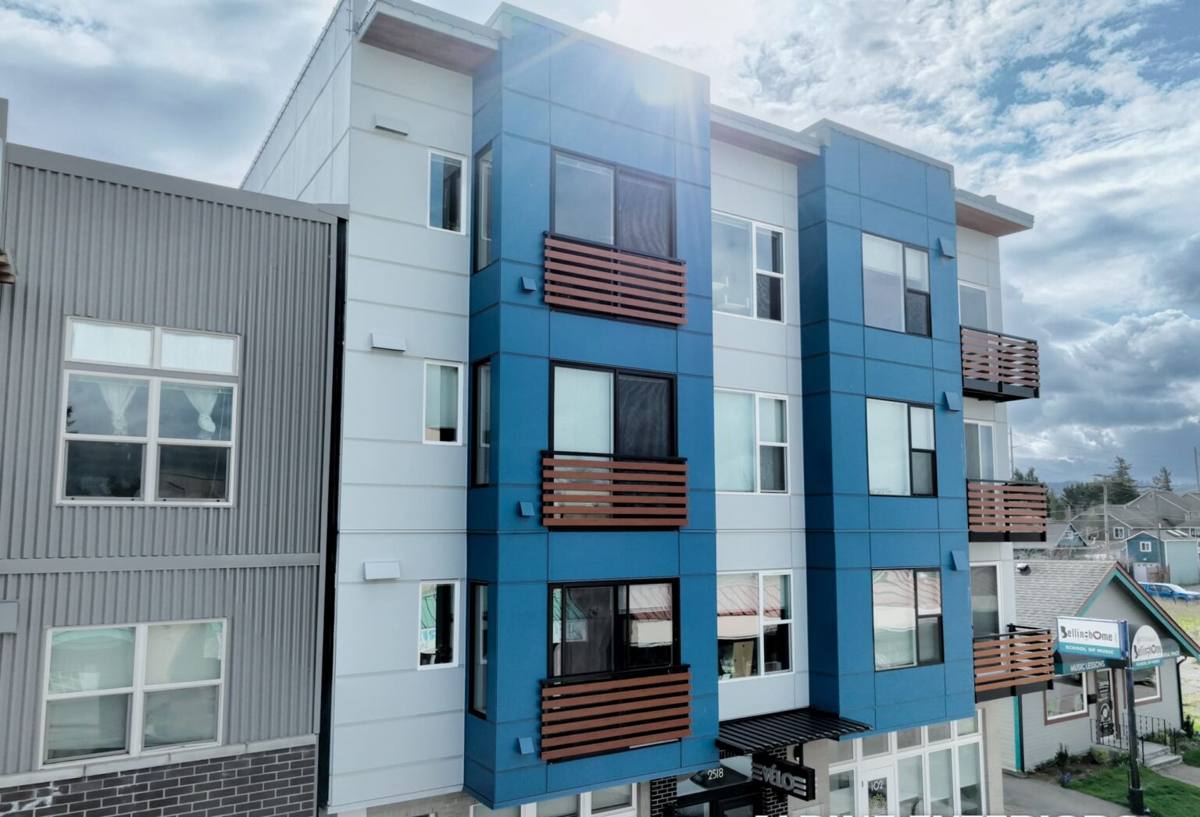
What Correct Siding Installation Actually Involves
Homeowners often assume siding installation is mostly about the visible panels — get a good-looking product, nail it up straight, done. In a salt-air, high-rain environment like Sandy Point, the parts nobody sees after the job is finished are what determine whether the siding actually performs for the next 30-plus years.
The details that matter most here
- A properly detailed weather-resistive barrier behind the siding, with seams lapped correctly so wind-driven rain can't track behind it
- Flashing at every window, door, and roof-to-wall intersection, installed so water sheds outward instead of pooling or wicking into the wall assembly
- Correct fastener spacing and type — undersized or corroding fasteners are one of the fastest ways a coastal installation fails early
- Proper clearance between the bottom of the siding and grade, decks, or roof lines, so splash-back and standing moisture don't sit against the material
- Butt joints and corners sealed and detailed to shed water, not just caulked as an afterthought
- Ventilation behind the siding so moisture that does get in has a way to dry out instead of being trapped
Skip any of these and the siding can look fine for a couple of years while the real damage builds behind it — swollen trim, soft sheathing, or paint and finish failure that shows up as bubbling, staining, or early fading, often first on the sides of the house that catch the most weather off the water.
Why We Install Only James Hardie Fiber Cement Siding
We made a decision a long time ago to install one siding system — James Hardie fiber cement — and not offer vinyl, LP SmartSide, cedar, primed spruce, or other fiber cement brands as alternatives. That's not a marketing position, it's a practical one built around what actually holds up in a place like Sandy Point.
Fiber cement is a non-combustible material made from cement, sand, and cellulose fibers, and it doesn't share the moisture-related failure points that engineered wood products can develop if a seam or cut edge is exposed to water repeatedly. Hardie's ColorPlus factory-applied finish is baked on under controlled conditions rather than field-applied, which gives it better fade and wear resistance than most site-painted siding — a real advantage on a home that's going to spend years absorbing sun, salt, and rain in roughly equal measure.
Hardie also builds its siding in engineered "HZ" product lines matched to different climate zones, so the version installed on a Whatcom County home is manufactured with the moisture and temperature conditions of the Pacific Northwest in mind, not a generic national spec. Combined with a strong transferable warranty, that gives Sandy Point homeowners a system that's engineered for exactly this kind of exposure — not a product we're asking to perform outside what it was designed for.
We're upfront that this means we won't be the contractor to call if you've already decided on vinyl or LP SmartSide. We'd rather tell you honestly why we don't install those products on homes in this environment than install something we don't believe will hold up to the water, wind, and moss season Sandy Point sees every year.
How Our Installation Process Works
1. On-site assessment
We look at the existing siding and wall assembly, note any moisture damage, soft sheathing, or failed flashing, and check how exposed each side of the house is to wind and rain off the water. Waterfront-facing and prevailing-wind walls almost always need more attention than sheltered sides.
2. Tear-off and substrate check
Old siding comes off and we inspect the sheathing underneath. Any rot or water damage gets addressed before anything new goes up — installing new siding over a compromised substrate just hides a problem instead of fixing it.
3. Weather-resistive barrier and flashing
A new water and air barrier goes on with properly lapped seams, and flashing is installed at every penetration — windows, doors, vents, and roof-to-wall transitions — so water is directed out and away from the wall assembly.
4. Hardie panel or lap installation
Siding goes up to manufacturer spec: correct fastener type and spacing, proper clearances at the bottom edge, and butt joints and corners detailed to shed water rather than trap it.
5. Trim, caulking, and final finish
Trim is installed and sealed at the joints that actually see water, not caulked everywhere as a substitute for good flashing. We walk the finished job with the homeowner before calling it done.
Siding Options Compared for a Salt-Air, High-Moisture Climate
| Material | Salt air / wind exposure | Moisture & rot resistance | Moss & algae resistance | Typical upkeep |
|---|---|---|---|---|
| James Hardie fiber cement | Non-combustible, engineered for coastal exposure | Does not rot; resists moisture-driven swelling when installed to spec | Factory finish resists staining better than field-painted wood | Occasional wash; repaint only after many years, if ever |
| Vinyl siding | Can warp or become brittle under wind and temperature swings | Water can get behind panels at seams and laps | Moss and algae can grow on the surface in shaded, damp conditions | Low, but damaged sections are hard to color-match over time |
| Cedar / primed spruce | Attractive but sensitive to sustained wet-dry cycling | Prone to rot and cupping if finish isn't maintained | Higher moss and mildew risk in shaded, damp spots | Regular refinishing needed to keep moisture out |
| LP SmartSide (engineered wood) | Performs reasonably when detailing is precise | Wood-based core is vulnerable if edges or seams are exposed to water repeatedly | Can support moss/algae growth similar to other wood-based products | Moderate; depends heavily on installation quality and touch-up |
What Affects the Cost of a Sandy Point Siding Installation
| Cost factor | Why it matters here |
|---|---|
| Home size and wall area | More square footage means more material and labor, straightforward everywhere |
| Condition of the existing wall assembly | Waterfront exposure sometimes means hidden moisture damage that needs repair before new siding goes on |
| Access and site conditions | Homes close to the water, on slopes, or with limited access can add setup and staging time |
| Trim, corners, and detail work | Homes with more windows, dormers, and roof lines require more precise flashing and cutting |
| Panel vs. lap siding and profile choice | Different Hardie profiles and finishes carry different material costs |
| Tear-off and disposal of old siding | Full removal of existing siding adds labor and disposal costs versus new construction |
We don't publish blanket per-square-foot pricing because the condition of the wall assembly and the amount of detail work varies house to house — especially on older homes near the water where hidden moisture issues aren't visible until tear-off. A walk-through gives a far more accurate number than a generic estimate.
Questions to Ask Before Hiring a Siding Crew for a Sandy Point Home
- Are you licensed, bonded, and insured to work in Washington State?
- Are your installers factory-trained or certified on the specific siding product you're installing?
- Have you worked on homes with direct wind and water exposure in this part of Whatcom County before?
- Can you walk me through your flashing and moisture-barrier details before the siding goes on, not just after?
- Is the manufacturer's warranty documented in writing, and does it transfer if I sell the home?
- What happens if you find water damage or soft sheathing once the old siding comes off?
- Do you have a written scope of work, not just a price?
A crew that's used to working near the water will have ready answers to all of these. Vague answers, especially around flashing and moisture barriers, are a sign the installer hasn't dealt with this kind of exposure before.
Living With Hardie Siding Through Whatcom County's Moss Season
Moss and algae growth on north-facing and shaded walls is a fact of life in this part of Washington, and no siding material is completely immune to it. What Hardie's ColorPlus finish does is give you a harder, more consistent surface for it to grow on and be washed off of, compared to a field-applied paint or stain finish that can absorb moisture and let growth take hold in the film itself. A periodic gentle wash — not pressure-washing at close range, which can force water behind laps and trim — is usually all that's needed to keep a Hardie exterior looking clean through the wet months. Trimming back vegetation that shades walls and keeps them damp longer than necessary also helps, on any siding material.
The bigger point is that moss on the surface is a cosmetic issue you can manage. Moisture getting behind the siding because of a poor installation is a structural one you can't easily undo without opening the wall back up. That's the distinction we build our process around.
Why a Crew That Already Works Sandy Point Matters
Every coastal neighborhood in Whatcom County has its own combination of wind exposure, shade, and rain direction, and Sandy Point's is shaped by its proximity to the water. A crew that installs siding here regularly already knows which walls typically take the worst weather, where moss tends to establish first, and how much extra attention the flashing and barrier details need on a home this close to the shoreline. That local experience shows up in the small decisions made on-site — where to add extra flashing, how tight to run clearances, which corners of the house need the most careful detailing — decisions that a generic installation crew unfamiliar with this specific stretch of coastline might not think to make.
If you're planning a siding project for a home in Sandy Point, we're happy to walk the property, look at what your current siding and wall assembly are dealing with, and put together a straightforward, honest estimate — no pressure, no obligation. Use the form below to get started.