 Blaine
 Decks in Point Roberts Take a Different Kind of Beating
Point Roberts sits on its own little peninsula off Boundary Bay, cut off from the rest of Whatcom County by water and from the rest of Washington by Canada. That geography is part of what makes it a great place to have a deck — and part of what makes building one correctly harder than it looks. Homes here sit close to open water, which means salt-laden air moving through wood fiber and metal fasteners nearly year-round. Add the long, wet Pacific Northwest fall-through-spring stretch and the shaded, moisture-holding conditions that let moss take over anything that isn't sloped or ventilated properly, and you've got a climate that's genuinely tough on outdoor structures.
A deck built the same way you'd build one in a dry inland town doesn't hold up the same way out here. We've worked on siding and exterior projects across Blaine and the surrounding Whatcom County coastline long enough to know which shortcuts show up as callbacks two winters later — and composite decking, done right, is one of the more reliable answers for this specific environment.
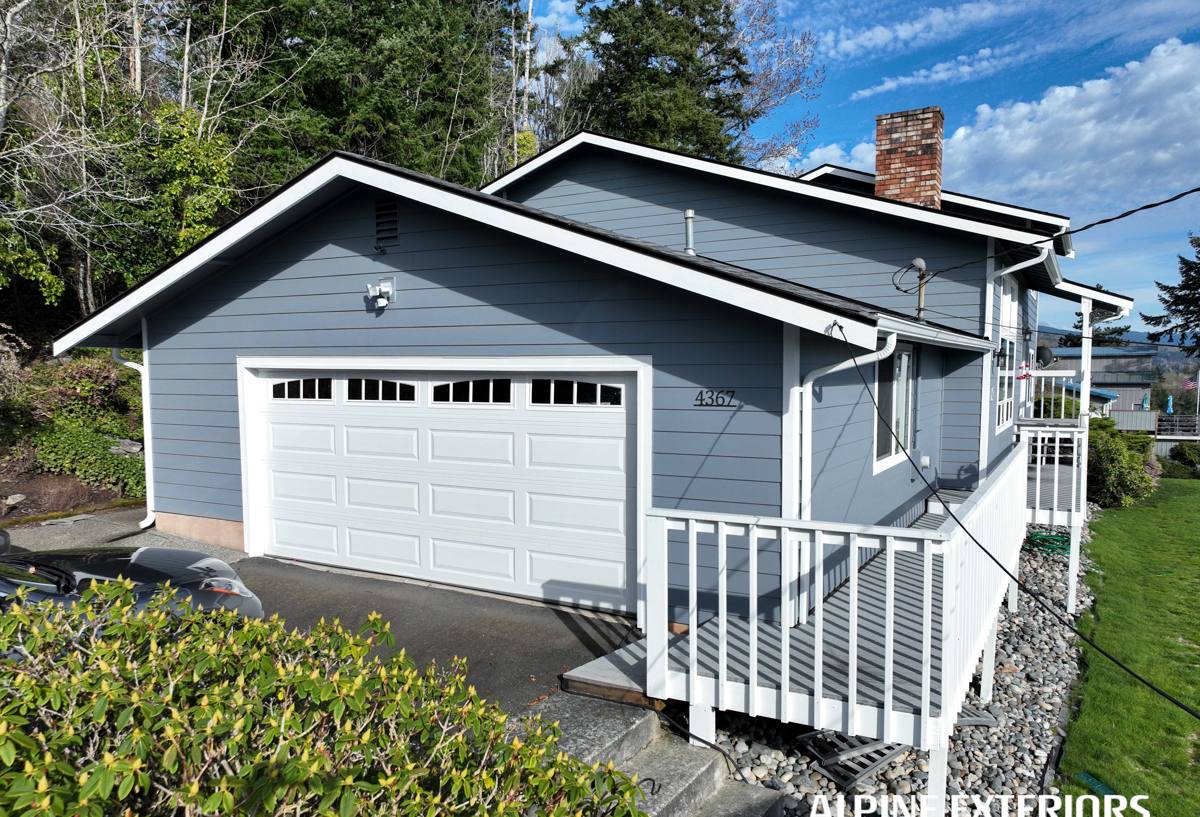
What Salt Air, Rain, and Moss Actually Do to a Deck
It's worth understanding the failure modes before talking about the fix, because they explain every decision in how we build.
Salt Air and Metal
Airborne salt accelerates corrosion on anything metal — screws, joist hangers, flashing, railing hardware. Standard galvanized fasteners that would last decades inland can start showing rust streaks and weakening within a handful of years this close to Boundary Bay. Once a fastener corrodes, it loses grip strength, and that's how boards start to work loose or squeak.
Driving Rain and Trapped Moisture
Storms coming off the water don't fall straight down — wind-driven rain gets pushed sideways into ledger boards, under railing posts, and into any gap that isn't properly flashed or sealed. Water that gets in and can't get back out is worse than water that never gets in at all, because it sits against wood framing and fasteners and does slow, hidden damage.
Moss and Shade
Point Roberts has plenty of tree cover and a marine climate that keeps surfaces damp for long stretches. Moss and algae need moisture, organic debris, and reduced airflow — exactly what a poorly ventilated, unsloped deck surface provides. Beyond looking bad, a mossy deck surface gets slick and holds moisture against the boards even longer, compounding the problem.
Why Composite Decking Fits This Climate
Wood decking isn't a bad product, but it asks a lot of a homeowner in this environment: annual or biannual staining/sealing, close monitoring for rot at fastener points and ledger connections, and more frequent replacement of individual boards that fail early. In a salt-air, high-moisture climate, that maintenance burden goes up, not down.
Modern capped composite decking — the kind with a protective polymer shell wrapped around a wood-fiber/plastic core — doesn't absorb water the way real wood does, doesn't need staining, and resists the surface mold and moss growth that plagues shaded, damp wood decks. That doesn't mean it's maintenance-free or immune to the climate; it still needs airflow underneath, correct fastening, and periodic cleaning. But it removes the biggest long-term liability of a coastal wood deck: slow moisture absorption into an organic material that eventually rots from the inside out.
We're upfront that composite isn't automatically the right call for every home or every budget — it costs more up front than pressure-treated lumber, and it has its own installation sensitivities (expansion gaps, fastener spacing, substructure requirements) that matter more with composite than with wood. We'll walk through the honest trade-offs for your specific deck rather than push one product as a cure-all.
What a Correctly Built Composite Deck Actually Involves
The board itself is only part of the job. Most composite deck problems we get called to fix started in the framing and flashing, not the decking material.
- Ledger flashing: Where the deck attaches to the house, proper flashing keeps wind-driven rain from working behind the siding and into the wall framing — a common failure point in coastal storms.
- Joist protection: We tape or cap joists so fasteners driving through composite decking into the framing don't create a moisture entry point at every screw hole.
- Ventilation underneath: Composite decking still needs airflow beneath the boards. Decks built low to grade or over enclosed skirting without vents trap moisture and invite moss and mildew on the underside.
- Correct fastener spacing and expansion gaps: Composite boards expand and contract with temperature more than people expect. Gaps that are too tight buckle in warm weather; gaps that are too wide look sloppy and catch debris.
- Hidden fastener systems: Most quality composite lines are designed for hidden clip systems rather than face-screwing, which both looks cleaner and avoids creating hundreds of exposed metal-to-composite penetration points for salt air to work on.
- Stainless or coated hardware at the coast: Given the salt exposure this close to Boundary Bay, we spec corrosion-resistant fasteners and structural hardware rather than standard galvanized where it matters most — ledger bolts, joist hangers, and post bases.
Composite vs. Wood vs. PVC: The Honest Comparison for This Climate
| Factor | Pressure-Treated Wood | Capped Composite | Full PVC |
|---|---|---|---|
| Moisture/rot resistance | Moderate — needs sealing to hold up to salt air and rain | High — capped shell resists absorption | Very high — no wood fiber content |
| Moss/algae resistance on surface | Low without regular cleaning and sealing | Good, especially with a textured cap | Good |
| Maintenance | Annual/biannual staining or sealing | Periodic washing, no staining | Periodic washing, no staining |
| Upfront cost | Lowest | Mid-to-high | Highest |
| Feel underfoot in cool, damp weather | Natural, but can feel rough or splintery over time | Solid, consistent | Can feel more plastic-like |
| Long-term coastal durability | Depends heavily on upkeep discipline | Strong if installed with proper ventilation | Strong, less prone to fading in UV/salt combo |
For most Point Roberts homeowners, capped composite lands in the sweet spot: meaningfully lower maintenance than wood in this climate, without the top-end cost of full PVC systems. We'll go over specific board lines and warranty structures during your estimate based on your budget and how you use the space.
How We Approach a Point Roberts Project
Because Point Roberts is only reachable by road through Canada, materials, crew scheduling, and site logistics take more planning than a job five minutes from our shop in Blaine. We account for that up front rather than discovering it mid-project.
- On-site assessment: We look at existing framing condition, ledger attachment, grade and drainage under the deck footprint, sun/shade exposure, and how exposed the site is to prevailing wind and rain off the water.
- Material and layout plan: We size the job, confirm board selection, fastener system, and railing needs, and account for permitting requirements through Whatcom County since Point Roberts is unincorporated county jurisdiction.
- Scheduling around logistics: Material deliveries and crew trips are planned as consolidated visits rather than piecemeal trips, which keeps the job moving efficiently despite the border crossing.
- Build: Framing and flashing first, then substructure ventilation, then decking installation with correct gapping and hidden fasteners, then railings and finish details.
- Walkthrough: We go over the finished deck with you, including what routine care looks like and what to watch for given your specific site conditions.
Living With a Composite Deck in a Salt-Air, Moss-Prone Climate
Composite decking cuts down maintenance significantly, but "low-maintenance" isn't "no-maintenance," especially this close to the water. A little routine care goes a long way toward keeping it looking and performing well for decades.
- Rinse or sweep off organic debris (leaves, needles, seed pods) regularly — trapped debris is what feeds moss and algae growth, not the composite material itself.
- Wash the surface a couple of times a year with mild soap and water or a manufacturer-approved deck cleaner, especially in shaded areas that stay damp longer.
- Keep gutters and downspouts near the deck clear so runoff isn't dumping extra water onto or under the deck surface.
- Check railing posts and ledger connections annually for any early rust bleed on hardware, particularly after winter storm season.
- Keep skirting vents clear of debris and vegetation so air can keep moving underneath the deck.
- Avoid pressure-washing at high pressure directly into board seams — it can drive water into the substructure and damage the cap surface.
Why Local Experience in Point Roberts Matters
A crew that's never worked in an exclave community can underestimate how much site access, material delivery, and permitting timelines matter to the actual schedule of the job. We've worked exterior projects throughout Blaine and the Point Roberts area, so we plan around the border crossing, the county permitting process, and the specific wind and moisture exposure of waterfront and near-waterfront lots — rather than treating it like any other job and running into delays or surprises partway through.
We also know what climate-driven deck failures actually look like around here, because we've replaced flashing, refastened loose railings, and torn out moss-damaged wood decking on homes throughout this region. That experience shapes how we frame, flash, and fasten every deck we build, not just the board brand we install.
If you're weighing a new composite deck or replacing an aging wood one in Point Roberts, we're happy to walk the site with you and give you a straight assessment — no pressure, no upsell, just what your home actually needs. Use the form below to request a free estimate.