 Blaine
 Peace Arch Homes Face a Tougher Climate Than Most of Whatcom County
Homes near the Peace Arch border crossing sit in one of the more punishing microclimates in Blaine. You're close enough to Semiahmoo Bay and Drayton Harbor to pick up salt-laden air off the water, exposed to the wind-driven rain that rolls in off the Strait of Georgia, and shaded by mature evergreens that keep siding damp long after a storm passes. That combination doesn't just mean more frequent cleaning — it means the siding itself works harder, and it fails differently than siding on a dry, sun-exposed lot inland.
Siding repair in this neighborhood isn't a one-size-fits-all job. A patch that would hold up fine in a drier part of Whatcom County can fail here within a season if it doesn't account for how water actually moves across and behind the cladding in a salt-air, high-rainfall environment. That's the lens we bring to every repair call in this area.
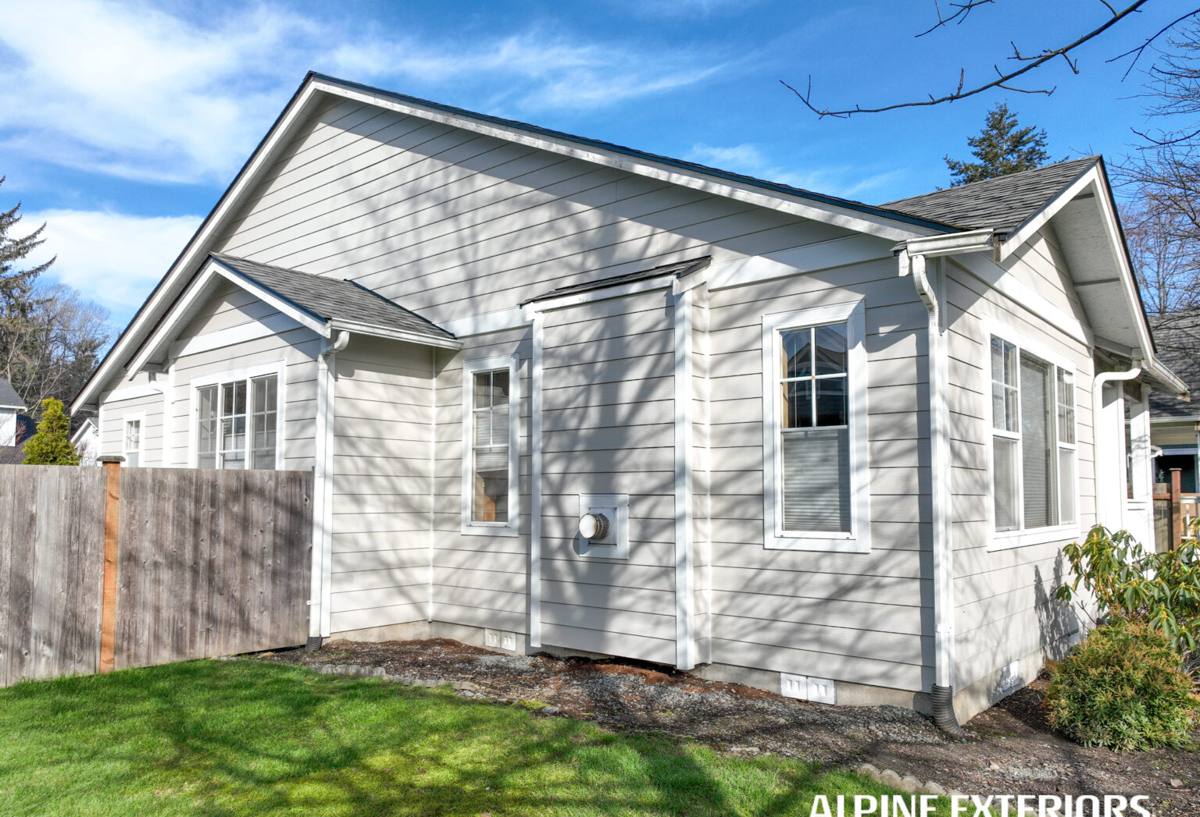
What Salt Air, Driving Rain, and Moss Actually Do to Siding
Salt Air
Airborne salt is corrosive to exposed fasteners, flashing, and trim before it ever becomes a visible problem in the siding itself. Once a nail head or a piece of unprotected metal trim starts corroding, it creates a weak point — a rust stain bleeding through paint, a loosened fastener that lets a panel flex, or a gap that lets water behind the cladding. Salt exposure is cumulative and constant on a property this close to the water, which is why fastener and flashing condition matters as much as the siding material itself.
Driving Rain
Wind-driven rain doesn't just fall on siding — it gets pushed sideways and upward, forcing water into laps, seams, and butt joints that would stay dry in calmer weather. Over time this finds any gap in caulking, any undersized flashing, or any panel installed with too little clearance from trim, and pushes moisture behind the siding where it can rot sheathing or framing long before the surface looks bad.
A Long Moss Season
Between the marine humidity and heavy tree cover common around Peace Arch, moss and algae can hold moisture against siding for months at a time rather than drying out between rains. That constant dampness is what turns a cosmetic staining issue into a structural one — trapped moisture behind moss-covered siding is what eventually leads to soft spots, delaminating trim, and paint failure.
Signs Your Siding Needs Repair, Not Just a Cleaning
Not every stained or dirty section of siding needs repair — but some symptoms point to a real problem underneath. Homeowners in this area should watch for:
- Soft, spongy, or bouncy spots when you press on the siding, especially near the bottom courses or under windows
- Visible gaps or separation at butt joints and corners where caulking has failed
- Rust streaks running down from fastener heads or metal trim
- Persistent moss or algae growth that comes back within weeks of cleaning
- Paint that's peeling, bubbling, or flaking in a localized patch rather than evenly across the whole wall
- Visible warping, cracking, or a section that looks different in color or texture from the rest of the wall
- Interior signs — a musty smell, a damp patch on drywall, or peeling interior paint on an exterior wall
Any one of these is worth a professional look. Several of them together usually mean water has already gotten behind the siding, not just onto it.
Repair vs. Replacement: How We Actually Decide
The right call depends on how far the damage extends, not just how it looks from the ground. We use moisture readings and a physical inspection of the sheathing behind the siding — not guesswork — to make this call.
| Situation | Typical Approach | Why |
|---|---|---|
| Localized impact damage or a cracked panel, dry sheathing behind it | Spot repair — remove and replace the affected panel(s) | Isolated damage with no hidden moisture doesn't require touching healthy siding |
| Recurring moss/algae staining with sound material underneath | Deep clean, repair failed caulking and flashing, monitor | Surface growth alone isn't a structural problem if moisture hasn't penetrated |
| Soft or delaminated siding in multiple spots along one elevation | Section replacement of that wall face | Damage clustered along a wall usually points to a shared flashing or drainage flaw, not isolated bad luck |
| Wet or damaged sheathing found behind the siding | Open the wall, dry and repair sheathing, then re-side that section | Covering wet framing with new siding just hides the problem and lets rot continue |
| Widespread failure across most elevations, siding at or past its service life | Full replacement | Repeated spot repairs on aging, failing siding rarely outlast a full re-side |
What a Correct Siding Repair Actually Involves
Diagnosis Before Demo
Before we remove anything, we check moisture levels at and around the damaged area, look at how the flashing and water table are performing, and identify whether the cause is a material failure, an installation flaw, or ongoing exposure that will damage a repair the same way it damaged the original siding. Fixing the symptom without addressing the cause just means doing the same repair again in a few years.
Matching Material and Reveal
A repair that's structurally sound but visually obvious — different panel width, mismatched reveal, or a butt joint in the wrong place — isn't a finished job. We match the existing panel profile, plank width, and exposure so the repaired section reads as part of the wall, not a patch on it.
Flashing and Fastening, Not Just Caulk
Caulk is a maintenance item, not a repair strategy on its own. Where we're removing siding to make a repair, we correct the underlying flashing, kick-out flashing at roof-wall intersections, and fastener placement so the repaired section handles wind-driven rain the way it was designed to, not just the way it happened to be built the first time.
Color and Finish
On factory-finished siding, matching color isn't guesswork — we work from the manufacturer's finish system rather than mixing field paint, which is the only way to get a repair that won't visibly fade or shift tone differently than the surrounding siding over the next few years.
Why We Only Repair and Install James Hardie Fiber Cement
We standardized on James Hardie fiber cement for every home we work on, including repairs, because it behaves predictably in exactly the conditions Peace Arch homes deal with. It's non-combustible, doesn't absorb and swell with moisture the way wood-based products can, and its ColorPlus factory finish holds up to UV and salt exposure better than field-applied paint. That matters for repair work specifically: when we're matching new material into an existing wall, Hardie's engineered consistency means the repaired section performs the same way the original did, not a slightly different material aging on a slightly different curve next to it.
We don't install or repair-match vinyl, LP SmartSide, primed spruce, or cedar as part of our standard work. Those products aren't necessarily bad choices in every climate, but in a salt-air, high-moisture environment like this one, they carry maintenance and moisture risks we're not willing to build a repair around. If your home currently has one of those materials, we'll still assess and advise honestly — but our repair recommendation will reflect what we've seen hold up here, not just what's already on the wall.
Our Repair Process for Peace Arch Homes
- Inspection and moisture check: We assess the visible damage and take moisture readings at the siding and, where accessible, the sheathing behind it.
- Honest scope: We tell you plainly whether this is a spot repair, a section replacement, or a sign of a larger issue — and why.
- Root cause fix: We correct the flashing, caulking, or drainage issue that caused the damage, not just the cosmetic symptom.
- Material and color match: We source matching Hardie panel or plank profiles and factory finish so the repair blends in.
- Follow-up guidance: We tell you what to watch for given your specific exposure — tree cover, wind direction, proximity to the water — so small issues get caught early next time.
Why a Crew That Already Works This Area Matters
Repair work near the border crossing has a few practical wrinkles that a contractor unfamiliar with Blaine won't necessarily anticipate — permitting through the City of Blaine or Whatcom County depending on your parcel, scheduling around the weather windows that actually allow siding work to cure and seal properly in a marine climate, and simply knowing which exposures in this specific area tend to fail first. A crew that's already done repair work on Peace Arch homes isn't guessing at how salt air and driving rain interact with a particular wall assembly — they've seen it.
There's also a response-time advantage. Storm damage and moisture intrusion don't wait for a convenient appointment slot, and a local crew can typically get eyes on a damaged section faster than one traveling in from farther south in the county.
What Affects the Cost of a Siding Repair
| Factor | Why It Matters |
|---|---|
| Extent of hidden moisture damage | Repairs that require opening the wall and drying or replacing sheathing cost more than surface-level panel swaps |
| Number and location of affected panels | Repairs high on a wall or near rooflines require more access work than ground-level sections |
| Color and profile matching | Older or discontinued color/profile combinations may take longer to source |
| Flashing and trim condition | Corroded or undersized flashing found during the repair adds scope but prevents a repeat failure |
| Accessibility | Landscaping, grade, or tree cover around the repair area can affect labor time |
We won't quote a repair without seeing it — anyone who does is guessing, and guessing is how you end up paying for the same repair twice.
If you're seeing soft spots, persistent moss, or staining on your Peace Arch home's siding, we're happy to take a look and give you a straight answer about what it actually needs. Reach out for a free, no-pressure estimate using the form below.