 Blaine
 Roofing for Peace Arch's Specific Weather, Not Generic "Pacific Northwest" Weather
Peace Arch sits close enough to Semiahmoo Bay and the Strait of Georgia that homes here deal with a combination most inland Whatcom County roofs never see: salt-laden air off the water, wind-driven rain that hits shingles sideways instead of straight down, and a moss season that can run eight or nine months out of the year in shaded, north-facing sections of a roof. Any one of those on its own is manageable with a standard asphalt shingle install. All three together is what actually wears out a roof early in this neighborhood, and it's why we don't treat a Peace Arch job the same way we'd treat a roof twenty minutes inland in Lynden or Everson.
Salt air accelerates corrosion on exposed metal — nail heads, flashing, vent hoods, gutter hardware. Driving rain finds every gap in a lap that would be fine in calm weather, which means fastener pattern and underlayment lap direction matter more here than the shingle brand does. And moss doesn't just sit on top of shingles looking bad — it holds moisture against the granule surface and lifts shingle edges over time, which is where leaks actually start. A roof built for "Blaine, WA" in general and a roof built for a shaded, salt-exposed Peace Arch lot are not quite the same job.
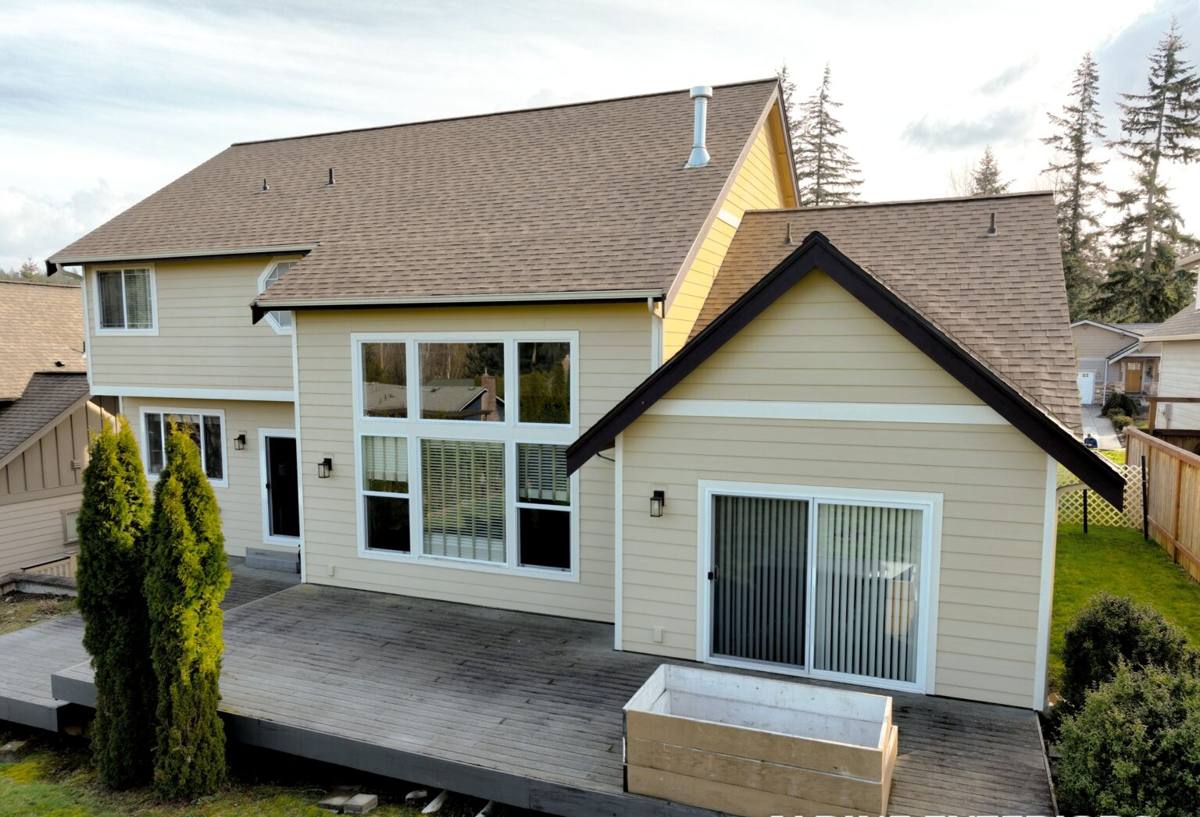
What a Correct Asphalt Shingle Job Looks Like Here
Asphalt shingle roofing is a system, not a single product. The shingle is the most visible part, but the layers underneath it are what determine whether the roof still performs in year twelve the way it did in year one. For Peace Arch specifically, we treat these as non-negotiable:
- Ice-and-water shield at eaves, valleys, and around penetrations — not just at the eave line, but anywhere wind-driven rain can push water uphill under a shingle lap.
- Synthetic underlayment across the full deck, lapped correctly for our prevailing weather direction off the water, not just laid by habit.
- Corrosion-resistant fasteners and flashing — salt air chews through standard galvanized hardware faster than inland homeowners expect, so we spec accordingly.
- Balanced attic ventilation (intake at the soffit, exhaust at the ridge) so moisture from inside the house doesn't condense against the underside of the deck and rot it from below — a slow, hidden failure mode that has nothing to do with the shingle itself.
- Proper nailing pattern and exposure per the manufacturer's wind rating, which matters more here than on a sheltered inland lot.
Skip any one of these and the shingle warranty on paper stops matching what actually happens on the roof. This is the single biggest gap we see when we're called out to look at a roof that failed early — the shingle itself was fine, but something underneath it wasn't done to spec.
Ventilation Deserves Its Own Mention
We bring this up separately because it's the most commonly skipped part of a re-roof, and in a moss-prone, humid coastal microclimate like Peace Arch, poor ventilation is what turns a normal roof lifespan into a shortened one. A hot, damp attic accelerates shingle aging from underneath, and it's invisible until you're dealing with soft decking or premature granule loss. We check intake and exhaust balance on every estimate, not just on full replacements.
Shingle Choices That Actually Hold Up to Salt Air and Moss
Not every asphalt shingle line is built the same way, and the differences matter more here than in a dry inland climate. We favor architectural (laminate) shingles with algae-resistant (AR) granules for anything near the water in Blaine — the copper- or zinc-infused granules slow algae and moss colonization on the shaded slopes that never fully dry out between rains.
| Option | Where It Fits in Peace Arch | Trade-off to Know |
|---|---|---|
| 3-tab asphalt shingle | Budget-conscious re-roofs, secondary structures, sheds | Lower wind rating and shorter algae resistance; not our first recommendation this close to open water |
| Architectural (laminate) shingle, standard | Most Peace Arch homes — good balance of cost and durability | Needs AR granule option specified, or moss/algae staining shows up faster on shaded slopes |
| Architectural shingle with algae-resistant granules | North-facing roofs, tree-shaded lots, anything within a few blocks of the water | Slightly higher material cost, but the maintenance savings usually justify it here |
| Impact-rated / high-wind-rated shingle | Exposed lots with a clear line to the water and prevailing wind | Premium product cost; worth it on lots with a real wind exposure history |
We're honest with homeowners about the trade-off: AR granules and higher wind ratings cost more up front. On a sheltered, inland lot we might not push for them. On a Peace Arch roof facing the water or shaded most of the day, we usually do, because the alternative is a homeowner paying for moss treatment and premature granule loss a few years down the road.
Our Process for a Peace Arch Roof
- On-site inspection — we look at slope exposure, existing ventilation, deck condition, and how close the lot sits to the water and tree cover, since that drives the moss and salt exposure risk.
- Written estimate — shingle line, underlayment spec, flashing and fastener hardware, and ventilation plan spelled out, not just a square-footage number.
- Tear-off and deck check — we don't shingle over a deck we haven't actually looked at. Soft or rotted sheathing gets flagged and priced separately before we cover it up.
- Underlayment and flashing install — full ice-and-water at vulnerable areas, synthetic underlayment across the field, new flashing at valleys, chimneys, and penetrations.
- Shingle installation — correct exposure and nailing pattern for the manufacturer's wind rating, matched to what the lot actually needs.
- Ventilation check and correction — intake and exhaust balanced, not just left as-is from the old roof.
- Final walkthrough — we show you what was done and why, before we consider the job finished.
Moss and Algae: Prevention Beats Cleanup
Moss doesn't appear overnight, and by the time it's visible from the ground it's usually already lifting shingle edges in shaded spots. A few habits go a long way toward protecting the investment in a new roof, or extending the life of an existing one:
- Keep overhanging branches trimmed back so shaded slopes get more light and airflow.
- Clear gutters and valleys before the fall rains — standing debris holds moisture right where shingles are most vulnerable.
- Have moss physically removed (not just chemically treated) on a schedule if a slope stays shaded most of the year.
- Ask about zinc or copper strips at the ridge on shaded roofs — they release trace metal ions with rainfall that slow regrowth over time.
- Don't power-wash asphalt shingles — it strips granules and shortens the roof's life faster than the moss would on its own.
Why a Crew That Already Works Peace Arch Matters
Roofing crews that mostly work drier, inland jobs sometimes bring inland habits with them — standard underlayment lap, standard fastener hardware, ventilation as an afterthought. None of that is negligence, it's just what works fine where they usually work. It's not what a lot facing Semiahmoo Bay actually needs. A crew that regularly works Blaine and the Peace Arch area already knows which slopes on a given lot type stay shaded longest, where wind-driven rain typically causes problems, and which hardware actually holds up to years of salt air instead of corroding early. That local pattern recognition is the difference between a roof that's technically installed to code and one that's actually built for the specific conditions the property sees.
What Drives Cost on a Peace Arch Roof
| Factor | Why It Matters Here |
|---|---|
| Roof size and pitch | Standard cost driver everywhere, but steeper pitches near the water also see more wind-driven rain exposure |
| Shingle line and AR granules | Algae-resistant options cost more upfront but reduce moss-related maintenance and callbacks |
| Deck condition | Salt air and long-term moss moisture can hide rot that only shows up once the old roof is off |
| Ventilation upgrades | Adding or correcting intake/exhaust adds cost but protects the deck and shingle from below |
| Flashing and fastener hardware | Corrosion-resistant hardware costs more than standard galvanized but lasts far longer this close to the water |
| Access and tear-off complexity | Tree cover, multiple layers of old roofing, or tight lot access all add labor time |
We give straightforward ranges during the on-site estimate rather than a phone quote — deck condition alone can shift a number meaningfully once we're actually up there.
Warranty and Manufacturer Considerations
Most quality asphalt shingle lines carry manufacturer warranties that assume a correctly installed system — proper underlayment, ventilation, and fastening. If any of that isn't done to spec, a manufacturer can deny a claim even if the shingle itself is the part that's visibly failing. We install to the manufacturer's documented requirements specifically so that warranty coverage stays intact, and we walk homeowners through what's covered and what isn't before the job starts, not after something goes wrong.
Ready for a No-Pressure Look at Your Roof
If you're in Peace Arch and dealing with moss buildup, granule loss, or just want a straight answer on how much roof life you've got left, we're happy to take a look. The estimate is free, there's no pressure to commit on the spot, and you'll get a written breakdown of what your roof actually needs — use the form below to get started.