 Blaine
 Why Nooksack-Area Siding Wears Differently
Homes in and around Nooksack don't fail the same way siding fails in a dry climate. Whatcom County sits at the intersection of three things that are individually manageable but brutal in combination: wind-driven rain off the Sound, a moss season that can run from late fall through spring, and enough salt-tinged coastal air moving inland from the Blaine shoreline to accelerate corrosion on fasteners and trim. None of those alone destroys siding overnight. Stacked together, year after year, they find every weak seam, every under-caulked joint, and every spot where water can get behind the cladding and stay there.
That's the context we bring to every repair call in this area. A crack or soft spot that might sit harmless for a decade in a drier region can turn into hidden sheathing rot here in two or three wet seasons if it's ignored. Repair work in Nooksack isn't just about matching a board — it's about understanding how water moves through a wall assembly in this specific climate and stopping it before it does more damage than what's visible on the surface.
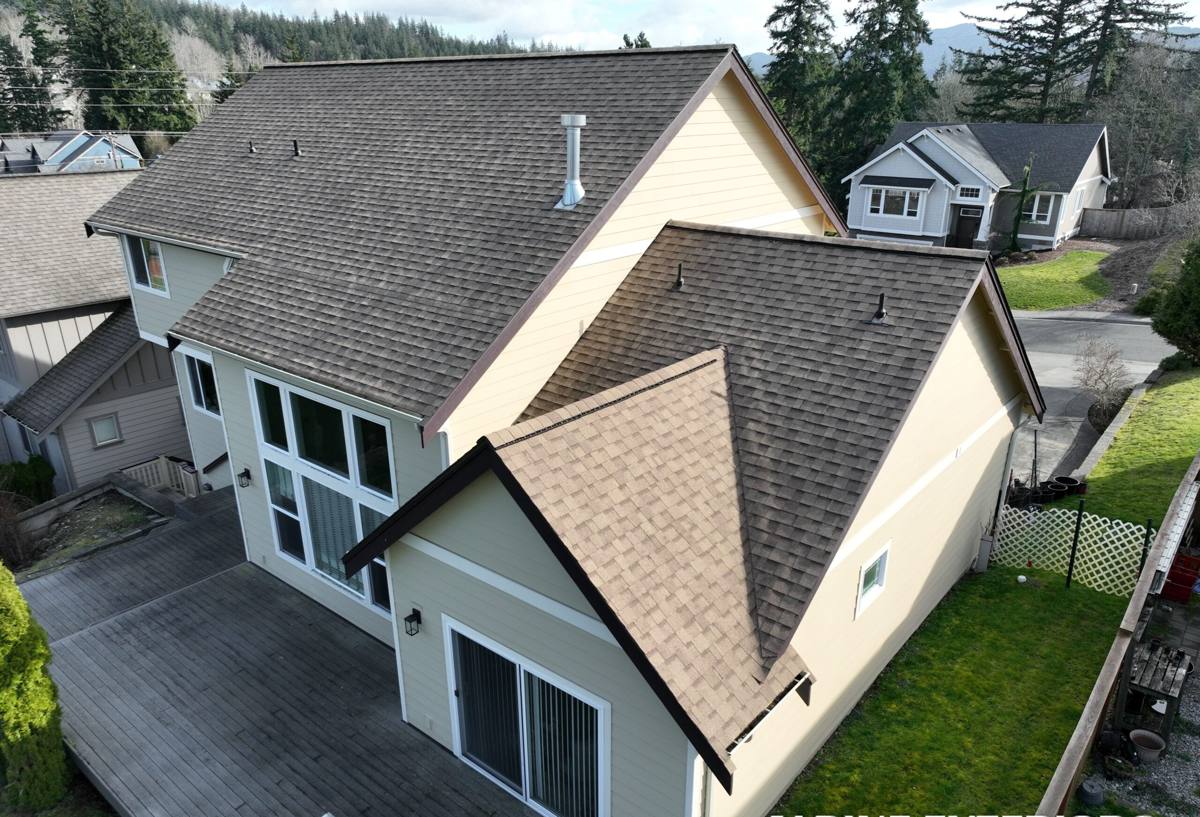
Signs Your Siding Needs Repair, Not Just a Wash
A lot of homeowners reach for a pressure washer or a moss treatment when the real problem is underneath the surface. Before you spend a weekend cleaning, look for these signs that point to actual siding damage rather than surface grime:
- Soft, spongy, or springy spots when you press on a board — usually rot underneath
- Paint or finish bubbling, peeling, or flaking in a localized area rather than evenly across the wall
- Dark staining or streaking below a seam, nail head, or trim joint
- Visible cracks, splits, or gaps at butt joints and corner trim
- Moss or algae that regrows within weeks of cleaning, especially on north- or west-facing walls
- Warping, bowing, or boards that no longer sit flush against the wall
- A musty smell near an exterior wall inside the home, which often means moisture has already reached the interior side of the sheathing
Any one of these on its own might be minor. Several together, or any sign near a window, door, or roofline transition, usually means water has already found a way in and the repair needs to address the cause, not just the symptom.
What a Correct Repair Actually Involves
It starts behind the siding, not at it
Patching the visible damage and calling it done is how the same repair ends up back on the schedule two years later. A repair done right starts with pulling the damaged section back far enough to see what's behind it — the house wrap or building paper, the sheathing, and the flashing at any nearby window, door, or roof line. If that layer is compromised, replacing the siding without addressing it just seals the moisture problem back up.
Matching profile, reveal, and fastening pattern
Siding repair only looks right if the replacement piece matches the existing course spacing, reveal, and butt joint pattern. That means correctly identifying the plank width and profile already on the house, cutting and fitting it to match the surrounding courses, and fastening it per the manufacturer's nailing schedule — not just wherever it happens to line up.
Flashing and sealant, done in the right order
Kickout flashing at roof-to-wall intersections, proper head flashing above windows and doors, and correctly lapped house wrap all matter more here than in a drier climate, because Whatcom County's rain volume gives water more chances to test every gap. Sealant has its place, but it's a finishing step — not a substitute for flashing that's installed and lapped correctly.
Repair or Replace: How We Make the Call
Not every damaged section needs a full re-side, and not every repair is worth doing on its own. We look at the extent of the damage, how much of the wall is affected, and what's driving the problem before recommending either path.
| Factor | Repair Usually Makes Sense | Replacement Usually Makes Sense |
|---|---|---|
| Extent of damage | Isolated to one or two boards or a single wall section | Recurring problems across multiple walls or elevations |
| Underlying sheathing | Sound, dry, no rot found on inspection | Soft, delaminated, or rotted sheathing found behind siding |
| Age of existing siding | Siding is younger and otherwise in good condition | Siding is near or past its expected service life |
| Material on the wall now | Original material is still available or closely matchable | Discontinued profile, color, or material that can't be matched |
| Root cause | A single identifiable failure point (flashing, caulk, impact damage) | Systemic moisture intrusion or widespread moss/algae damage |
When repair is the right call, we do it properly and stand behind it. When the damage points to a bigger underlying problem, we'll tell you that plainly rather than patching over something that's going to resurface.
Why the Material Behind the Repair Matters
What we can offer for a repair depends partly on what's already on the house. If a home has vinyl, LP-style engineered wood, or an older primed wood siding, we can still assess and repair it — but matching an aging, weathered, or discontinued product exactly is sometimes not possible, and that's worth knowing before work starts rather than after.
This is also why, when a wall section or an entire elevation is far enough gone that repair no longer makes sense, our recommendation is James Hardie fiber cement rather than a like-for-like replacement in the original material. It's the only siding we install as a company. Hardie's HZ5 product line is engineered for climates like ours — non-combustible, dimensionally stable in high-moisture conditions, and finished with a factory-applied ColorPlus coating that holds up to sustained damp weather better than field-applied paint. It also carries a strong transferable warranty, which matters on a wall that's already shown one moisture problem. We're not going to pretend every square foot of a home needs to become Hardie the day one board rots — but when a section is being replaced anyway, it's what we'd put on our own homes here.
Our Repair Process, Step by Step
- On-site inspection — we look at the visible damage plus surrounding areas that tend to fail together (adjacent corners, trim, flashing points)
- Diagnosis — pulling back enough material to confirm what's causing the damage, not just what it looks like from the driveway
- Scope and estimate — a clear explanation of what needs to happen, why, and what it will cost, in writing before any work starts
- Repair or targeted replacement — matched material, correct flashing and fastening, proper sealant application
- Cleanup and walkthrough — we don't leave debris behind, and we walk the repair with you before calling it finished
Common Trouble Spots in Nooksack's Microclimate
Certain parts of a house fail more often than others here, and knowing where to look speeds up both inspection and repair:
North- and shade-facing walls
Walls that don't get direct sun stay damp longer after rain, which is exactly what moss and algae need to establish. Left untreated, sustained moss growth holds moisture against the siding surface far longer than an open, sun-exposed wall would ever experience.
Ground-level boards
Splashback from downspouts, grade that slopes toward the foundation, and vegetation planted too close to the wall all keep the lowest courses of siding wetter than the rest of the house — a common source of rot we find at the bottom of a wall long before it's visible higher up.
Fasteners and trim closer to the shoreline
Homes nearer the water and the salt air moving off Blaine's coastline see faster corrosion on exposed fasteners and metal trim than homes farther inland. Corroded fasteners eventually lose their grip, and that's often the actual cause behind a board that looks like it's "just warped."
Why a Crew That Already Works Nooksack Matters
Siding repair isn't a generic skill applied the same way everywhere. A crew that regularly works the Nooksack and greater Blaine area already knows which wall orientations tend to fail first, how much rain exposure to expect from a given roofline, and what moss growth actually looks like when it's become a moisture problem rather than a cosmetic one. That local pattern recognition is the difference between a repair that treats a symptom and one that fixes the reason the damage happened in the first place. It also means faster response — we're not driving in from out of the area to look at a soft spot that's already spread.
Keeping a Repair From Becoming a Repeat Repair
A good repair should be the last time you deal with that section of wall for years. A few habits make that more likely in this climate:
- Keep gutters and downspouts clear so water isn't overflowing onto the wall below
- Trim back vegetation and shrubs so air can circulate and walls can dry between storms
- Address moss regrowth early rather than letting it establish for a full season
- Walk the exterior once a year, especially after the wet season, checking caulk lines and trim joints
- Have any new staining or soft spots checked promptly rather than waiting to see if it spreads
If you're seeing damage on your siding or just want a second opinion on a spot that doesn't look right, we're glad to come take a look. The estimate is free, there's no pressure, and you'll get a straight answer about whether it's a repair or something bigger.