 Blaine
 Roofing Built for the Sumas Climate, Not a Generic One
Sumas sits in a corner of Whatcom County where the weather doesn't do a homeowner any favors. Winters bring long stretches of steady rain broken up by wind events that drive water sideways into places a roof was never designed to shed it. Shaded lots and tree cover mean moss gets a foothold fast and doesn't let go on its own. Add in the freeze-thaw swings that show up most winters, and you've got a climate that will find every weak point in a roofing system over time, not just the obvious ones.
A roof that works well in a drier inland climate or a mild coastal one somewhere else in the country often isn't the right fit here. What holds up in Whatcom County is a system chosen and installed with this specific mix of rain, moss, and temperature cycling in mind — not just a product picked off a brochure.
Moss and Moisture
Moss isn't just cosmetic. Once it establishes on a roof, it holds moisture against the shingle or shake surface long after the rest of the roof has dried out. That constant dampness accelerates granule loss on asphalt shingles, promotes rot on wood-based roofing, and can work its way under tabs and flashing over several seasons. In a region with a moss season that runs most of the year, how a roof is designed to shed water and resist growth matters as much as the material itself.
Wind-Driven Rain
Rain that falls straight down is easy to manage. Rain that's pushed sideways by wind is a different problem — it tests every seam, every flashing detail, and every fastener pattern on the roof. This is where a lot of roofs that look fine from the ground actually fail first: not through the field of the roof, but at valleys, penetrations, and edges where wind-driven water finds a way in.
Temperature Swings
Freeze-thaw cycles cause materials to expand and contract. Over years, that movement can loosen fasteners, stress sealants, and open small gaps that let water in. It's rarely dramatic in any single season, but it adds up, which is part of why roofs in this region need to be installed with a bit more margin for movement than a roof going on a house somewhere with a more stable climate.
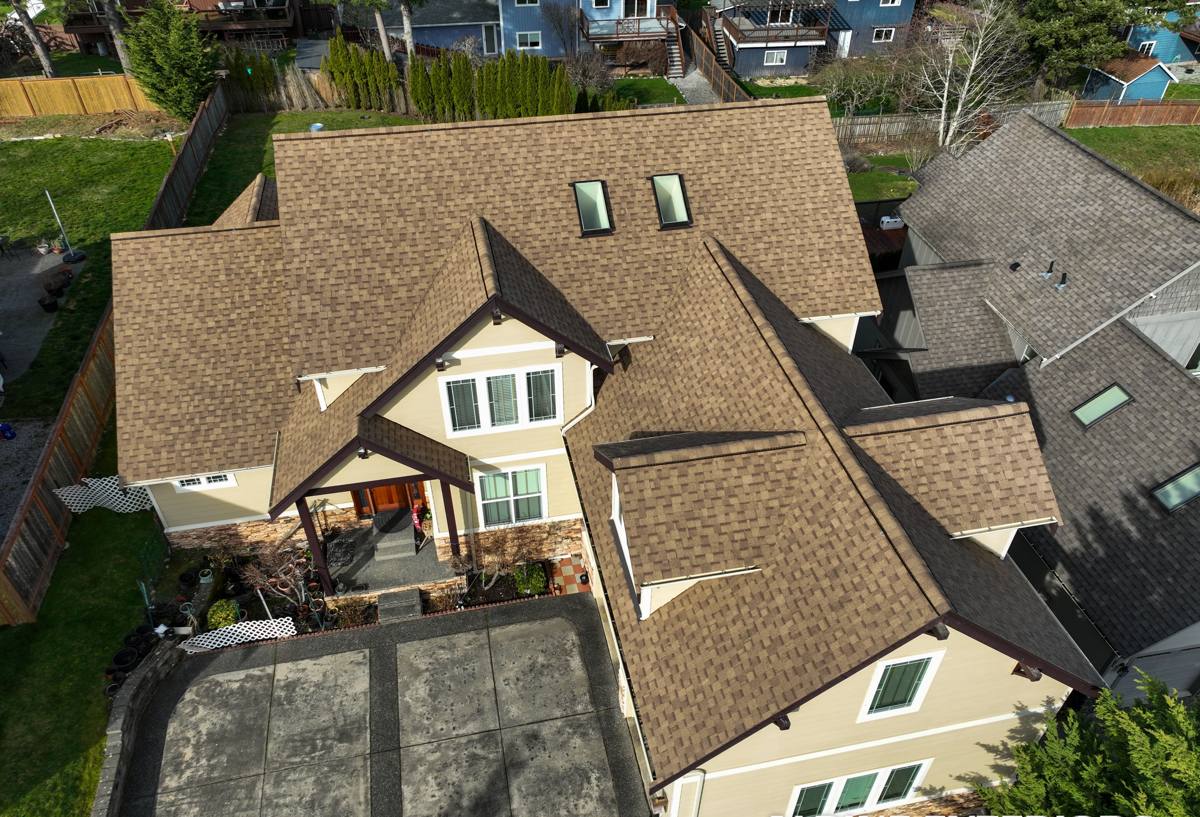
What a Correct New Roof Installation Actually Involves
A new roof is more than laying shingles over the old deck. The parts of the system homeowners can't see — the deck itself, the underlayment, the flashing, and the ventilation — are what determine whether a roof lasts its full expected lifespan or starts causing problems in year eight or ten.
- Tear-off and deck inspection: old roofing is removed down to the deck so any soft, rotted, or delaminated sheathing can be found and replaced, not covered up.
- Ice and water shield at vulnerable areas: eaves, valleys, and penetrations get a self-adhering waterproof membrane underneath the roofing material, not just felt or synthetic underlayment alone.
- Synthetic or felt underlayment across the field: a full secondary water barrier under the entire roof, not just the high-risk spots.
- Proper flashing at every transition: chimneys, skylights, sidewalls, and roof-to-wall junctions are where leaks most often start, so flashing gets formed and installed to shed water, not just caulked and hoped for.
- Balanced ventilation: intake at the eaves and exhaust at the ridge working together, sized to the attic space, so moisture and heat don't build up under the new roofing.
- Fastening to manufacturer and code specification: nail placement and pattern affect wind resistance and warranty validity, and it's an easy step to shortcut if a crew is moving too fast.
Choosing a Roofing Material for a Sumas Home
There's no single "best" roofing material — the right choice depends on the home's roof pitch, how much shade and tree cover the lot has, the budget, and how much long-term maintenance the homeowner wants to take on. Here's how the common options compare for this climate specifically.
| Material | Moss & moisture behavior | Maintenance | Typical lifespan |
|---|---|---|---|
| Architectural asphalt shingle | Good with proper ventilation; algae-resistant granule options help | Low to moderate | 25–30 years |
| Standing seam metal | Sheds water and resists moss growth very well due to smooth, sloped surface | Low | 40–50+ years |
| Cedar shake | Attractive but holds moisture longer; needs active upkeep to resist rot in this climate | High — regular cleaning and treatment | 20–30 years with upkeep |
| Synthetic composite shingle | Good moisture resistance, doesn't absorb water like wood | Low | 30–50 years |
We're upfront that cedar shake, while a classic look, asks the most of a homeowner in a climate like this one — it needs consistent maintenance to keep moisture from settling in over the years, and skipping that upkeep is where problems start. That's a maintenance trade-off worth knowing about going in, not a reason to avoid the look entirely if you're prepared to keep up with it.
Our New Roof Installation Process
- On-site inspection and estimate: we look at the existing roof, deck condition, ventilation, and any problem areas before quoting anything.
- Material selection: we walk through options based on your home's pitch, exposure, and budget — no pressure toward the most expensive system.
- Permitting: we handle the paperwork required for a full roof replacement in Whatcom County.
- Tear-off and deck repair: old material comes off, the deck gets inspected, and any damaged sheathing is replaced before anything new goes down.
- Underlayment and flashing installation: the waterproofing layer goes in first, with extra attention at eaves, valleys, and penetrations.
- Roofing installation: the chosen material is installed to manufacturer spec, including fastening pattern and exposure.
- Ventilation check and final walkthrough: we confirm intake and exhaust are balanced, clean up the site, and walk the finished roof with you.
Signs a Sumas Home Needs a New Roof, Not Just a Repair
Not every roofing issue means a full replacement, but there are signs that patching won't solve the underlying problem for long.
- Shingles that are curling, cracking, or losing granules across large sections of the roof, not just one spot
- Moss or dark streaking that comes back within a season or two of cleaning
- Daylight visible through the roof deck from inside the attic
- Soft or spongy spots when walking the roof
- Recurring leaks in different locations after repairs
- A roof that's approaching or past the expected lifespan of its material
- Visible sagging along the roofline
If you're only seeing one or two of these and the roof is otherwise in decent shape, a repair may genuinely be the more sensible move — we'll tell you that when it's true rather than push a full replacement that isn't needed yet.
Ventilation and Moss Prevention Are Part of the Installation, Not an Add-On
A lot of moss and moisture problems that show up a few years after a new roof aren't a failure of the roofing material — they're a ventilation problem. An attic that can't breathe traps warm, moist air against the underside of the roof deck, which speeds up moss growth and shortens the life of the roofing material from underneath. Getting the intake and exhaust balance right at installation is one of the most overlooked parts of a new roof, and it's one we don't treat as optional.
Why Local Experience in Whatcom County Matters
A crew that installs roofs across different climates might install a roof correctly by a national standard and still miss what this specific area needs — the ventilation margin for a long moss season, the flashing detail that holds up against sideways rain, the underlayment choice that accounts for freeze-thaw cycling. Working regularly in Blaine, Sumas, and the surrounding Whatcom County area means we're not guessing at how a roof will perform here — we've seen how different systems hold up through actual local winters, and we build accordingly.
Warranty, Permits, and What Affects Cost
Every new roof installation includes manufacturer material warranties and our workmanship warranty on the installation itself. Cost varies a fair amount from home to home, and the honest answer is that it depends on several factors more than any single one.
| Factor | Why it affects cost |
|---|---|
| Roof size and pitch | Steeper roofs take longer and require more safety setup |
| Number of layers to remove | Tear-off of multiple old layers adds labor and disposal cost |
| Deck condition | Rotted or damaged sheathing needs replacing before new roofing goes on |
| Material choice | Asphalt, metal, and composite products carry different material costs |
| Roof complexity | Valleys, dormers, chimneys, and skylights each add flashing work |
For most Whatcom County homes, a full roof replacement generally falls somewhere in the low-to-mid five figures, with the specifics depending heavily on the factors above. We give a firm number after seeing the actual roof, not a phone estimate.
If your roof is showing its age or you're just planning ahead, we're happy to take a look and give you a straightforward, no-pressure estimate. Use the form below to get started.