 Blaine
 Why Dakota Creek Roofs Wear Out Faster Than the Brochure Says
Dakota Creek sits close enough to the water that homes here deal with a different set of conditions than a roof twenty miles inland. Salt-laden air off the Salish Sea works on exposed metal fasteners, flashing, and vent caps year-round. Driving rain off Drayton Harbor and the Strait doesn't fall straight down — wind pushes it sideways, up under shingle tabs and into any gap a lazy installation left behind. And Whatcom County's long, wet shoulder seasons give moss and algae months at a time to get established on north-facing slopes and shaded valleys.
None of that means a roof in this neighborhood is doomed. It means the installation has to account for those conditions from the first course of underlayment to the last cap shingle, not just meet minimum code. A roof that would hold up fine in a drier part of the state can fail early here if it's built to a generic spec instead of a Whatcom County one.
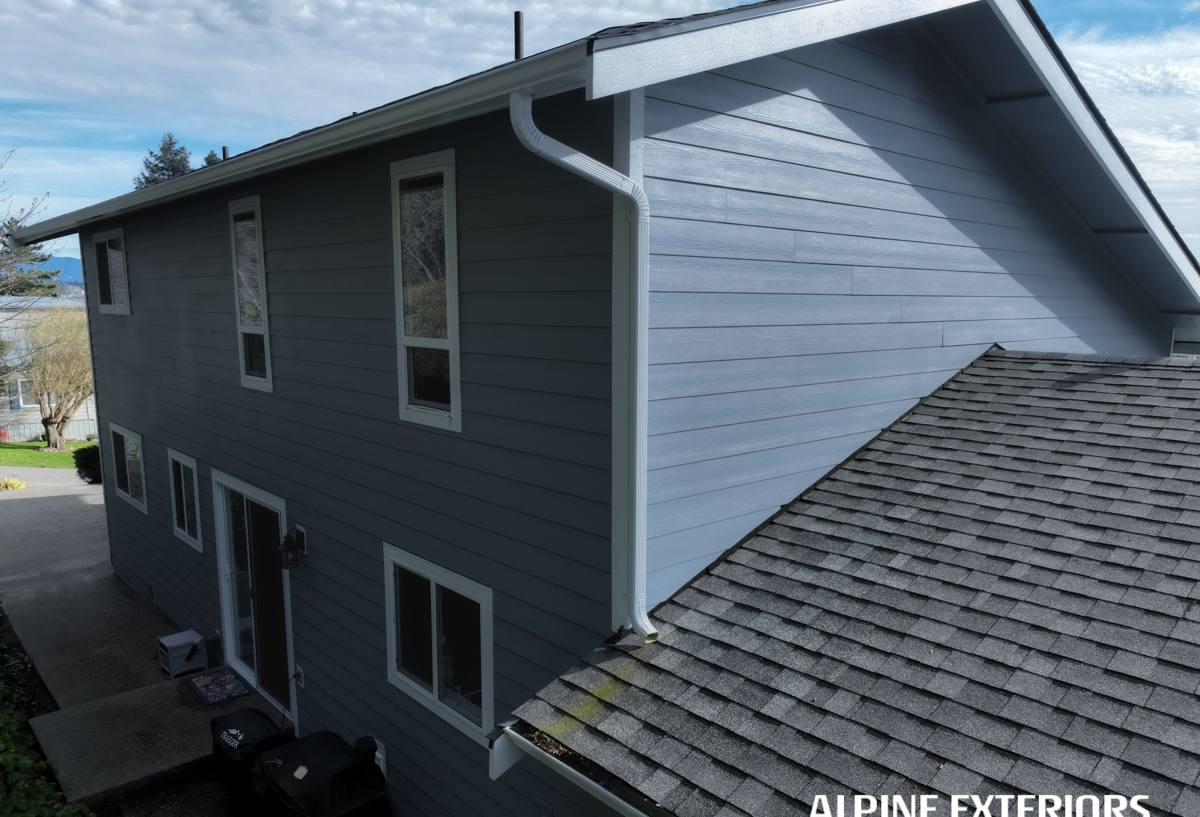
What a Correct New Roof Installation Actually Involves
"New roof" covers a lot of ground, and the difference between a roof that lasts and one that doesn't usually comes down to steps that aren't visible once the job is done. A proper tear-off and replacement includes:
- Full removal of old roofing down to the decking — not a layover on top of existing shingles
- Decking inspection and replacement of any soft, delaminated, or water-stained sheathing
- Ice-and-water shield at eaves, valleys, and around every penetration, not just where code requires the minimum
- Synthetic underlayment across the full field for a secondary water barrier under wind-driven rain
- New flashing at chimneys, skylights, sidewalls, and roof-to-wall transitions — reused flashing is a common shortcut and a common leak source
- Balanced intake and exhaust ventilation, sized to the actual attic, not guessed at
- Proper nailing pattern and fastener spacing matched to the shingle manufacturer's wind rating
Skip any one of these and the roof can still look fine from the street for a year or two. The failures show up later, as a soft spot near a valley or a slow stain on a ceiling, and by then the fix costs more than doing it right the first time would have.
Where Salt Air and Rain Change the Details
On a coastal-adjacent property, we pay closer attention to fastener material and flashing metal — plain steel corrodes faster near salt air than corrosion-resistant options. Valleys get sized generously because a narrow valley that's fine in a drier climate can back up under a heavy Whatcom County rain event. Flashing at wall transitions gets extra attention because wind-driven rain finds the weak point, and on an exposed lot near the water that weak point gets tested more often than it would inland.
Material Choices for This Microclimate
There's no single "best" roofing material for Dakota Creek — the right choice depends on the home, the budget, and how much ongoing maintenance the owner wants to take on. Here's how the common options actually compare under local conditions, not manufacturer marketing:
| Material | Moss/Algae Resistance | Salt Air Durability | Typical Lifespan Here | Maintenance |
|---|---|---|---|---|
| Standard architectural asphalt | Moderate — needs algae-resistant granules to hold up | Good with corrosion-resistant fasteners | 20–30 years | Periodic moss removal, gutter clearing |
| Algae-resistant (AR) asphalt shingle | Strong — copper/zinc granules actively resist growth | Good | 25–30 years | Lower than standard asphalt |
| Standing-seam metal | Very strong — little for moss to grip | Excellent with proper coating and fastener choice | 40–50+ years | Low, but requires correct coating spec near salt air |
| Cedar shake | Poor without diligent upkeep | Moderate — needs regular treatment | 20–25 years with maintenance | High — regular treatment and moss control required |
We don't install cedar shake as a default recommendation for homes this close to the water and this exposed to a long moss season — not because the product is bad, but because the maintenance schedule needed to keep it performing well doesn't match what most homeowners actually want to sign up for. If a client wants it anyway and understands the upkeep, that's their call to make with full information.
Ventilation and Moisture: The Part You Never See
A new roof that isn't ventilated correctly will age faster from the inside out. Warm, moist air from the living space rises into the attic; if it can't escape through balanced intake and exhaust vents, it condenses on the underside of the decking. Over a wet Whatcom County winter, that condensation soaks sheathing and shortens the life of the whole roof system — sometimes faster than weather damage from the outside.
There's also a direct link between attic ventilation and moss. A poorly ventilated attic runs warmer and holds moisture longer, and that combination gives moss and algae an easier foothold on the roof surface above it. Getting ventilation right isn't a cosmetic upgrade — it's part of what makes the roofing material's warranty and lifespan numbers realistic instead of theoretical.
Our Process, From First Look to Final Walkthrough
- On-site inspection. We walk the roof and the attic, not just look at it from the driveway. Decking condition, ventilation, and flashing all get checked before we quote anything.
- Written estimate with material options. You get a clear scope, a material comparison suited to your home and budget, and a straight answer on what's driving the cost.
- Scheduling around the weather. Roofing in this part of Washington means working with rain windows, not against them. We plan tear-off and dry-in to minimize how long your decking is exposed.
- Tear-off and decking repair. Old material comes off, decking gets inspected board by board, and anything compromised is replaced before anything new goes down.
- Underlayment, flashing, and ventilation installed to spec. This is the stage that determines how the roof performs in year eight, not just how it looks in week one.
- Roofing material installation. Installed to the manufacturer's nailing and exposure requirements so the wind and weather warranty is actually valid, not voided by a shortcut.
- Cleanup and magnetic sweep. Debris, old material, and stray fasteners cleared from the property and driveway.
- Final walkthrough. We go over the finished roof with you before we consider the job done.
Moss, Algae, and Salt Air: Keeping the Roof Healthy After Install
A correctly installed roof still needs some seasonal attention in this climate — that's just the reality of a long wet season with tree cover nearby. What we recommend to homeowners after installation:
- Keep gutters and valleys clear so water doesn't pool or back up under shingles during heavy rain
- Have moss physically removed rather than pressure-washed off, which can lift granules and shorten shingle life
- Trim back overhanging branches where possible to reduce shade and debris buildup on north-facing slopes
- Do a visual check after major windstorms for lifted shingles or displaced flashing, especially on exposed sides of the roof
None of this is heavy maintenance — it's the kind of light upkeep that keeps a well-installed roof performing for its full expected lifespan instead of needing early repairs.
Why It Matters That We Already Work in Dakota Creek
Roofing crews that mostly work inland or in drier parts of the state sometimes underspec flashing, skip the extra ice-and-water coverage, or default to standard shingles without algae resistance — not out of carelessness, but because that's what works fine where they usually build. A crew that regularly works Blaine and the surrounding Whatcom County coastline treats the extra flashing, the corrosion-resistant fasteners, and the moss-resistant shingle upgrade as the default, not an upsell, because we've seen what happens when a roof out here is built to a generic spec.
We also know the practical side: permitting through the local jurisdiction, how weather windows actually work on this stretch of coast during the wet months, and what roof details tend to leak first on homes exposed to wind off the water. That's not something you can fully substitute with a general contractor's checklist — it comes from doing the work here repeatedly.
What Drives the Cost of a New Roof Installation
| Factor | Why It Matters |
|---|---|
| Roof size and pitch | More square footage and steeper pitches mean more material, more labor time, and more safety setup |
| Number of existing layers | Tear-off of multiple old layers takes longer and generates more disposal cost than a single-layer roof |
| Decking condition | Rotten or delaminated sheathing found during tear-off adds material and labor to replace it properly |
| Material choice | Standard asphalt, algae-resistant asphalt, and metal carry different material costs and installation labor |
| Flashing and penetration complexity | Chimneys, skylights, and multiple roof planes all add flashing detail work |
| Ventilation upgrades | Adding or correcting intake/exhaust venting is inexpensive relative to the lifespan it protects |
Every one of these varies enough from house to house that we don't quote a number without walking the roof first. Broadly, most single-family reroofs in this area land somewhere in the low five figures to the low-to-mid twenties depending on size and material — but that range narrows fast once we've actually looked at your roof.
A Short Checklist Before You Sign Anything
- Is the estimate itemized — material, labor, tear-off, disposal — or just one lump number?
- Does the quote specify underlayment type and ice-and-water shield coverage, not just "shingles"?
- Is ventilation addressed in the scope, or only the roofing surface itself?
- Is the contractor licensed and insured in Washington, and will they show you proof without being asked twice?
- Does the warranty cover workmanship separately from the manufacturer's material warranty?
If a contractor can't answer these clearly before you sign, that's worth taking seriously — it usually predicts how clearly they'll communicate once the job is underway.
If you're weighing a new roof for a home near Dakota Creek, we're glad to take a look and give you a straightforward, no-pressure estimate — use the form below to get started.