 Blaine
 Siding Built for Grandview's Version of Blaine's Climate
Grandview is a residential stretch of Blaine, and like the rest of the city it sits inside a marine climate that's harder on exterior siding than most people realize until they're the ones dealing with the damage. Salt-laden air drifts in off the water for most of the year, rain arrives with real wind behind it instead of falling straight down, and Whatcom County's mild, wet stretch of the calendar gives moss and algae a long season to take hold on anything that stays damp. None of that is unique to Grandview specifically, but it's the reality every home in this part of Blaine is built into, and it's the starting point for any siding decision here — new construction or a full re-side of an older house.
This page is about siding installation for Grandview homes specifically: what the climate demands, what a correct job looks like, how we approach it, and why the crew doing the work matters as much as the material going on the wall. We install James Hardie fiber cement exclusively and don't install vinyl, LP SmartSide, or cedar, so everything below reflects that system.
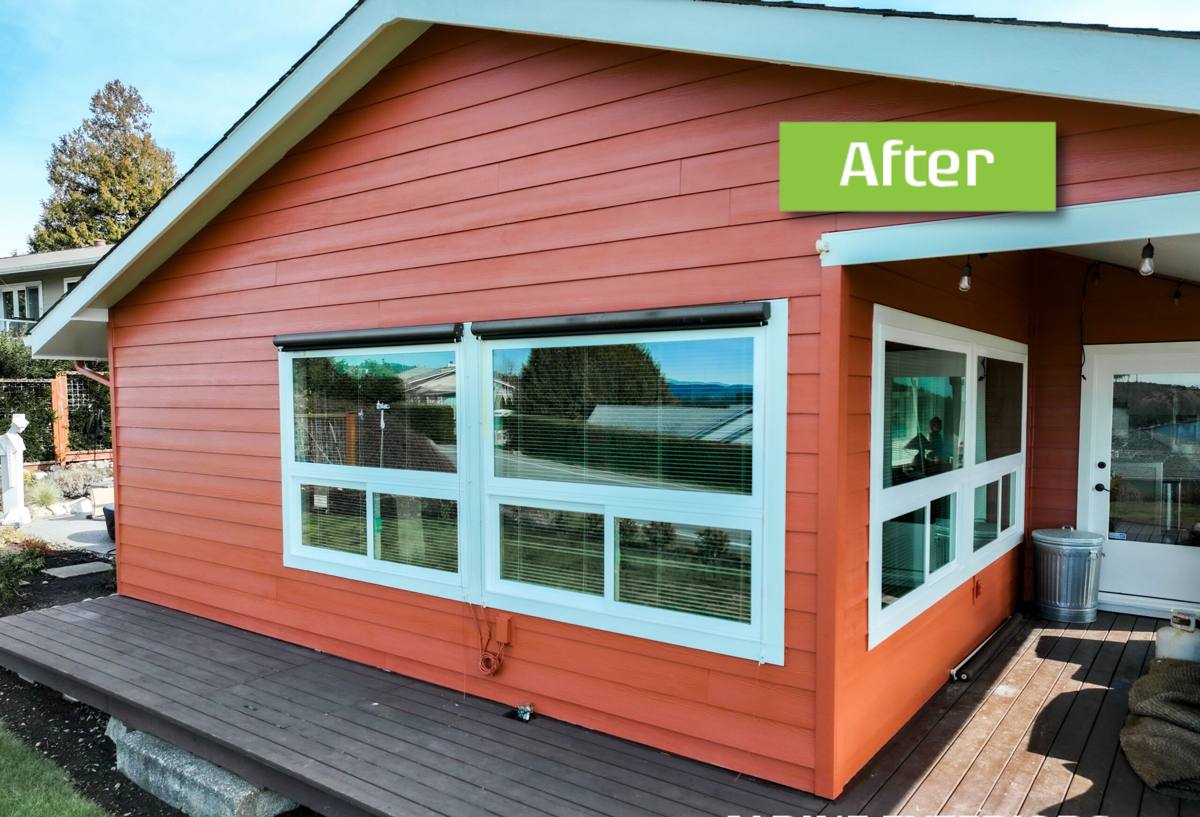
What Grandview Homes Need From Their Siding
Salt Air Doesn't Take a Break
Homes throughout Blaine, Grandview included, take on salt exposure as an everyday condition rather than an occasional weather event. Over time that accelerates corrosion on fasteners, flashing, and trim hardware faster than it would on a home well inland. Siding hardware chosen for cost rather than corrosion resistance tends to show it first — rust streaking down a wall, trim that's worked loose, fasteners that no longer hold tight.
Wind-Driven Rain Finds the Weak Points
Rain that comes in sideways doesn't just run down a wall and off the eave — it gets pushed into panel joints, around window and door flashing, and into any seam where trim meets field siding. What's underneath the visible siding, and how carefully it was installed, ends up mattering more than the siding material itself. A properly lapped and sealed water-resistive barrier stops wind-driven water before it reaches the sheathing; a rushed one gives it a way in that won't show up until the damage is already done.
A Long Moss Season Rewards Airflow, Not Just Material
Mild, wet conditions for a large part of the year mean any wall surface that stays damp for extended stretches becomes a growth surface eventually, regardless of what it's made of. What actually keeps a wall drier is installation detail: correct clearance at the base of the wall, a drainage plane that lets moisture escape instead of trapping it, and siding that isn't jammed tight against trim or flashing in a way that blocks airflow.
What Correct Installation Looks Like on a Grandview House
James Hardie fiber cement is a strong product, but the product alone doesn't determine how a house performs over the next twenty or thirty years — the installation does. A correct job on a Grandview home means following the manufacturer's published spec closely, not adapting it loosely to save time. That includes:
- Fastener type, spacing, and placement matched to the specific Hardie product line being installed, not a generic approach used the same way on every job
- Proper clearance maintained between the bottom of the siding and grade, decks, patios, and roof lines, so water doesn't wick up into the panel edge
- Flashing installed and lapped correctly at every window, door, and wall penetration before any siding covers it up
- Every field-cut panel edge sealed or primed before it goes on the wall, since a raw cut edge is the fastest place for moisture to get in
- A continuous water-resistive barrier underneath the siding, properly lapped and taped at seams and penetrations
- Butt joints and trim seams treated with the correct sealant and technique rather than caulked over as an afterthought
Skipping any one of these usually doesn't show up on the day the job wraps up. It shows up a few winters later, once wind-driven rain and repeated wet-dry cycles have had time to find the gap.
How We Approach a Grandview Installation
Assessment Before Anything Gets Ordered
Before we quote a Grandview job, we look at the specific exposure of the house — how close it sits to open water, which walls take the worst of the prevailing wind and rain, what condition the existing sheathing is in once old siding comes off, and whether there's evidence of past moisture problems that need to be addressed rather than covered up. That assessment shapes the flashing detail and product selection for that specific house, not a one-size-fits-all plan.
Tear-Off and What It Reveals
Removing the old siding is also when problems that weren't visible from outside tend to surface — soft sheathing, failed old flashing, or a water-resistive barrier that was never installed correctly the first time. We address what tear-off reveals before anything new goes up, rather than installing new siding over an unresolved problem underneath.
Installation to Spec, Not to Schedule Pressure
We follow James Hardie's published fastening, spacing, and clearance requirements as written, because that's what the product's warranty coverage actually depends on. Weather also plays a bigger role in scheduling here than it does further inland — wind off the water can shut down safe panel handling on a day that would otherwise be workable, so we build some flexibility into the timeline rather than rushing a step to hit a date.
A Walkthrough, Not Just an Invoice
When the job is finished, we walk the house with the homeowner and explain what was done — where flashing sits, how clearances were handled, what maintenance to expect going forward. A homeowner who understands their own siding system is in a better position to catch a problem early if one ever comes up.
Why James Hardie for Grandview's Conditions
We install James Hardie fiber cement exclusively, and Grandview's exposure is a big part of why. Hardie's HZ5 formulation is engineered specifically for climates with significant moisture exposure and freeze-thaw cycling, which is a reasonable description of the cool, wet, marine conditions here. Fiber cement is also non-combustible, holds its factory-applied ColorPlus finish far longer than field-painted materials under constant sun and salt exposure, and carries a strong transferable warranty when installed to spec — which is exactly why installation quality matters as much as it does.
We don't install vinyl, LP SmartSide, cedar, or other fiber cement brands, not because those products have no merit, but because we've standardized on one system we can install, warranty, and stand behind consistently rather than juggling several products with different installation requirements and different failure points in this climate.
How the Common Options Compare in This Climate
| Material | How it handles Grandview's climate |
|---|---|
| Vinyl siding | Can warp or crack under temperature swings and impact, and seams give wind-driven rain more entry points over time |
| LP SmartSide (engineered wood) | Wood-based core is more sensitive to sustained moisture exposure if any installation detail fails |
| Cedar siding | Needs regular refinishing to hold up against salt air and constant moisture; upkeep demand is significant |
| James Hardie fiber cement | Non-combustible, holds factory finish well under salt and sun exposure, HZ5 formulation matched to this climate |
Signs a Grandview Home May Need New Siding
Not every siding issue means a full replacement is necessary, but these are worth taking seriously in this climate:
- Soft spots or visible warping when you press on the siding, especially near the bottom of walls or below windows
- Paint that's peeling, bubbling, or failing repeatedly in the same spots despite being repainted
- Persistent moss or algae growth that comes back quickly after cleaning
- Visible gaps, cracking, or separation at seams and trim joints
- Rising energy bills without another clear explanation, which can point to a compromised weather barrier
- Interior signs like musty odors or staining on walls that share an exterior wall with visible siding issues
Why a Crew That Already Works Grandview Matters
Installation quality tends to diverge fastest in a demanding coastal climate like this one. A crew that regularly installs siding on homes exposed to Blaine's salt air and wind-driven rain develops judgment that a crew installing here only occasionally doesn't have time to build — where extra flashing attention actually pays off, which fastener spec holds up on a water-facing wall over years rather than months, and which shortcuts genuinely can't be taken regardless of how tight the schedule is. That judgment comes from doing this specific work in this specific place repeatedly, not from applying a generic installation checklist the same way everywhere.
If you're planning a new siding installation for a Grandview home, or want an honest second opinion on whether existing siding was installed correctly, we're happy to come take a look. Reach out using the form below for a free, no-pressure estimate.