 Blaine
 A deck in Ferndale has to do more than look good on a dry afternoon. It has to shed weeks of driving rain without trapping water in the framing, shrug off a marine layer that keeps everything damp well into the day, and resist the moss and algae that colonize any shaded, north-facing surface in Whatcom County within a season or two. We build decks in this corner of Washington the way the climate actually demands, not the way a catalog photo suggests, and that difference shows up five and ten years down the line, not on install day.
What Ferndale's Climate Actually Does to a Deck
Ferndale sits close enough to the water that salt-laden air reaches fasteners, flashing, and railing hardware even on homes that aren't waterfront. Combine that with the region's long stretch of wet months and you get two slow, cumulative problems: corrosion on anything that isn't rated for it, and moisture that doesn't dry out between rains the way it would in a drier climate. A deck built with interior-grade hardware or the wrong fastener coating will show rust streaks and loosening joints well before the wood itself gives out.
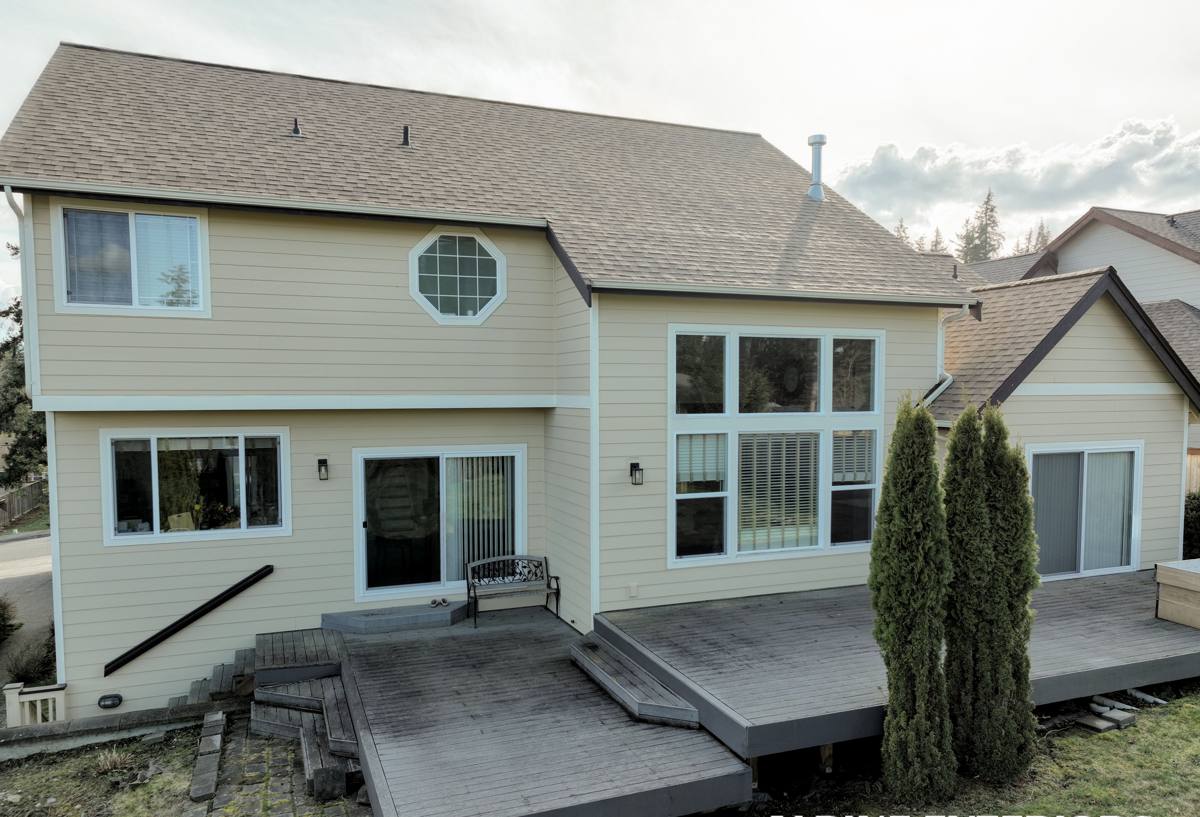
The other constant is moss. Whatcom County's moss season runs long — anywhere shaded, low to the ground, or slow to dry becomes a host surface. On a deck, that means the gaps between boards, the tops of joists under low clearance, and any spot where two surfaces sit tight against each other with no airflow. Moss holds moisture against the wood or composite surface, which accelerates rot in real lumber and can leave permanent staining on lighter-colored composite and PVC boards if it's left to sit.
What a Correctly Built Deck Requires Here
Framing and Ledger Attachment
The ledger board — where the deck attaches to the house — is the single most common point of failure on decks in wet climates, because it's the hardest spot for water to escape once it gets behind the siding. A correct attachment uses proper flashing that directs water out and away from the wall, not just a bead of caulk and a bolt pattern. We flash every ledger connection and use structural fasteners rated for exterior, wet-service use, not interior deck screws that happen to be galvanized.
Footings Below Frost and Grade
Footings need to sit below the local frost depth and be sized for the soil they're going into. Whatcom County soils vary block to block — some sites drain well, others hold water — and a footing that isn't set deep enough or wide enough for the actual soil will heave or settle over a few wet winters. We check soil conditions on site rather than assuming a standard footing size will work everywhere.
Drainage and Airflow Underneath
A deck that traps standing water or still air underneath is a deck that grows moss and rots framing years ahead of schedule. Correct grading under the deck, gaps that let air move through the joist bay, and board spacing that lets water drain instead of pool are all decisions made at the framing stage — not something you can fix later without tearing boards back up.
Decking Material Options for This Climate
There's no single "best" decking material — there's a best material for your budget, your maintenance appetite, and how much sun or shade the deck actually gets. Here's how the common options hold up under Whatcom County conditions specifically:
| Material | Upfront Cost | Moisture & Moss Behavior | Maintenance | Typical Lifespan |
|---|---|---|---|---|
| Pressure-treated lumber | Lowest | Absorbs moisture; needs sealing to resist moss staining and checking | Annual cleaning, re-sealing every 1–3 years | 10–15 years with upkeep |
| Cedar | Moderate | Naturally moisture- and insect-resistant, but still needs sealing to prevent graying and moss growth in shaded areas | Cleaning and sealing every 1–2 years | 15–20 years with upkeep |
| Composite decking | Higher | Doesn't rot, but can hold surface moss/algae if not cleaned; quality varies a lot by brand and core construction | Periodic washing, no sealing or staining | 25–30 years |
| PVC/capped polymer | Highest | Fully moisture-sealed surface; best resistance to staining and moss adhesion | Occasional washing | 25–30+ years, longest warranties |
For a lot of Ferndale homeowners, the honest answer is a composite or capped polymer board on a shaded, north-facing deck where moss is the biggest recurring headache, and cedar or pressure-treated on a sunnier, more exposed deck where the wood gets a real chance to dry out between rains. We'll tell you which situation you're actually in rather than steering everyone toward the same product.
Railings, Fasteners, and Hardware
Salt air is hard on metal, full stop. We use stainless steel or coated structural fasteners rated for coastal exterior use rather than standard deck screws, because the cost difference over the life of the deck is small compared to the cost of replacing rusted-out hardware or repairing the wood damage that follows a failed connection. The same logic applies to railing brackets, post bases, and any hidden fastening system — hidden connectors are a nice look, but only if what's underneath is actually rated for wet, salt-exposed conditions.
Moss and Long-Term Maintenance
No deck material in Whatcom County is entirely moss-proof — the goal is to build it so moss doesn't get a foothold and so cleaning it off is straightforward when it does. That means:
- Board spacing wide enough to let water drain and air move, not tight-butted joints that trap moisture
- No low-clearance dead zones underneath where debris and moss can build up unnoticed
- Materials matched to sun exposure — full shade needs a more moss-resistant surface than a deck that gets afternoon sun
- A yearly wash-down before moss season sets in, which is far cheaper than board replacement
We design for this up front rather than leaving it as a maintenance problem for you to discover in year three.
Permits and Code Basics for Ferndale-Area Decks
Most attached decks and any deck built above a certain height require a building permit, and guardrails are required once the walking surface is roughly 30 inches or more above grade — that's a standard code threshold, though exact requirements depend on your specific jurisdiction's adopted code. Footing depth requirements are tied to local frost depth and soil conditions rather than a single statewide number. We pull the permit, handle the inspection scheduling, and build to the code that applies to your specific lot rather than guessing — that's part of what you're paying a licensed contractor for instead of doing it yourself.
How We Build a Deck, Start to Finish
- On-site visit to look at grade, drainage, sun/shade exposure, and how the deck will tie into the house
- Design and material discussion, with honest trade-offs between wood, composite, and PVC for your specific spot
- Permit application and structural planning, sized to your actual soil and frost conditions
- Framing with properly flashed ledger attachment, correctly sized footings, and drainage built in from the start
- Decking, railing, and hardware installation using fasteners and connectors rated for coastal exposure
- Final walkthrough and inspection sign-off, plus straight talk on what maintenance the deck will actually need
Why a Ferndale-Familiar Crew Matters
A deck built from a generic set of plans, without accounting for Whatcom County's rain totals, salt exposure, and moss season, tends to look fine for a year or two and then start showing problems — rust streaks at the fasteners, soft spots at the ledger, green film on boards that never quite dries out. A crew that already works this area knows which details aren't optional here: the flashing, the fastener grade, the drainage, the board spacing. That's not a sales pitch, it's the difference between a deck that needs real repair work in five years and one that just needs an occasional wash.
What to Check Before You Hire Anyone for a Deck Project
- Do they flash the ledger board, or just bolt and caulk it?
- What fastener grade do they use, and is it actually rated for coastal/exterior wet-service conditions?
- Do they size footings based on your soil, or use a one-size-fits-all approach?
- Are they pulling the permit and scheduling inspections, or leaving that to you?
- Can they explain, in plain terms, why they'd recommend one decking material over another for your specific spot?
If a contractor can't answer those questions clearly, that's worth knowing before the framing goes in, not after.
If you're planning a new deck or replacing an old one in the Ferndale or Blaine area, we're happy to take a look and give you a straight, no-pressure estimate — just fill out the form below and we'll go from there.