 Blaine
 Dakota Creek's Climate Is Harder on Siding Than Most Homeowners Realize
Dakota Creek sits close to the water on Blaine's edge, and that proximity shapes everything about how a home's exterior ages here. Salt-laden air blows in off Semiahmoo Bay and the Strait of Georgia almost daily, driving rain comes in sideways during fall and winter storms, and the shaded, damp pockets common along the creek corridor stay wet long after the rain stops. Add Whatcom County's long, low-sun winters and you get months at a stretch where siding rarely gets a full dry-out between weather events.
Most siding materials aren't engineered with that combination in mind. Salt air accelerates corrosion on fasteners and trim metal. Constant moisture cycling — wet, damp, wet again — is what drives rot, delamination, and paint failure. And the shade and humidity that make Dakota Creek a pleasant, green neighborhood are the same conditions that grow moss and algae on anything that stays damp too long. A siding system that isn't built to shed water fast and resist that biological growth is fighting a losing battle here.
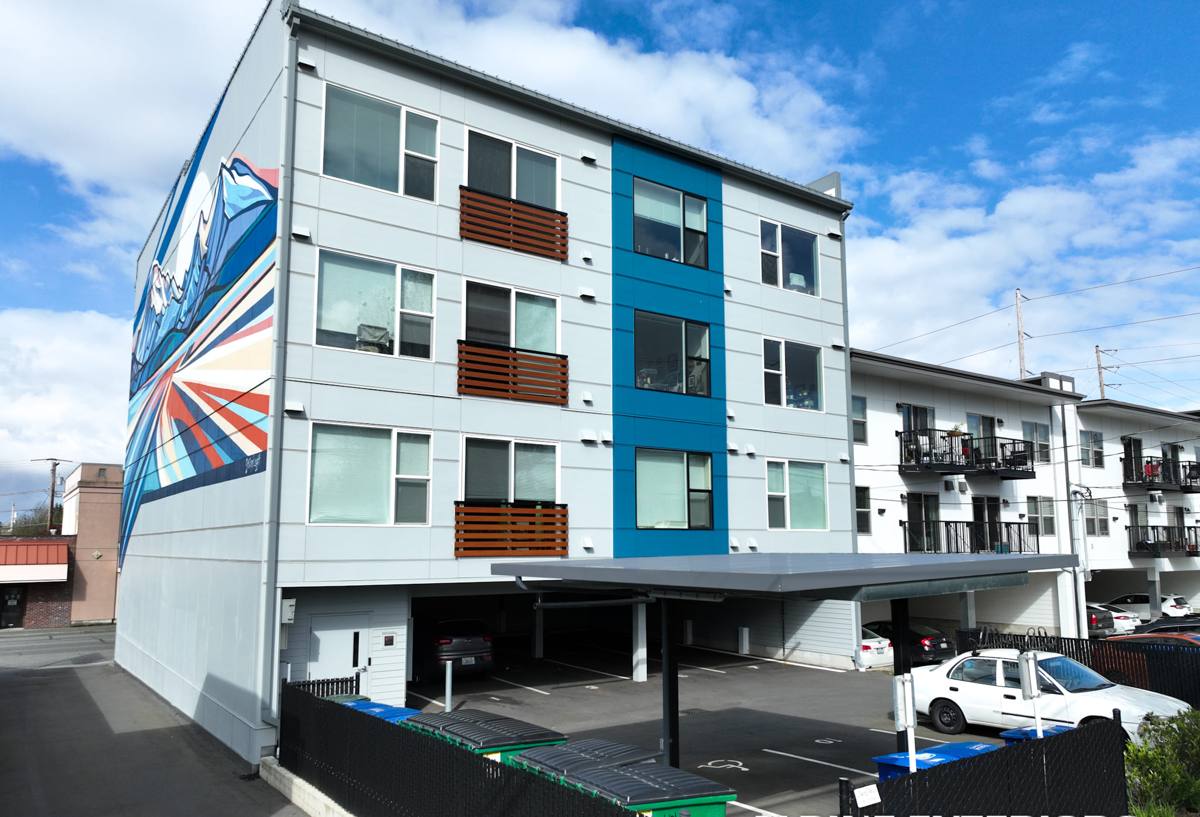
Why We Only Install James Hardie on Dakota Creek Homes
We don't install vinyl, LP SmartSide, cedar, primed spruce, or composite panel products like Cemplank or Allura. That's a deliberate standard, not a sales pitch, and it comes down to how those materials actually perform over years of exposure to conditions like Dakota Creek's — not just how they look on install day.
- Vinyl expands and contracts with temperature swings, can warp or crack in wind-driven weather, and its color is baked into a thin material that fades — it can't be refinished, only replaced.
- LP SmartSide and other engineered wood products are wood-based. Even with resin treatments, sustained moisture exposure at seams, cuts, and fastener points is their known weak spot, and salt-air environments accelerate that wear.
- Cedar and primed spruce require an ongoing maintenance commitment — repainting, caulking, and moisture monitoring — that most homeowners underestimate until the first signs of rot show up at butt joints and corners.
James Hardie fiber cement is cement, sand, and cellulose fiber — it doesn't rot, it's non-combustible, and it doesn't provide the organic material that moss and algae feed on the way wood-based products do. That's why it's the only product we put our name behind for homes in this area.
What James Hardie Actually Brings to a Marine-Influenced Property
The HZ5 Engineered Line
James Hardie engineers its siding by climate zone, and Whatcom County falls into the HZ5 category — the line built for wetter, more moisture-exposed regions of the Pacific Northwest. HZ5 products are formulated with moisture resistance and crack resistance specific to freeze-thaw cycling and prolonged damp exposure, which matters more in a creekside microclimate than it does a few miles inland.
ColorPlus Factory Finish
Instead of field-painted siding that depends on weather conditions during installation, ColorPlus finish is baked on at the factory in a controlled process, then backed by its own finish warranty. In an area where paint failure from moisture and salt exposure is a real, recurring problem, a factory-cured finish that doesn't rely on a painter's timing or a dry week is a meaningful advantage.
Non-Combustible Composition
Fiber cement doesn't fuel a fire the way wood-based sidings can. That's a relevant consideration anywhere in Washington, and it's one more reason the product holds up as a long-term investment rather than a material you'll be re-evaluating in a decade.
Material Comparison for a Dakota Creek Exterior
| Factor | James Hardie Fiber Cement | Vinyl | Wood-Based (Cedar / LP SmartSide) |
|---|---|---|---|
| Moisture / rot resistance | High — cement-based, doesn't rot | Doesn't rot, but seams and gaps trap moisture behind panels | Vulnerable at seams, fastener points, and cut edges |
| Salt air / corrosion behavior | Stable; use of stainless or coated fasteners protects trim | Panel itself is stable, but can become brittle in cold, salty wind | Moisture uptake accelerated by salt exposure |
| Moss / algae resistance | Non-organic surface resists growth better than wood fiber | Resists growth but traps grime in laps | Organic material feeds growth if damp persists |
| Finish longevity | Factory ColorPlus finish, multi-decade warranty | Color molded in, fades over time, not refinishable | Field-applied paint, needs repainting on a cycle |
| Fire behavior | Non-combustible | Combustible | Combustible |
What a Correct Installation Involves Here
James Hardie siding performs the way it's designed to only when it's installed to spec — and in a location like Dakota Creek, the details that get rushed on an easier job are exactly the ones that matter most.
Water Management Comes First
Before a single course of siding goes up, the water-resistive barrier, flashing at windows and doors, and weep screed at the foundation line have to be right. Fiber cement doesn't rot, but the sheathing and framing behind it can — so the whole point of correct flashing and drainage detail is keeping water out of the wall assembly, not just off the surface.
Clearance and Fastening
Hardie's install specs call for minimum clearance from grade, decks, and roof lines, and for specific fastener spacing and placement to keep panels secure without over-driving nails that can crack the material. In a driving-rain environment, skipping ground clearance is one of the most common ways a siding job fails early — splashback keeps the bottom courses wet far more often than the rest of the wall.
Caulking Discipline
Hardie's panel systems are engineered to shed water at lap joints without relying on caulk as a primary seal. Crews that over-caulk (or under-caulk) butt joints and trim intersections are working against the product's design, and in a salt-air, high-moisture area those mistakes show up as staining and failure points years before they should.
Corrosion-Resistant Fasteners and Trim
Given the salt air coming off the bay, fastener and trim material selection matters more here than it would on a home fifteen miles inland. We spec corrosion-resistant fasteners and flashing appropriate to a marine-influenced environment, not generic hardware.
Our Process for a Dakota Creek Project
- On-site assessment — we look at the home's exposure (wind direction, shade, proximity to water and vegetation), existing siding condition, and any signs of moisture intrusion at trim, corners, and penetrations.
- Sheathing and moisture check — before committing to a full tear-off scope, we check what's happening behind the existing siding so there are no surprises once removal starts.
- Product and color selection — HZ5 panel or plank profile, ColorPlus finish selection, and trim package suited to the home's exposure.
- Water management detailing — house wrap, flashing, and weep screed installed or corrected before siding goes up.
- Installation to Hardie spec — proper clearance, fastening, and joint treatment throughout.
- Final walkthrough — we go over the completed exterior with you before calling the job done.
Living With It: Maintenance in a Salt Air, Moss-Prone Area
One of the real advantages of James Hardie in this environment is how little ongoing maintenance it actually needs compared to wood-based siding — but "low-maintenance" isn't "no-maintenance," especially this close to the water.
- Rinse siding annually (a garden hose is enough) to clear salt residue and organic buildup before it becomes established growth.
- Keep gutters clear so overflow isn't running down and pooling against siding courses.
- Trim back vegetation and tree cover that keeps sections of the wall shaded and damp longer than the rest of the house.
- Check caulking at trim and penetrations every year or two — not because Hardie relies on it structurally, but because sealant at windows, doors, and fixtures still needs upkeep.
- Watch for chalking, staining, or lifted edges near ground level, which usually signal a drainage or clearance issue worth addressing early.
Cost Factors for a Dakota Creek Siding Project
| Factor | Why It Affects Cost |
|---|---|
| Tear-off vs. new construction | Removing and disposing of existing siding, and repairing any hidden sheathing damage, adds labor |
| Home size and wall complexity | More corners, gables, and trim detail mean more cutting and labor time |
| Panel vs. lap plank profile | Different Hardie profiles carry different material and install labor costs |
| Trim and accessory package | Corner boards, window trim, and fascia detail scope varies by home style |
| Water management repairs | Correcting flashing, sheathing rot, or drainage issues found during tear-off |
We don't quote broad numbers without seeing the home — wall complexity and existing condition swing the cost more than most homeowners expect. What we can tell you upfront is that we price the job to be done to spec, not to hit a low number that skips the water management detail this location actually needs.
Why Hiring a Crew That Already Works This Area Matters
Siding installation isn't identical from one part of Whatcom County to another. A crew that mostly works drier, inland jobs can still do competent general work, but they're not necessarily thinking about splashback clearance near a creek corridor, wind-driven rain patterns off the bay, or how fast moss establishes itself in a shaded, damp microclimate. A crew that already works Blaine and the Dakota Creek area day to day has seen what happens when those details get skipped — and what it takes to get them right the first time.
That local familiarity shows up in small decisions: where to add extra flashing attention, which corners of a given lot get more wind exposure, and how to sequence a job around this area's rain patterns so water-resistive barrier isn't left exposed longer than it should be. None of that is exotic knowledge — it's just what you get from doing the work here repeatedly instead of occasionally.
Ready to Talk About Your Home
If you're in Dakota Creek or elsewhere around Blaine and thinking about siding, we're happy to take a look and walk you through what your home actually needs — no pressure, no generic sales pitch. Fill out the form below for a free estimate and we'll go from there.