 Blaine
 Dakota Creek Sits Right at the Edge of the Weather
The homes along and near Dakota Creek, on the edge of Blaine, take on a version of Whatcom County's weather that's a notch more aggressive than what a house ten miles inland deals with. You've got salt-laden air moving in off the water, wind-driven rain that doesn't just fall straight down but gets pushed sideways into wall assemblies, and tree cover along the creek corridor that keeps siding shaded and damp long after a storm has passed. That combination is exactly what wears out the wrong siding material faster than homeowners expect.
None of that is exotic weather. It's the same marine climate that defines this whole stretch of the Pacific Northwest coast. But low-lying, creek-adjacent lots concentrate it — more humidity sitting in the yard, more shade holding moisture on north- and west-facing walls, and more exposure to salt carried in off the Strait. Siding on these homes needs to handle sustained moisture contact, not just occasional rain.
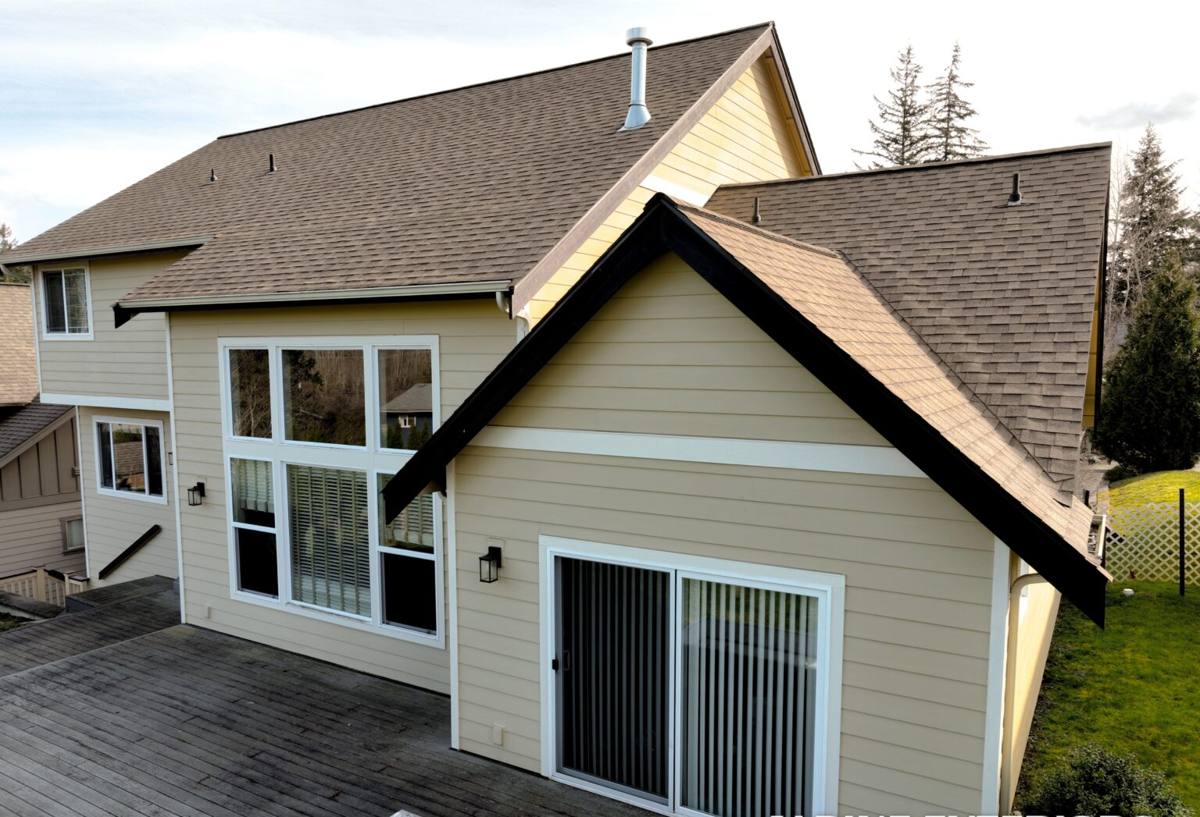
What This Climate Actually Does to Siding
It helps to be specific about the failure modes, because "coastal weather is tough on siding" is true but vague. Here's what we actually see on Dakota Creek-area homes when the wrong product or a sloppy install job is in place:
- Moss and algae staining that sets into shaded, moisture-holding surfaces and keeps coming back after pressure washing if the underlying material stays damp
- Swelling and delamination on wood-based or engineered wood products where edges and cut ends aren't sealed and stay wet
- Fastener corrosion from salt air reacting with the wrong grade of nails or screws, leading to streaking and loose panels
- Caulk and seam failure where UV exposure and constant damp-dry cycling break down sealant faster than manufacturers' published lifespans
- Paint failure on field-painted siding, where moisture behind the paint film causes peeling years before a factory finish would show wear
Every one of these is a maintenance problem that starts small and gets expensive if it's ignored. The starting point for avoiding it is choosing a material that's dimensionally stable and moisture-resistant by design, and then installing it in a way that doesn't create the gaps and unsealed edges that let water in.
Why We Only Install James Hardie Fiber Cement Here
We standardized on James Hardie fiber cement siding for every home we work on, and a coastal, creek-adjacent property like the ones around Dakota Creek is a good example of why. Fiber cement is a mix of cement, sand, and cellulose fiber — it doesn't swell when it absorbs moisture the way wood or wood-composite products can, and it doesn't rot. It's also non-combustible, which matters less for storm exposure but is still a real advantage over wood-based alternatives.
James Hardie engineers specific product lines for different climate zones, and this part of Whatcom County falls into the wetter end of that spectrum. Their HZ5 formulation is built for climates with more moisture exposure and freeze-thaw cycling than the milder HZ10 zone covers — it's the right baseline for a home near the water here, not an upsell.
The other piece is the factory-applied ColorPlus finish. Instead of being painted on site — where weather, temperature, and application quality all affect how well the paint bonds and how long it lasts — ColorPlus is baked on in a controlled factory process before the boards ever reach the site. That finish holds color and resists the fading, chalking, and peeling that field-applied paint struggles with in a damp, shaded, salt-air environment. It also carries its own dedicated warranty coverage separate from the substrate warranty, which is a meaningful difference from touch-up-paint siding systems.
What We Deliberately Don't Install
We don't install vinyl siding, LP SmartSide or other engineered wood products, or unfinished cedar or spruce siding — not because those products have no merit anywhere, but because we've made a professional call about what holds up correctly on the homes we work on in this climate, including moisture-heavy, shaded lots like the ones near Dakota Creek. Vinyl can warp and doesn't offer the impact resistance homeowners often assume it does. Wood-based composite siding is more moisture-sensitive at cut edges and seams than fiber cement, which matters a lot when a home sits in near-constant dampness. Unfinished wood siding demands a maintenance schedule — stripping, staining, sealing — that most homeowners underestimate until the siding is already showing damage. We'd rather install one product well than offer four options and let a homeowner guess wrong.
What a Correct Installation Involves
Fiber cement siding is only as good as the installation behind it. A huge share of the "fiber cement failures" that get blamed on the material are actually installation errors — and in a wet climate, those errors show up faster and cost more to ignore. On every job we do near Dakota Creek, the details that matter most are:
| Detail | Why it matters here |
|---|---|
| Weather-resistive barrier and proper flashing | Redirects wind-driven rain away from the sheathing before it ever reaches the siding |
| Correct fastener spacing and type | Corrosion-resistant fasteners driven per Hardie's specs prevent streaking and panel movement |
| Minimum ground and roof clearances | Keeps siding out of direct splash-back and standing moisture at grade |
| Sealed and primed cut edges | Factory finish only protects factory edges — field cuts need to be treated the same way |
| Proper joint and seam treatment | Reduces the water intrusion points that lead to moss growth and staining behind the siding |
Skipping any one of these doesn't usually cause an obvious problem on day one. It shows up two or three winters later as staining, a soft spot, or a section that's pulling away — after the damage is already done to the sheathing behind it.
Our Process on a Dakota Creek Project
The work follows the same disciplined sequence on every home, adjusted for the specific exposure of the lot:
- Site and exposure assessment — we look at which walls take the most wind-driven rain, where shade and tree cover keep surfaces damp longest, and what the existing siding and sheathing condition actually is
- Tear-off and sheathing inspection — old siding comes off and we check for hidden rot or moisture damage before anything new goes up, which is common on older homes in this area that were never built with a proper weather-resistive barrier
- Weather barrier and flashing installation — this is the layer that does the real waterproofing work; the siding on top of it is the second line of defense, not the first
- Hardie panel and trim installation — installed to manufacturer clearance and fastening specs, not shortcuts
- Sealing and finish detailing — cut edges, seams, and penetrations get sealed correctly so the ColorPlus finish isn't compromised anywhere
- Final walkthrough — we go over the finished job with the homeowner before calling it done
Signs Dakota Creek Homeowners Should Watch For
- Dark green or black staining that keeps returning to the same section of wall after cleaning
- Soft, spongy, or visibly swollen siding, especially near ground level or under roof lines
- Paint that's peeling or bubbling rather than just fading
- Visible gaps, cracks, or separation at seams and corners
- Rust streaking below fasteners or trim pieces
- A musty smell near exterior walls, which can point to moisture getting behind the siding
Any one of these on its own isn't necessarily an emergency, but on a home this close to the water, they're worth having looked at before the next wet season rather than after.
What Affects the Cost
We don't publish fixed pricing because every home is different, but the main cost drivers on a fiber cement siding project in this area are consistent:
| Factor | Effect on cost |
|---|---|
| Tear-off and disposal of existing siding | Adds labor and disposal cost, especially with multiple layers of old siding |
| Sheathing repair or replacement | Hidden moisture damage found during tear-off increases scope |
| Home size and number of stories | More surface area and more complex access both add labor time |
| Trim and architectural detail | Corners, window trim, and fascia work add material and installation time |
| Panel vs. lap siding profile | Different Hardie profiles carry different material and labor costs |
| ColorPlus color selection | Standard colors versus premium palette options affect material pricing |
Why Local Experience on This Stretch of Coastline Matters
A crew that's worked homes near Dakota Creek and elsewhere around Blaine already knows what this specific stretch of Whatcom County coastline does to a house — which walls take the worst of the wind-driven rain, where moss takes hold fastest, and what condition to expect when old siding comes off a home that's been sitting in this moisture for decades. That's not something you get from a general contractor bid sheet; it comes from doing the work here repeatedly and seeing what holds up and what doesn't.
It also means fewer surprises during the job — permitting familiarity, realistic weather-window scheduling, and a clear sense of which details actually matter for a home in this exposure versus a checklist written for a drier climate.
A Practical Checklist for Choosing a Siding Contractor
- Do they install one siding system correctly, or several with no clear standard?
- Can they explain their flashing and weather-barrier approach in specific terms, not just "we seal everything"?
- Are they familiar with James Hardie's clearance and fastening specifications, not just general siding installation?
- Do they inspect sheathing condition before installing new siding, rather than covering up existing damage?
- Have they worked on homes in this same coastal, shaded, moisture-heavy environment before?
- Is the warranty coverage clear, transferable, and backed by the manufacturer — not just a verbal promise?
If your Dakota Creek home's siding is showing staining, soft spots, or paint failure — or you're planning ahead for a replacement before the next wet season sets in — we're happy to take a look and walk you through what we're seeing. The estimate is free, there's no pressure, and you'll get a straight answer about what your home actually needs.