 Blaine
 Building a Deck That Belongs on Dakota Creek
Dakota Creek sits close enough to the water that every outdoor structure on a property has to deal with salt-laden air, wind-driven rain off the strait, and long stretches of gray, damp weather that keep everything shaded from drying out. A deck built with the same materials and details you'd use for an inland lot in a drier part of the state will show its age fast here — soft spots, rust streaks, algae film, and fastener failure show up years before they should. A deck built for this specific stretch of Whatcom County holds up because every material and detail was chosen with the local conditions in mind, not because it happened to look right in a catalog.
This page is about one thing: building or replacing a custom deck for a home in or near Dakota Creek, and what that actually requires once you account for the climate, the soil moisture, and the proximity to salt water.
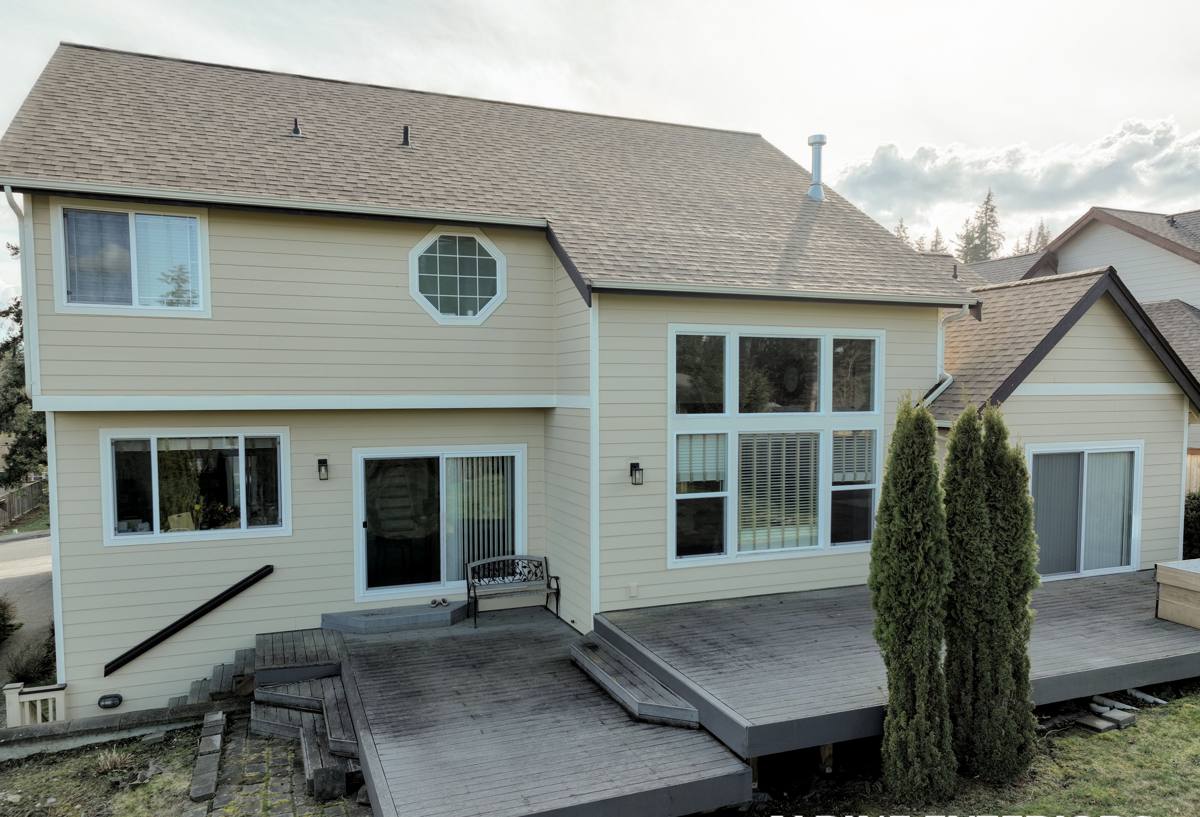
What the Local Climate Actually Does to a Deck
It helps to be specific about the failure modes we're designing around, because "coastal weather" means different things in different parts of the country.
Salt Air
Airborne salt from Semiahmoo Bay and the surrounding shoreline settles on every exposed surface. It's not enough to cause visible damage in a season, but over years it accelerates corrosion on any metal that isn't rated for it — screws, joist hangers, post bases, railing hardware. Once a fastener starts rusting, it weeps stain into the wood or composite around it and loses holding strength at the same time.
Driving Rain
Storms coming off the water don't just fall straight down — wind pushes rain sideways into ledger connections, under railing posts, and into any gap where end grain is exposed. A deck detail that would shed water fine in a calm rain can still let water in during a wind-driven one, which is the more common pattern here for a good chunk of the year.
Moss Season
Between the shade from mature trees common on these lots, the humidity, and the sheer number of damp days, moss and algae get a long runway to establish themselves on any decking surface that stays wet. Moss holds moisture against the board surface, and on wood decking that moisture cycle is what starts rot at the joints and fastener holes.
Choosing Decking Material for This Location
There's no single "best" decking material — there's a best material for this climate and this budget. Here's how the common options actually perform under salt air, standing moisture, and moss pressure, not just in a showroom.
| Material | Moisture/Salt Behavior | Moss Resistance | Upkeep |
|---|---|---|---|
| Pressure-treated pine | Prone to cupping and checking if not sealed regularly; treatment resists rot but not surface weathering | Low — porous surface holds moss spores | Needs re-sealing every 1-2 years in this climate |
| Cedar | Naturally rot-resistant heartwood, but sapwood and cut ends still need sealing | Moderate — still needs periodic cleaning | Annual cleaning and re-oiling recommended |
| Composite decking | Doesn't absorb water or rot; performs consistently in salt air | Higher — smooth-surface boards shed moss more easily than wood grain | Occasional washing; no sealing or staining |
| Tropical hardwood (e.g., ipe) | Very dense, naturally water-resistant | Moderate to high | Periodic oiling to maintain color; otherwise low |
For a lot with heavy shade and standing dampness — which describes a fair number of Dakota Creek properties — we usually steer homeowners toward composite or a well-sealed hardwood over untreated softwoods, simply because the maintenance burden of keeping a wood deck moss-free in constant shade is more than most owners want to take on year after year. That said, plenty of homeowners prefer the look and feel of real wood and are happy to keep up with the sealing schedule — it's a legitimate choice as long as it's made with eyes open about the upkeep.
What's Underneath Matters More Than What's on Top
The decking surface is the part everyone sees, but the framing, fasteners, and flashing underneath are what actually determine whether the deck is still solid in fifteen years.
Fasteners and Hardware
In a salt-air environment, we spec stainless steel or high-grade coated fasteners and connectors rather than standard galvanized hardware. Standard galvanizing can hold up fine inland, but the combination of salt and constant moisture here shortens its service life noticeably. It costs more up front and saves the homeowner from rust streaks and weakened connections down the line.
Ledger and Flashing Details
Where the deck attaches to the house, the ledger board needs proper flashing that directs water away from the house band joist, not just a bead of caulk. Driving rain will find any shortcut in this detail eventually, and a leaking ledger connection is one of the more expensive things to repair after the fact because it usually means opening up siding or trim to fix rot behind it.
Joists and Framing
Joist tops, especially on wood-framed decks, benefit from a protective tape or membrane before decking goes down, which keeps water from sitting on top of the joist where fastener holes create entry points. On a shaded, damp lot, this small detail is often the difference between framing that lasts and framing that needs mid-life repair.
Drainage, Slope, and Keeping Moss From Taking Over
Moss and algae need two things to establish: shade and standing moisture. We can't change how much shade a lot gets, but we can control how long water sits on the deck surface.
- Decking is set with a slight slope away from the house so water runs off instead of pooling
- Board spacing is set to allow airflow and drainage between boards, which matters more in constant-damp conditions than in a drier climate
- Where a deck sits low to the ground or over a shaded crawlspace, we look at ventilation underneath so the substructure has a chance to dry between rain events
- Railing posts and structural posts are detailed so water doesn't collect at the base, which is a common spot for hidden rot to start
None of this eliminates the need for periodic cleaning — moss spores travel on the wind and will land on any surface — but good drainage and airflow buy real time between cleanings and slow how aggressively moss can take hold.
Our Process for a Dakota Creek Deck Build
The steps aren't unusual, but the details at each step are shaped by the site conditions described above.
- Site walk and assessment — we look at sun exposure, tree cover, existing drainage patterns, and how close the build is to grade or standing water, since all of that changes the framing and material approach.
- Design and material selection — layout, railing style, and decking material are chosen together, with moisture exposure and maintenance appetite factored in from the start rather than decided after the fact.
- Permitting — plans are prepared to match what the local jurisdiction requires for the size and height of the structure.
- Framing — ledger flashing, joist protection, and corrosion-resistant hardware go in before anything else is visible.
- Decking and railing installation — spacing, fastening pattern, and slope are set to shed water rather than trap it.
- Final walkthrough — we go over the maintenance expectations for the specific material chosen, so there are no surprises about upkeep down the road.
Permits and Local Considerations
Deck permitting in Blaine and unincorporated Whatcom County depends on the size, height, and attachment of the structure, and that requirement doesn't change based on neighborhood. What can change near Dakota Creek is whether the property falls close enough to the creek or shoreline to trigger critical area or shoreline review in addition to standard building permitting. If your lot backs up to the creek or sits within a buffer area, that's worth checking with the city or county before finalizing a layout, since it can affect how close to the water line a structure can be placed. We handle this as part of the design and permitting step rather than leaving it for the homeowner to sort out separately.
Maintenance a Coastal Deck Actually Needs
A well-built deck in this climate still needs some seasonal attention — the goal of good construction is to make that maintenance manageable, not to eliminate it entirely.
- Sweep debris and standing leaves off the deck surface regularly, especially in fall and through the wet season
- Clean moss and algae film off the surface at least once a year — sooner in heavily shaded areas
- Check railing post bases and any ground-contact posts for signs of moisture trapping
- Inspect fastener heads periodically for rust bleed, which is often the first visible sign of a hardware issue
- Re-seal or re-oil wood decking on the schedule appropriate to the species — don't wait until it visibly grays and cracks
- Keep gutters and downspouts near the deck clear so roof runoff isn't adding extra water onto or under the structure
Why Local Build Experience Matters Here
A deck built to a generic spec sheet can look identical to one built for this specific location — until a few winters of salt air and driving rain go by. The difference shows up in the hardware that doesn't rust, the ledger connection that doesn't leak, and the boards that don't stay green with moss every spring. Crews who build regularly in and around Dakota Creek learn which details actually matter here versus which ones are just industry defaults that don't account for a shoreline-adjacent, heavily shaded lot. That's not a marketing point — it's the practical result of having repaired enough decks that were built without those details in mind.
If you're planning a new custom deck or replacing one that hasn't held up, we're happy to walk the site with you and talk through material and design options honestly, including the trade-offs of each. Reach out for a free, no-pressure estimate using the form below.