 Blaine
 Fiber Cement Siding Built for Custer's Exposure
Custer sits on flat, open agricultural land in Whatcom County, a few miles inland from the Salish Sea but close enough that marine air, wind-driven rain, and a long moss season all reach the properties out here just as surely as they reach homes closer to the water. The open terrain doesn't do homeowners any favors, either — there's little in the way of tree lines, hills, or windbreaks to slow a storm down before it hits a wall, which means siding on a Custer home works harder, more often, than siding on a similarly built house in a more sheltered part of the county.
We install James Hardie fiber cement siding exclusively, and this page is focused specifically on what that means for Custer: what the climate actually asks of a wall out here, what a correct fiber cement install involves, and how our process is built around this particular stretch of Whatcom County rather than a one-size-fits-all install checklist.
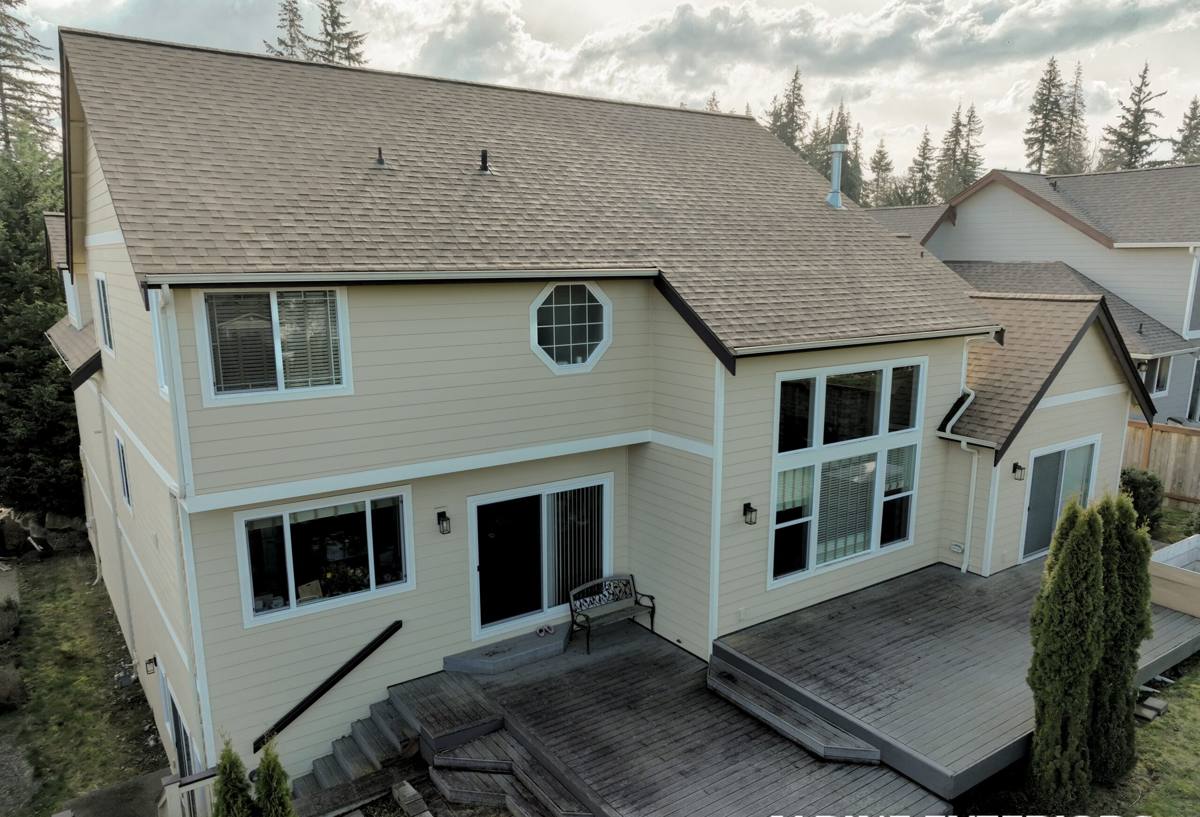
What Custer's Climate Asks of a Fiber Cement Wall
Open Terrain and Wind-Driven Rain
Without much of a windbreak, storms coming off the water tend to arrive with more force here than they would in a more sheltered neighborhood a few miles away. Rain doesn't just fall on a Custer home's siding — it gets pushed sideways into laps, seams, and trim lines that a straight-down rain would never reach. Fiber cement handles that kind of exposure well because it doesn't swell or distort at a wet seam the way a wood-based product can, but it only performs that well when the laps, clearances, and flashing behind it are built for wind-driven conditions, not just average annual rainfall.
Salt-Laden Air Carried Inland
Custer isn't waterfront, but it sits close enough to the Salish Sea that salt-laden air reaches most properties in town on a regular basis, not just the ones with a water view. That steady, low-level salt exposure is hard on exposed fasteners and trim hardware over time, which is why fastener spec and corrosion resistance matter on every Custer job, not only the ones closest to the shoreline.
A Moss Season That Runs Most of the Year
Mild temperatures and consistent moisture add up to a moss and mildew season that stretches across most of the calendar on shaded and north-facing walls, and Custer's flat, often tree-lined lots have plenty of both. Moss holds moisture against a wall surface longer than bare siding would on its own, and that's usually where slow, long-term problems — soft trim, failing caulk joints, premature finish wear — actually start.
Why Fiber Cement Is the Right Call for This Property Type
None of these three conditions — wind-driven rain, salt-laden air, an extended moss season — is unusual for the Pacific Northwest on its own. What makes Custer's exposure worth planning around specifically is that the open terrain removes the natural buffer a lot of other Whatcom County neighborhoods have, so all three show up with less mitigation than they would somewhere more sheltered. That's a large part of why we don't install vinyl, LP SmartSide, Cemplank, Allura, primed spruce, or cedar on Custer homes. Fiber cement is the direction we believe the material needs to go for this kind of exposure, and we standardized on James Hardie specifically within that category.
| Material | Behavior Under Wind-Driven Rain | Salt Air Durability | Moss/Moisture Resistance |
|---|---|---|---|
| James Hardie fiber cement | Dimensionally stable at laps; doesn't swell or cup | Factory finish and corrosion-resistant fastener spec hold up well | Non-organic core doesn't feed moss growth |
| LP SmartSide (engineered wood) | More sensitive at cut edges and fastener penetrations | Coating protects hardware; core is still wood-based | Wood-fiber core is more hospitable to growth if the finish wears |
| Vinyl | Can flex or gap at laps under sustained wind pressure | Doesn't corrode itself, but hardware behind it can | Doesn't feed moss, but traps moisture behind it if it warps |
| Cedar | Absorbs moisture at every exposed seam without regular upkeep | No inherent corrosion issue, but finish fails faster in salt air | Organic surface is highly hospitable to moss and mildew |
James Hardie's ColorPlus factory finish is baked on before the boards ever reach a Custer job site, which matters in an environment where a field-applied coating would be fighting salt air and UV exposure from day one. And because the fiber cement core itself is inorganic, it isn't the material that decides whether moss takes hold on a shaded wall — that comes down to surface care and wall drainage, which the install controls, rather than the product fighting an uphill battle against its own composition.
What a Correct Fiber Cement Install Involves
Fiber cement's reputation for longevity depends heavily on installation quality — the material can only do its job if the details around it are right. On a Custer property, that means:
- House wrap or a weather-resistive barrier installed and properly lapped before any siding goes up
- A drainage gap or rainscreen behind the siding so wind-driven rain that gets past the surface can dry out instead of sitting against the sheathing
- Manufacturer-specified clearances at grade, rooflines, and decks to keep splash-back and standing moisture away from board edges
- Corrosion-resistant fasteners, correctly placed and spaced, to hold up against Custer's salt-laden air over decades, not years
- Properly flashed and lapped transitions at windows, doors, and corners, where wind-driven rain finds its way in when the detailing is off
- Field-cut edges primed before installation so the factory ColorPlus finish's protection isn't undermined at every cut
Skip any one of these and a fiber cement wall can still look fine on install day. The problems that show up when corners get cut — staining at seams, soft trim, premature finish failure — usually take a wet season or two to surface, which is exactly why they're easy for a rushed install to get away with until the homeowner is the one living with it.
Our Process for a Custer Fiber Cement Project
Walkthrough and Assessment
We start by looking at your specific walls — which ones take the brunt of wind-driven rain given your lot's orientation and whatever windbreak it does or doesn't have, which are shaded enough to hold moss longer, and whether the existing wall assembly already has moisture issues that need addressing before new siding goes up. New fiber cement over an already-compromised wall just buries the problem under fresh material.
Planning Before Install Day
We work out clearances, flashing details, and how the siding will meet trim, windows, and rooflines before any material gets cut. Deciding those details on paper first, instead of improvising in the field, is where a lot of long-term performance actually gets decided.
Installation to Manufacturer Spec
Every fastener, clearance, and flashing lap follows James Hardie's published installation requirements for this climate zone. That's what keeps the manufacturer's warranty intact, and it's what keeps the wall performing the way it's supposed to for decades rather than years.
Final Walkthrough
We walk the finished job with you, cover what little ongoing maintenance fiber cement actually requires, and make sure you know what a healthy wall looks like if you ever want to check on it yourself down the road.
Choosing a Profile and Color for a Custer Home
James Hardie's HZ5 product line is engineered for regions with sustained moisture exposure and freeze-thaw cycling, which fits Whatcom County's winters better than product lines built primarily for hot, dry climates. Beyond the underlying product line, most Custer homeowners are choosing between a few practical profiles:
- Lap siding — the most common profile, with a traditional horizontal reveal that suits most house styles in the area
- Board and batten — a vertical profile with more seams, best suited to homeowners who want that specific look and are willing to invest in the extra detailing it requires
- Panel siding — larger sheets with fewer overall seams, sometimes used on outbuildings or as an accent alongside lap siding
Color choice matters more here than it would in a drier climate, since a factory-applied ColorPlus finish is doing real work resisting fade from salt-laden air and UV rather than just looking good on installation day. We walk through the available colors and finishes as part of the estimate, with an eye toward what actually holds up under this kind of exposure over time, not just what looks best on a sample chip.
Cost Factors for Fiber Cement Siding in Custer
Fiber cement generally costs more upfront than vinyl and lands comparable to or somewhat above engineered wood, reflecting the heavier material and more labor-intensive install. Beyond the base material, a few things move the price on a specific Custer property:
| Factor | Why It Matters |
|---|---|
| Wall exposure and orientation | Walls taking direct wind-driven rain with little windbreak may need extra flashing detail |
| Existing wall condition | Rot or moisture damage found during tear-off needs repair before new siding goes up |
| Profile choice | Board and batten and other multi-seam profiles use more material and labor than standard lap |
| Trim and window detailing | More openings mean more flashing and finish work around each one |
| Access and site conditions | Open, flat lots are usually easier to stage than tight or sloped ones, which can shorten labor time |
We'll walk your specific property and give you real numbers rather than a rough estimate based on square footage alone — two homes of similar size in Custer can land at very different costs depending on how many of these factors are actually in play.
Why Hire a Crew That Already Works Custer
Fiber cement rewards installation experience with this specific stretch of Whatcom County in a way a generic install guide can't fully capture. A crew that's worked Custer's open, wind-exposed lots through multiple wet seasons already knows which orientations need extra flashing attention because there's no windbreak to soften the rain, how much clearance actually holds up against salt-laden air carried inland from the Sound, and where a rainscreen gap earns its keep versus where it's optional on a given wall. That judgment doesn't show up on a spec sheet, and it's the difference between a fiber cement wall that still looks and performs the same in twenty years and one that's showing seam staining or soft trim within the first five.
It also matters after the install is finished. If a warranty question or a maintenance question comes up years down the line, it helps to be calling a crew that's still working the same roads, not one that's moved on to a different part of the state entirely.
If you're planning a fiber cement siding project for a Custer home, we're glad to walk the property, look at your specific exposure, and give you a straightforward, no-pressure estimate. There's a form below — reach out and we'll set up a time to take a look.