 Blaine
 Building Decks in Custer That Actually Hold Up
Custer sits close enough to the water and the Canadian border that its decks take a beating most inland builders never have to plan for. Between the salt-laden air drifting off Semiahmoo Bay and Drayton Harbor, the long stretches of driving rain typical of Whatcom County winters, and a moss season that can run from October well into April, an outdoor deck here is under near-constant environmental pressure. A deck built the way it might be built in a drier climate — standard fasteners, tight board spacing, no real drainage plan underneath — will show problems within a few seasons: rust bleed at the screw heads, soft spots where water pools, and a green film that never fully goes away no matter how often it's power washed.
We build decks for homes in Custer and the surrounding Blaine area specifically with that climate in mind. That means different hardware, different spacing, different attention to how water moves off and away from the structure, and material choices that are honest about what will and won't hold up over ten or twenty years in this environment.
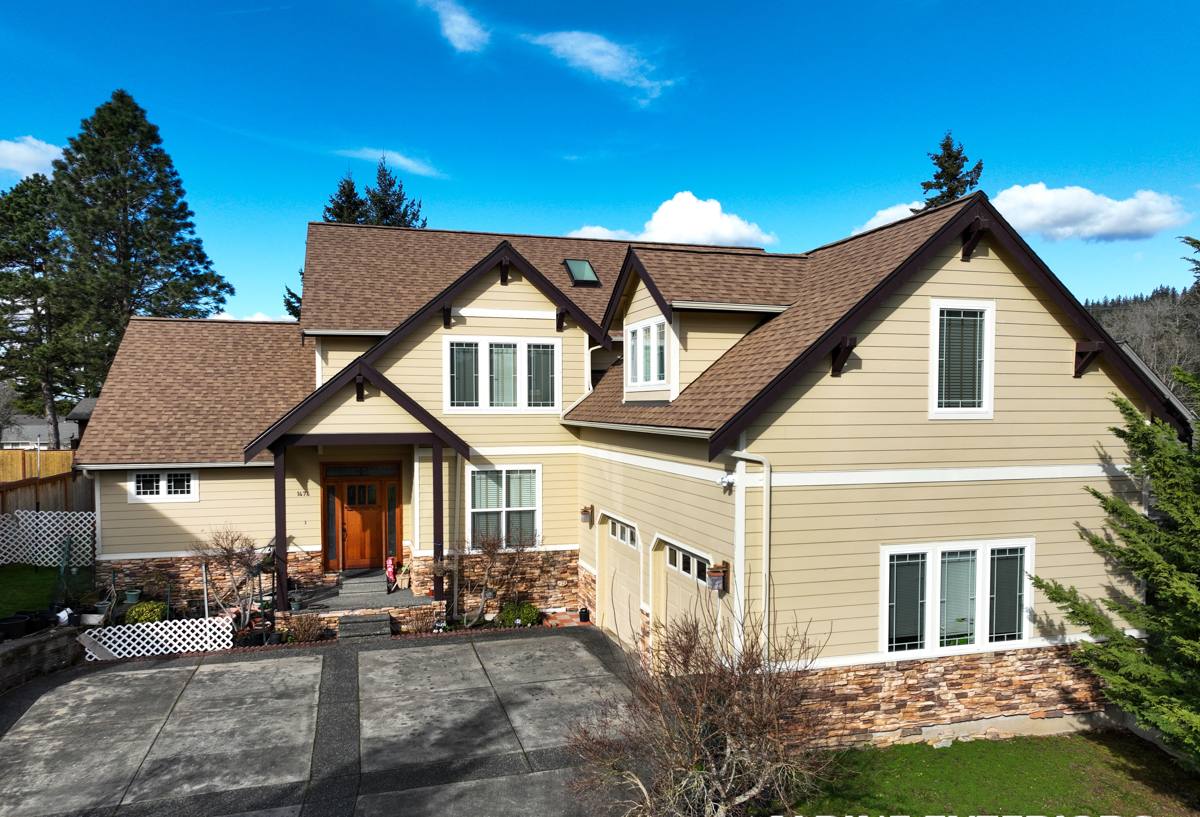
What the Local Climate Actually Does to a Deck
Salt air and corrosion
Homes within a few miles of the coastline see accelerated corrosion on any metal component that isn't rated for it — fasteners, joist hangers, railing brackets, even some post caps. Standard galvanized hardware can start showing rust streaks down the face of decking boards within a couple of years in a salt-air environment. This isn't a defect in the wood; it's the hardware failing to keep up with the exposure.
Sustained rain and moisture cycling
Whatcom County doesn't get short, hard downpours as much as it gets long, steady rain that soaks structures for days at a time. A deck's substructure — the framing, ledger board, and any wood in contact with the ground or foundation — needs a real path for that water to drain and dry out between storms. Where that path is blocked or undersized, you get trapped moisture, and trapped moisture is what leads to rot, not rainfall itself.
Moss and organic growth
Shaded, north-facing, or tree-covered lots around Custer stay damp for months at a stretch, which is exactly what moss and algae need to establish. On decking, this isn't just cosmetic — moss holds moisture against the board surface, which accelerates decay in wood decking and can stain composite and PVC products over time if the surface isn't finished to shed water and debris.
What a Correctly Built Deck Involves Here
A deck that's going to last in this climate comes down to a handful of details that are easy to skip and expensive to fix later:
- Corrosion-resistant fasteners and hardware throughout, not just where it's visible
- Proper ledger board flashing where the deck attaches to the house, so water can't work its way behind the siding
- Adequate board spacing to let water drain through rather than pool on the surface
- Ventilation and drainage beneath the deck, especially on low-clearance builds close to grade
- Footings set below frost depth and rated for the soil conditions on the lot
- Railing systems that won't loosen as wood swells and shrinks through wet and dry cycles
None of these are exotic upgrades — they're the difference between a deck that needs board replacement in seven years and one that's still solid at twenty-five, in a climate that doesn't give a structure much of a break.
Choosing a Decking Material for Custer's Conditions
There's no single "right" material for every homeowner — budget, maintenance appetite, and how the deck will be used all matter. What we do insist on is being straightforward about the trade-offs of each option under local conditions, rather than pushing whatever has the best margin.
| Material | How It Handles Our Climate | Maintenance | Typical Lifespan |
|---|---|---|---|
| Pressure-treated wood | Good value; needs proper sealing and airflow underneath to resist rot and moss staining | Annual cleaning and re-sealing every 2-3 years | 15-20 years with upkeep |
| Cedar | Naturally more rot-resistant than pine framing lumber; still needs finish maintenance in this rainfall | Cleaning plus periodic oil or stain | 20-25 years with upkeep |
| Composite decking | Resists rot and doesn't absorb water like wood; some early-generation composite products can hold moisture at the core if damaged, so proper edge sealing at cuts matters | Periodic washing to keep moss and mildew from taking hold on the surface | 25-30+ years |
| PVC/capped decking | Fully sheds water at the surface; performs well in salt air and constant moisture | Occasional washing | 25-30+ years |
For homes closer to the water in Custer, we lean toward recommending composite or PVC decking on the walking surface, paired with a well-drained substructure, simply because they remove one variable — surface moisture absorption — from a climate that's already working against wood. That said, plenty of well-built and properly maintained wood decks in this area hold up fine; it comes down to whether the homeowner wants to stay ahead of the maintenance schedule.
Framing, Footings, and What's Underneath Matters More Than the Surface
Homeowners often focus on the decking boards because that's what they see, but the framing and footings are what actually determine how long a deck lasts. In this part of Whatcom County, footings need to be set to the depth required for local soil and frost conditions, and ledger connections to the house need flashing that integrates properly with the existing siding and weather barrier — not just caulk over a lag bolt. Where a deck sits low to the ground, we pay particular attention to grading and drainage underneath so water has somewhere to go instead of sitting against the joists year-round.
This is also where using fasteners and joist hangers rated for coastal or high-moisture exposure earns its keep. It costs more up front than standard galvanized hardware, but it's the difference between hardware that's still sound at year twenty and hardware that's staining the decking and losing grip strength by year five.
Railings, Stairs, and Hardware in a Salt-Air Environment
Railing posts and connection hardware take a disproportionate amount of stress compared to the decking field, since they're what people actually lean and push against. In a salt-air environment, we use fasteners and structural connectors rated to resist that corrosion, and we make sure post connections are through-bolted into framing rather than just screwed to the rim joist. Stair stringers, similarly, need to be sized and fastened so they don't develop play as the wood moves seasonally with the area's wet-to-dry cycling.
Our Process for a Custer Deck Project
- On-site assessment — we look at sun and shade exposure, drainage on the lot, proximity to the water, and how the deck will be used before recommending materials
- Design and material selection — sized to the house, the intended use, and an honest conversation about maintenance versus upfront cost
- Permitting — deck projects in this area typically require a permit depending on size and height; we handle that process rather than leaving it to the homeowner
- Footings and framing — built to local frost depth and soil conditions, with attention to drainage underneath
- Decking, railing, and stairs — installed with corrosion-resistant fasteners and proper spacing for drainage
- Final walkthrough — checking fastener seating, railing rigidity, and drainage before we call the job done
Living With a Deck Through Moss Season
Even a well-built deck needs some seasonal attention in this climate. A few habits go a long way toward protecting the investment:
- Sweep leaves and debris off the surface regularly through fall, when moss gets its foothold
- Keep gutters and downspouts near the deck clear so runoff isn't dumping directly onto or under it
- Wash the surface at least once a year to knock back algae and moss before it stains or holds moisture
- Check railing posts and stair connections annually for any looseness
- Trim back overhanging branches that keep the deck surface shaded and damp longer than necessary
None of this requires a contractor visit — it's just basic upkeep that keeps a properly built deck performing the way it should.
Why It Matters to Hire a Crew That Works Custer and Blaine Regularly
A deck builder who mostly works drier, inland areas isn't necessarily going to default to salt-resistant hardware or think through under-deck drainage the way it needs to be handled here — not out of carelessness, but because it's simply not the daily problem they're solving. A crew that already works Custer, Blaine, and the rest of this stretch of Whatcom County has already run into the corrosion, moss, and moisture issues specific to this coastline, and builds accordingly from the first fastener. It also means faster response if a warranty question or maintenance issue comes up later, rather than coordinating with a company that has no ongoing presence in the area.
Get a Straightforward Estimate
If you're planning a new deck or replacing one that's showing its age, we're happy to take a look and walk through the options honestly — materials, hardware, and what it will actually take to make the deck last in Custer's climate. The estimate is free, and there's no pressure to move forward. Use the form below to get started.