 Blaine
 Siding Repair Built for the California Creek Corridor
California Creek runs through low-lying, tree-shaded ground just outside Blaine before it reaches Semiahmoo Bay, and homes along that corridor deal with a slightly different mix of punishment than siding a few miles inland. There's more standing shade from mature trees, more humidity that lingers after a storm instead of drying off in open wind, and the same salt-laden air that moves in off the water throughout Whatcom County. None of that is dramatic on its own. It's the combination, repeated over years, that shows up as soft trim, cracked caulk lines, and moss creeping up from the bottom courses of a wall.
Siding repair in this area isn't a generic fix. It has to account for why the damage happened in the first place, or the same spot fails again in a season or two.
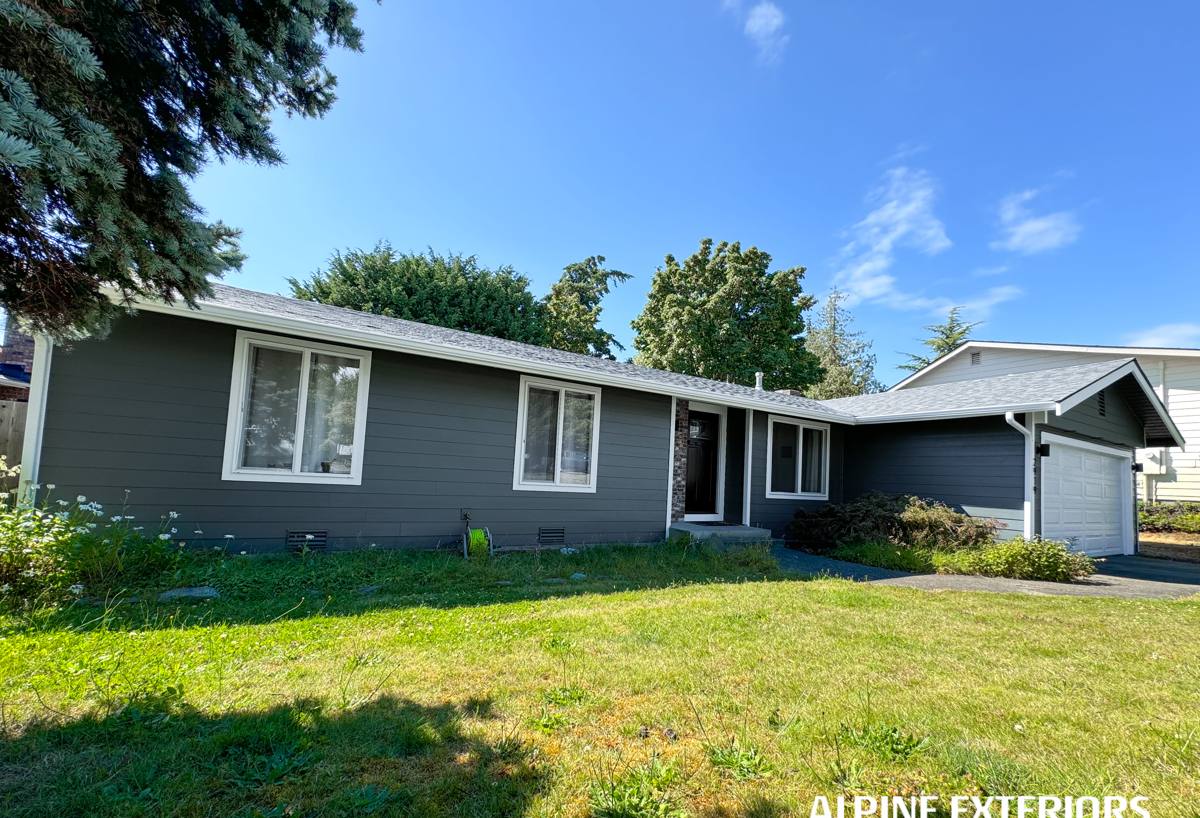
Why This Climate Wears Down Siding Faster
Salt air
Proximity to Semiahmoo Bay and the Strait of Georgia means airborne salt settles on exterior surfaces, accelerates corrosion on fasteners and metal flashing, and can slowly degrade paint film and caulk adhesion faster than it would further inland.
Driving rain
Blaine gets wind-driven rain off the water, not just straight-down rain. That matters because driving rain gets pushed sideways into lap joints, butt seams, and anywhere caulk has started to shrink or pull away — points that shed a straight-down rain just fine but fail under a sideways gust.
Moss and shade
The tree cover common along the creek keeps siding damp longer after every rain. Moss and algae take hold in that lingering moisture, and once established they hold water against the siding surface around the clock, not just during a storm.
Signs Your Siding Needs Repair Now, Not Later
- Soft or spongy spots when you press on the siding, especially near the bottom courses or under window sills
- Visible moss or dark green-black staining that keeps coming back after cleaning
- Caulk lines that have cracked, shrunk, or pulled away from joints and trim
- Paint that's bubbling, peeling, or chalking heavily in one section but not others
- Rust streaking below nail heads or metal flashing
- Gaps or warping at butt joints where two pieces of siding meet
- Any spot where you can see daylight, feel a draft, or notice a musty smell from inside near an exterior wall
Any one of these on its own might be minor. Two or three in the same area usually means water has been getting behind the siding for a while, and the repair needs to address the water path, not just the visible symptom.
What a Correct Repair Actually Involves
A repair that only replaces the damaged board and caulks the edges is a cosmetic fix. A correct repair traces the problem back to its source. That usually means:
- Removing enough siding to see the sheathing and house wrap behind it — not just the piece that looks bad, but enough to confirm how far the damage actually goes.
- Checking the water-resistive barrier and flashing at that spot. If the house wrap is torn, or flashing above a window or door is missing or improperly lapped, replacing the siding alone won't stop the problem from coming back.
- Letting the substrate dry and confirming there's no rot in the sheathing before anything new goes back on. Closing damp sheathing back up under new siding just delays the next repair.
- Matching material, profile, and reveal so the repaired section doesn't stand out and, more importantly, so it sheds water the same way the surrounding wall does.
- Re-flashing and re-caulking properly at every joint, with attention to how wind-driven rain will hit that spot specifically.
Repair or Replace? How We Make That Call
Not every problem area needs a full re-side, and we won't tell you it does just to sell a bigger job. But there's a point where patch repairs stop making sense. Here's roughly how we think about it:
| Situation | Repair usually makes sense | Full replacement usually makes sense |
|---|---|---|
| Damage location | Isolated to one or two wall sections | Spread across multiple elevations |
| Underlying sheathing | Sound, dry once opened up | Soft or rotted in more than one spot |
| Siding material | Still available or closely matchable | Discontinued, badly faded, or a product we won't warranty repairs on long-term |
| Age of siding | Under roughly two-thirds of its expected service life | Near or past its expected service life with recurring issues |
| Moss/algae extent | Surface-level, cleans up after repair | Established enough that it's affecting multiple courses and trim |
We'll walk the whole exterior, not just the spot you called about, because a problem visible on one wall often has a quieter twin starting somewhere shadier or closer to grade.
What We Repair With, and Why
If your existing siding is James Hardie fiber cement, repairs are straightforward — we patch in matching Hardie boards or panels and blend the ColorPlus factory finish or repaint to match, and the repaired section performs exactly like the rest of the wall going forward.
If the existing siding is something else — cedar, vinyl, an older composite, or a primed wood product — we'll still repair it honestly where a repair is the right call. What we won't do is pretend a patch on a failing material is a long-term fix. Wood and composite sidings in a shaded, salt-air, high-moisture spot like the California Creek corridor tend to show recurring problems in the same areas because the material itself is working against the climate, not because of a one-time installation flaw. When a homeowner is dealing with repeat failures on those materials, we'll say so plainly and explain why we've standardized on James Hardie fiber cement for anything beyond a straightforward patch: it's non-combustible, engineered for wet marine climates, holds its factory finish far longer than field-painted wood or composite, and carries a strong transferable warranty. That's a bigger conversation than a repair call, and we only bring it up when the repair history actually points that direction — not as an upsell on every visit.
Our Process for California Creek Siding Repair
Because we already work this stretch of Blaine, we're not learning the local conditions on your dime. Our process:
- On-site inspection of the reported problem area plus a full exterior walk, checking shaded and low-airflow spots that tend to hide moss and moisture first
- Opening up the affected section to check sheathing, house wrap, and flashing before quoting a fix
- A written scope that tells you plainly whether this is a repair, and what we found that led to that call
- Matched materials and proper re-flashing, not just a patch-and-caulk job
- A final check that the repaired area sheds water the way the rest of the wall does — not just that it looks right
Why Local Experience Matters More Than It Sounds
Whatcom County has plenty of exterior contractors, but not all of them spend regular time in the tighter, tree-covered, water-adjacent lots around California Creek. A crew that's used to open, sun-exposed subdivisions can miss why moss keeps coming back on a shaded north wall, or underestimate how far wind-driven rain off the bay travels sideways into a joint. Working this area regularly means we're not guessing at where water actually goes on a given wall — we've seen the pattern before on a similar lot nearby.
Keeping Repaired Siding Ahead of the Next Wet Season
A good repair buys you years, but a little upkeep stretches that further, especially in a spot with this much shade and moisture:
- Rinse moss and algae off siding before it gets a foothold, rather than waiting until it's visibly established
- Trim back branches and vegetation that keep a wall in constant shade and slow drying time
- Walk the exterior once a year, ideally before the wet season ramps up, and check caulk lines at joints and trim
- Keep gutters and downspouts clear so roof runoff isn't dumping extra water against a wall
- Address small paint or caulk failures while they're small — they're inexpensive to fix and expensive to ignore
If you're seeing soft spots, recurring moss, or failing caulk on a home near California Creek, we're happy to take a look and give you a straight answer on what it needs — repair, or something more. The estimate is free, there's no pressure attached, and you'll get a clear explanation of what we found and why.