 Blaine
 Siding Replacement for Homes Around Blaine Harbor
Homes around Blaine Harbor sit about as close to open water as a house in Whatcom County can get. The harbor and marina bring boat traffic, open exposure across the water, and a nearly constant flow of salt-laden air onto the siding of every house nearby, whether it has a direct water view or sits a block or two back. That's a harder environment than most of Whatcom County deals with, and it's a different question from siding replacement anywhere else in Blaine — homes right at the harbor take the exposure first and hardest, with less tree cover and fewer structures to break up the wind before it reaches the wall.
This page is specifically about siding replacement for homes in the Blaine Harbor area — pulling off an existing, aging siding system and putting on a new one — not new construction and not small patch repairs. Replacement is a different job with different stakes: it means an honest look at what's been happening behind the old siding for years, sometimes decades, before anything new goes up. We install James Hardie fiber cement exclusively, and everything below is written around that system, since it's the only one we put on Blaine Harbor homes.
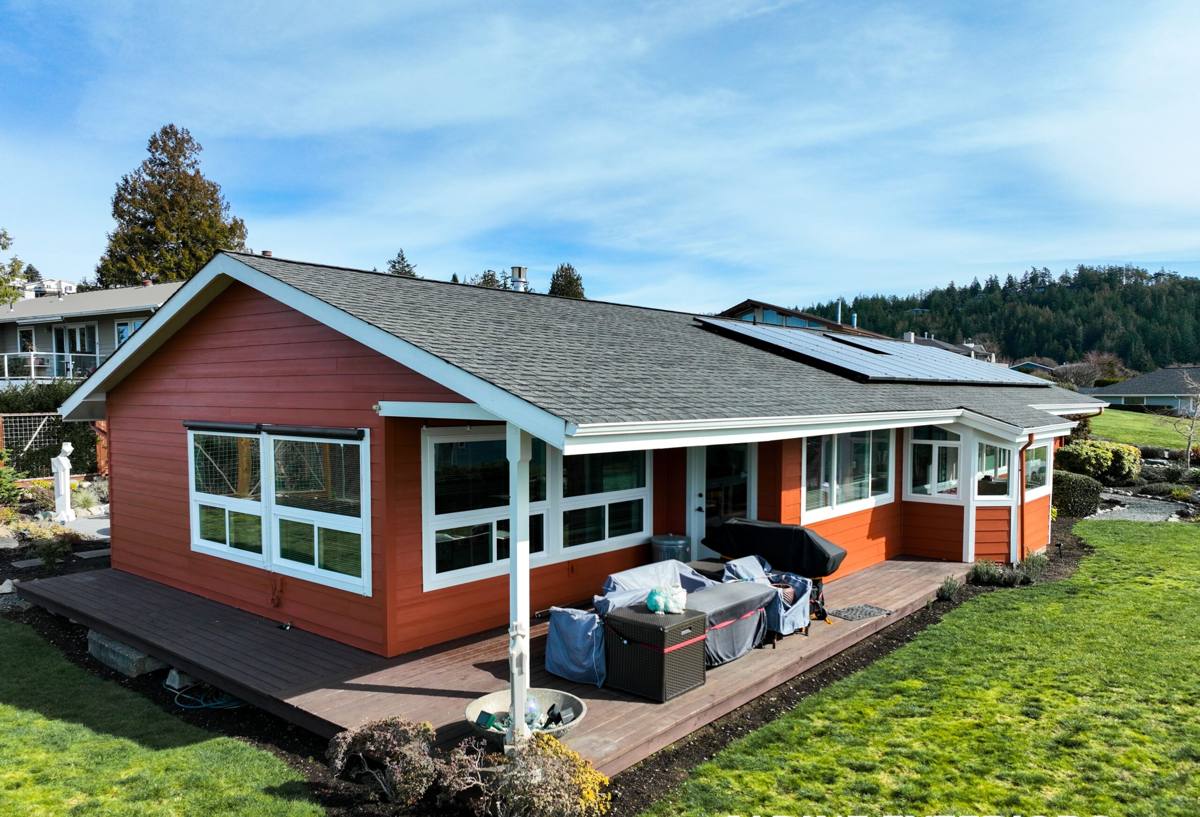
What Harbor Exposure Does to Siding Over Time
Salt Air Right Off the Water
Being this close to the harbor means salt-laden air isn't an occasional condition, it's a daily one. Salt accelerates corrosion on fasteners, flashing, and any exposed metal trim, and it breaks down lower-grade paints and coatings faster than a home even a mile or two inland would ever see. On a replacement project, this shows up as corroded nails, streaked trim, and a finish that's clearly failed well ahead of its expected life — often the first visible sign that a siding system installed decades ago wasn't built with this level of exposure in mind.
Driving Rain and Wind Funneling Off the Harbor
Open water gives wind a clean run at the house, and storms coming off the harbor push rain sideways into wall assemblies, window flashing, and siding joints instead of just falling straight down. That wind-driven pattern puts more stress on a wall than the same total rainfall would in a sheltered location, and it finds gaps that a calmer climate would never expose. Older siding systems, especially ones installed before rain-screen detailing and modern water-resistive barriers were standard practice, are often not built to handle water arriving from the side.
A Moss Season That Barely Lets Up
Mild temperatures and near-constant moisture give moss and mildew a growing season that runs most of the year on shaded or north-facing walls near the harbor. Anything porous enough to hold moisture against the surface becomes a growth surface eventually, and older wood-based or lower-grade siding products are especially prone to it. On a lot of Blaine Harbor homes, the wall facing away from the sun or shaded by a neighboring structure shows moss and staining years before the rest of the house does.
Repair or Replace? Reading the Signs on a Harbor Home
Not every siding problem on a Blaine Harbor home means a full replacement. Isolated damage — a cracked board from an impact, a small area of failed caulking — can often be repaired. But this close to the water, damage tends to be a symptom of a broader issue rather than an isolated event, since the whole wall has been taking on the same salt air and wind-driven rain for the same number of years. A few signs that point toward replacement rather than repair:
- Soft or spongy siding in more than one area of the wall, not just around one window or corner
- Moss or dark staining that returns quickly after cleaning, especially on multiple walls
- Paint or finish failure across large sections rather than one weathered spot
- Visible warping, cupping, or separation at panel joints and seams
- Rust streaking from corroded fasteners showing up in more than a few isolated spots
- Interior signs — musty smells, soft drywall, or staining near exterior walls — that suggest moisture has already gotten behind the siding
If more than one of these shows up, it's usually a sign the siding system as a whole has reached the end of what it can protect the house from, not that a section needs patching.
What a Correct Replacement Involves
A siding replacement isn't just pulling off the old material and nailing up new panels. On a Blaine Harbor home, what's underneath the old siding matters as much as what goes back on top of it, because years of salt air and driving rain exposure mean there's a real chance moisture has already worked its way into the wall assembly.
Tear-Off and an Honest Look at the Sheathing
Once the old siding comes off, the sheathing underneath gets inspected before anything new goes up. This is the step that gets skipped when a contractor is racing to install over an existing wall, and it's the step that matters most on a harbor-exposed home. Soft, delaminated, or water-stained sheathing needs to be addressed at this stage — covering it with new siding just buries the problem under a fresh surface.
A Continuous, Properly Lapped Water-Resistive Barrier
The barrier underneath the siding does most of the real work of keeping wind-driven rain out of the wall, and on a harbor-facing wall it needs to be installed with every seam and penetration lapped and sealed correctly, not just stapled up quickly before the siding covers it.
Correct Fastening and Clearances
James Hardie specifies fastener type, spacing, and minimum clearance above grade, decks, and roofing, and those specs exist for a reason on a home this exposed. Skipping them doesn't show up on install day — it shows up two or three winters later as wicking, softness, or fastener corrosion.
Sealed Field Cuts and Flashing at Every Penetration
Windows, doors, vents, and hose bibs all interrupt the siding plane, and every one of those interruptions is a place water can get behind the wall if it's flashed incorrectly. Any panel cut on site gets sealed before it goes up, not left raw.
Why We Replace With James Hardie Fiber Cement
We install one siding system on Blaine Harbor homes: James Hardie fiber cement. We don't install LP SmartSide, vinyl siding, Cemplank, Allura, primed spruce, or cedar. That's a professional standard we've settled on, not a sales pitch, and it comes from what we've consistently found underneath older siding systems on tear-offs in exactly this kind of harborfront, salt-air environment.
- Non-combustible core: Fiber cement doesn't feed a fire the way wood-based siding products can, which matters for both safety and insurance considerations.
- Factory-applied ColorPlus finish: The color is baked on under controlled factory conditions instead of brushed on in the field, so it resists fading, chalking, and moisture damage far longer than site-applied paint.
- Climate-engineered HZ5 formulation: Built for regions with sustained moisture exposure and freeze-thaw cycling, which fits harborside Whatcom County well.
- Dimensional stability: Fiber cement doesn't swell, cup, or warp the way engineered wood products can after repeated wetting in a marine climate.
- Strong transferable warranty: Hardie backs the product with one of the stronger warranty structures in the industry, provided the installation follows their spec.
Each of the products we don't install has a legitimate place in the market and homeowners who are satisfied with them in less demanding settings. But a wall exposed to open harbor water and wind nearly every day of the year is exactly the setting where those products' weaknesses — moisture-sensitive cores, field-applied finishes, higher maintenance burdens — show up soonest. We'd rather stand fully behind one system than offer something cheaper that quietly shifts long-term maintenance risk onto the homeowner.
Comparing Materials for a Harborfront Replacement
| Material | Moisture Behavior at the Harbor | Maintenance in Salt Air | Typical Longevity Here |
|---|---|---|---|
| James Hardie fiber cement | Dimensionally stable, resists swelling and warping | Low; factory finish resists fading and chalking | 30+ years with correct installation |
| Vinyl siding | Can distort or warp under direct heat and wind load | Low upfront; seams and fasteners remain exposure points | Variable; often shorter this close to open water |
| LP SmartSide / engineered wood | Wood-based core is moisture-sensitive at cut edges and joints | Moderate; edge sealing and caulk upkeep matter | Depends heavily on installation and ongoing maintenance |
| Cedar / primed wood | Absorbs and releases moisture readily | High; regular refinishing needed in salt-laden air | Shorter without consistent, ongoing upkeep |
Our Replacement Process, Step by Step
- Site assessment: We walk the property and evaluate how each wall is exposed to harbor wind and water, where past moisture damage or moss shows up, and what condition the current siding is actually in.
- Written scope and estimate: Before any work starts, we put together a clear, itemized scope so there are no surprises about what's included.
- Tear-off and sheathing inspection: Old siding comes off and the sheathing gets checked for rot or water damage before anything new goes up.
- Weather barrier and flashing: A continuous water-resistive barrier goes on with proper laps and taped seams, followed by correctly integrated flashing at every window, door, and penetration.
- Siding installation to manufacturer spec: Panels go up following Hardie's fastening, spacing, and clearance requirements as the baseline, with field cuts sealed as they're made.
- Final walkthrough: We go over the completed work with the homeowner and talk through what basic upkeep looks like on a home this close to the harbor.
Timing a Replacement Around the Harbor's Weather
The wettest, windiest stretch in this part of Whatcom County generally runs from late fall through winter, and the open exposure at Blaine Harbor can make bad-weather days shut down safe siding work more often than a few miles inland. Spring and summer typically offer the most reliable stretch for tear-off and installation, since fiber cement, the weather barrier, and sealants all perform best going on and curing under dry, stable conditions. That said, if a home is already showing signs of moisture getting behind the siding, it's worth addressing on its own timeline rather than waiting out the calendar — active water intrusion doesn't pause for the season.
A Quick Checklist Before Hiring for a Harbor Replacement
- Ask whether the sheathing gets inspected during tear-off, not just replaced over
- Confirm current Washington contractor licensing and insurance
- Ask what fastener grade and clearance standards they use for salt-air exposure
- Get a written scope of work before signing anything
- Ask how they handle unexpected sheathing damage found once old siding comes off
Why a Crew That Already Works Blaine Harbor Matters
A contractor who mostly works more sheltered, inland jobs can still do competent work, but a harbor-exposed home has variables that don't come up as often elsewhere — heavier salt exposure, wind funneling straight off open water, and sheathing that's had years to absorb moisture behind an aging siding system. Working this area regularly means we're not guessing at those conditions on your project. We've seen what tends to be hiding behind older siding on Blaine Harbor homes, which fastener grades actually hold up here, and which details are worth the extra time rather than a shortcut.
If your Blaine Harbor home has siding that's reaching the end of its life, or you just want an honest read on whether repair or full replacement makes more sense, we're glad to walk the property with you. Reach out below for a free, no-pressure estimate.