 Blaine
 Blaine Harbor's Climate Is Rougher on Siding Than Most Homeowners Realize
Homes near Blaine Harbor sit at the edge of Puget Sound, where salt-laden air, wind-driven rain, and a long, damp Pacific Northwest winter all work on exterior walls at the same time. It's a different environment than siding a few miles inland. Salt air accelerates corrosion on fasteners and metal trim, wind pushes rain sideways into joints and seams that would stay dry elsewhere, and Whatcom County's mild, wet winters give moss and algae months to establish themselves on north-facing and shaded walls. None of this is dramatic on its own, but stacked together over years, it's exactly the combination that exposes weak siding installations — and weak siding materials — faster than almost anywhere else in the region.
This page is about one thing specifically: what it takes to install siding correctly on a Blaine Harbor home, given that climate, and why the product and the crew you choose both matter more here than they would in a drier, more sheltered part of the state.
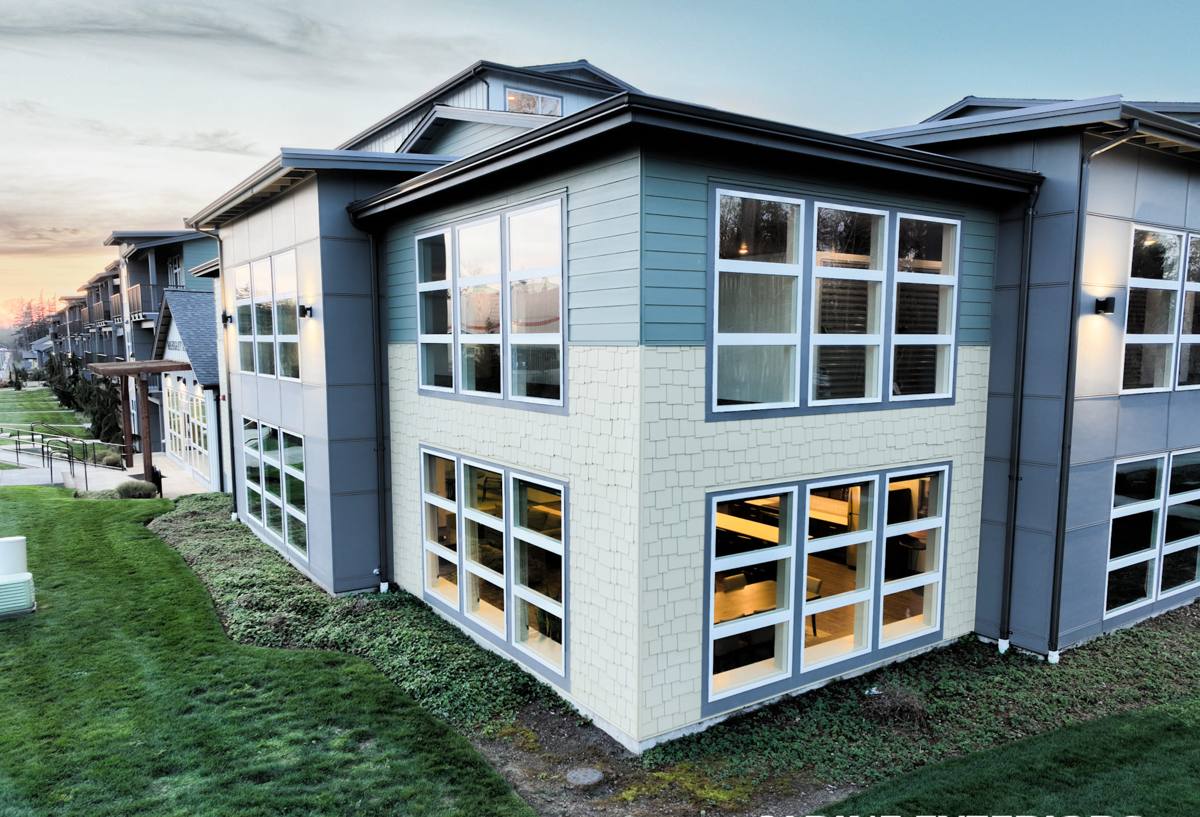
What Salt Air, Rain, and Moss Actually Do to a Wall System
It helps to be specific about the failure points, because they're predictable:
- Salt air speeds up corrosion on exposed steel and low-grade aluminum trim, fasteners, and flashing — problems that usually show up first as rust streaking or staining near seams.
- Driving rain off the water finds any gap in flashing, caulking, or panel overlap and pushes moisture behind the siding instead of letting it run off the face, which is where rot and hidden water damage start.
- Prolonged damp and shade on north and east-facing walls near tree lines lets moss, algae, and mildew colonize a siding surface that doesn't dry out quickly between rain events.
- Freeze-thaw cycling, while milder here than inland, still happens enough winters to stress any siding that's already absorbing moisture it shouldn't be.
None of these forces are exotic — they're the same forces every coastal Pacific Northwest town deals with. What changes near Blaine Harbor is the frequency and intensity, which is why installation details that are "good enough" fifteen miles inland aren't good enough here.
How Common Siding Materials Hold Up in This Environment
We get asked constantly why we standardized on one product instead of offering several. The honest answer is that in a marine climate like Blaine Harbor's, material choice isn't a style decision — it's a maintenance and longevity decision.
| Material | Behavior in salt air & driving rain | Moss/algae resistance | Long-term maintenance burden |
|---|---|---|---|
| Vinyl siding | Can warp or become brittle with UV and temperature swings; seams are a weak point against wind-driven rain | Low — surface holds moisture and grime, promotes growth | Moderate to high; panels can crack and are hard to color-match when replaced |
| LP SmartSide (engineered wood) | Wood-based core is vulnerable if moisture gets behind panels or into cut edges | Low to moderate; needs consistent sealed edges and prompt repainting | High; edge sealing and repainting on a strict schedule |
| Cedar / primed spruce | Natural wood absorbs moisture readily; salt air accelerates weathering | Low; organic material is a food source for moss and mildew | Highest; regular refinishing, caulking, and moisture monitoring |
| James Hardie fiber cement | Non-combustible, dimensionally stable cement composite; engineered HZ5 line is formulated for the Pacific Northwest's wet climate | High; factory ColorPlus finish resists moisture absorption at the surface | Low; periodic rinsing and inspection, no refinishing cycle required |
This isn't a claim that other materials are defective — vinyl, engineered wood, and cedar all have legitimate uses. It's that in a location dealing with salt air, sideways rain, and a long moss season every single year, the maintenance and moisture behavior of those materials becomes a recurring homeowner burden rather than a rare one. That's the trade-off we decided we didn't want to install into Blaine Harbor homes.
Why We Installed Fiber Cement, Specifically Hardie
James Hardie's fiber cement is a mix of cement, sand, and cellulose fiber, engineered to be dimensionally stable — it doesn't expand and contract with moisture the way wood-based products do, which matters directly on a wall that's absorbing rain and salt spray for months at a time. It's non-combustible, holds its factory ColorPlus finish without the repainting cycle that wood siding needs, and the HZ5 product line is formulated specifically for wetter, harsher climates like ours rather than a one-size-fits-all national spec. Paired with a transferable warranty, it's the product we're comfortable standing behind on a coastal installation.
What a Correct Installation Actually Involves Here
Siding installation near the water isn't just fastening panels to a wall — the parts you don't see are what determine whether the job holds up.
Weather-Resistive Barrier and Flashing
Every wall gets a continuous weather-resistive barrier behind the siding, with flashing detailed at every window, door, and penetration so wind-driven rain has a drainage path out instead of a path in. This is the single most common shortcut on rushed jobs, and it's the one that causes hidden rot years later.
Fastening and Corrosion Resistance
Given the salt-air exposure, fastener selection matters more here than inland. Corrosion-resistant fasteners and trim hardware, installed to the manufacturer's spacing and depth specs, prevent the rust staining and loosening that plain fasteners develop over a few salt-air winters.
Clearances, Trim, and Caulking
Hardie's installation instructions specify minimum clearances from grade, roofing, and decking so the bottom edge of the siding isn't sitting in standing moisture. Joints are caulked with a product rated for the movement and moisture cycling this climate produces, not a generic bead that will fail in a season or two.
Our Process for a Blaine Harbor Siding Installation
- On-site assessment — we walk the home, note existing moisture damage, wall orientation relative to prevailing wind and rain, and any areas already showing moss or staining.
- Tear-off and sheathing inspection — old siding comes off and the sheathing underneath is checked for rot or soft spots before anything new goes up, since covering a damaged wall just hides the problem.
- Weather barrier and flashing installation — a continuous drainage plane is installed and detailed around every opening.
- Hardie panel installation — installed to manufacturer spec for fastening, clearance, and seam treatment, using the HZ5 climate-engineered product line.
- Trim, caulking, and final inspection — trim and joints are sealed, and we walk the finished job before calling it done.
Living With Salt Air and Moss: What Ongoing Maintenance Looks Like
Correctly installed fiber cement siding is low-maintenance, not no-maintenance. In a Blaine Harbor environment, a short annual routine keeps it performing the way it's supposed to:
- Rinse siding once or twice a year, focusing on shaded, north-facing, and tree-line-adjacent walls where moss and algae take hold first.
- Walk the exterior after major windstorms and check for loose trim, damaged caulking, or debris caught behind panels.
- Keep gutters clear so overflow isn't running directly down the siding face during heavy rain events.
- Trim back vegetation and tree cover that keeps a wall section damp and shaded longer than the rest of the house.
- Have caulking and trim seals inspected every few years — they're the first thing to age, well before the siding panels themselves.
Cost Factors for Siding Installation Near the Harbor
Every home is different, but the same handful of factors drive cost on most Blaine Harbor jobs:
| Factor | Why it affects cost |
|---|---|
| Tear-off scope | Removing and disposing of existing siding down to the sheathing, versus a simpler re-side |
| Sheathing repair | Rot or moisture damage found once old siding comes off requires repair before new siding goes on |
| Home size and wall complexity | Corners, dormers, and multiple stories add labor and trim work |
| Wind and salt exposure of the site | Homes directly exposed to the water may warrant additional flashing and sealing detail |
| Trim and accent work | Custom trim, fascia, and color combinations add material and labor time |
We give firm numbers only after seeing the home in person — anyone quoting a full siding job over the phone without an on-site look isn't giving you a real estimate.
Why a Crew That Already Works Blaine Harbor Matters
A contractor who's done siding work in this specific area already knows which wall orientations take the worst weather, how much clearance a given lot's drainage needs, and what corrosion-resistant hardware actually holds up here versus what looks fine for the first year or two. That's not something you can fully substitute with a generic installation manual — it comes from repeatedly seeing how Blaine Harbor's combination of salt air, wind, and moss plays out on real homes over time. It also means a crew that's accountable locally, not a company that installed one job in the area and moved on.
If you're planning a siding project on a Blaine Harbor home, we're happy to take a look and walk you through what we'd recommend for your specific walls and exposure. Reach out using the form below for a free, no-pressure estimate.