 Blaine
 Why Birch Point Roofs Take a Different Kind of Beating
Birch Point sits close enough to the water that its roofs deal with a combination most inland Whatcom County homes never see: salt-laden air, wind that comes off the strait with real force, and a wet season that stretches on long enough to grow a thick coat of moss before summer ever shows up. Any one of those on its own is manageable. Together, they shorten the life of roofing materials, hide damage in places homeowners don't think to check, and turn small storm damage into a bigger repair if it sits too long.
A roof in a drier, more sheltered part of the county might go years between real problems. A Birch Point roof is working against salt corrosion on metal fasteners and flashing, wind uplift on shingle edges, and moss that holds moisture against the roof deck for months at a time — often all in the same season. When a storm comes through, it's rarely doing damage to a roof that was otherwise in perfect shape. It's usually finding the weak point that salt air and moss had already been working on.
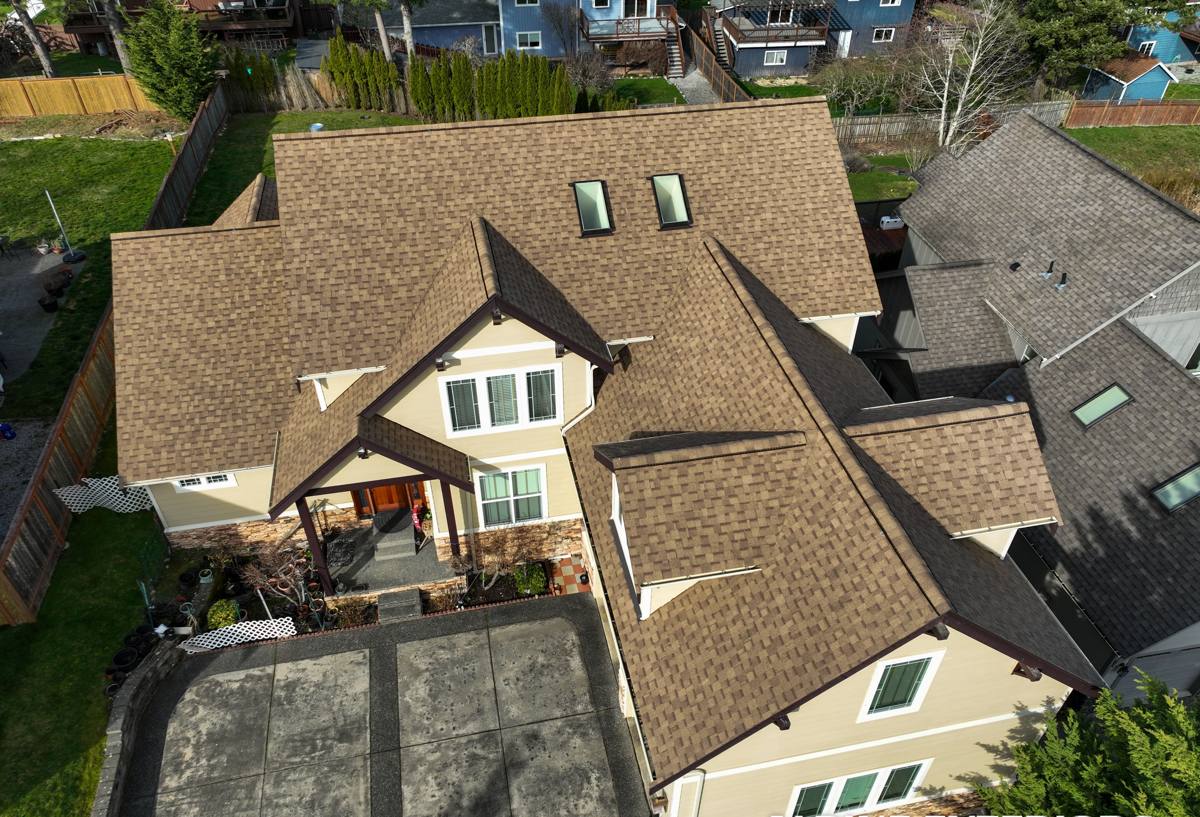
What Storm Damage Actually Looks Like on a Birch Point Roof
Wind
Wind off the water doesn't just push straight down on a roof — it gets under edges and creates uplift, which is what actually tears shingles loose or cracks their seal. On Birch Point roofs we most often find damage concentrated at ridge caps, rake edges, and any spot where a previous repair or an older roofing job didn't nail or seal correctly to begin with. A few missing or lifted shingles rarely look dramatic from the ground, which is exactly why they get missed until a leak shows up inside.
Moss and Trapped Moisture
Moss doesn't just sit on top of shingles looking bad — it holds water against the roofing material and, over time, lifts shingle edges enough for wind and rain to get underneath. A roof with heavy moss going into a storm is far more likely to lose shingles or take on water than a roof that's been kept reasonably clear. Moss damage and storm damage often show up together because one sets up the other.
Salt Air Corrosion
The metal parts of a roof — flashing, drip edge, fasteners, vent boots — are what salt air attacks first. Corroded or thinning flashing around chimneys, skylights, and roof-to-wall transitions is one of the most common things we find causing leaks after a storm, even when the shingles themselves look fine. It's not dramatic damage, but it's often the actual source of water getting into the house.
Repair or Replace? How We Make That Call
Not every storm-damaged roof needs full replacement, and we don't push that direction just because it's a bigger job. The honest answer depends on how much of the roof is affected, how old the existing roofing is, and whether the damage is isolated or a sign of broader wear.
| Factor | Points Toward Repair | Points Toward Replacement |
|---|---|---|
| Age of existing roof | Roofing is under roughly 15 years old | Roofing is near or past its expected service life |
| Extent of damage | Damage is limited to one section or a few isolated spots | Damage is spread across multiple slopes or the whole roof |
| Underlying condition | Deck and surrounding shingles are sound | Deck shows rot or soft spots from long-term moisture |
| Moss history | Moss has been managed and is light | Heavy, long-term moss growth has degraded shingles broadly |
| Match to existing material | Replacement shingles are available to match | Discontinued material makes patch repairs visibly mismatched |
We inspect first and give you a straight answer either way. Most storm calls on Birch Point turn out to be repairable — targeted work on the damaged area rather than a full tear-off — but we'll tell you plainly if what we find suggests the roof is past the point where another patch makes sense.
What a Correct Storm Repair Involves
A Real Inspection, Not a Guess From the Ground
Storm damage is often worse — or in a different spot — than what's visible from the driveway. A proper repair starts with getting on the roof and checking the areas most exposed to wind and driving rain: ridges, edges, valleys, and every flashing point. We also check the attic or roof deck from underneath where accessible, since water stains inside often trace back to a leak that's been happening quietly for a while before a storm made it obvious.
Materials Matched to Coastal Exposure
Fasteners, flashing, and vent components that hold up in a drier inland climate don't always hold up the same way this close to the water. For Birch Point work we use corrosion-resistant fasteners and flashing rather than standard-grade hardware, because replacing the same failure point every couple of years costs more in the long run than doing it right once.
Flashing and Fastening Details
Most roof leaks trace back to flashing and fastening details, not the shingles themselves. A correct repair reseats or replaces flashing with proper overlap and sealant, re-nails or replaces lifted shingles to manufacturer spec rather than just gluing them down, and checks that vent boots and pipe collars — common failure points — are still sealing properly. Shortcuts here are exactly what turns a one-time storm repair into a recurring leak.
Our Process From Call to Completed Repair
- Initial call or estimate request — tell us what you're seeing (missing shingles, a leak, visible damage) and roughly when the storm happened.
- On-roof inspection — we walk the roof and document the actual extent of damage, not just what's visible from ground level.
- Straight assessment — you get a clear explanation of what's damaged, what's causing it, and whether it's a repair or something bigger.
- Written estimate — scope and cost before any work starts, no surprises added mid-job.
- Repair work — matching shingles and materials where possible, corrosion-resistant hardware and flashing given the coastal exposure.
- Final check — we confirm the repair area and surrounding roof are sound before calling the job done.
What to Do Right After a Storm
What you do in the first day or two after a storm can make a real difference in whether damage stays minor or spreads.
- Check ceilings and upper closets for new water stains, even faint ones
- Look for shingle pieces or granules in gutters or on the ground around the house
- From the ground only — do not get on the roof yourself — note any obviously lifted or missing shingles
- Photograph anything you can see safely, for your records and any insurance claim
- Avoid tarping or attempting repairs yourself on a wet or steep roof
- Call for an inspection sooner rather than later — exposed areas let in more water with every rain that follows
Cost Factors for Storm Damage Repair
Every roof and every storm is different, so we don't quote a number without seeing the damage. In general terms, cost depends on a handful of factors:
| Factor | Why It Matters |
|---|---|
| Size of the damaged area | A few lifted shingles cost far less to fix than a full slope |
| Flashing vs. shingle damage | Flashing repair at chimneys, skylights, or valleys often takes more labor time than shingle replacement alone |
| Roof pitch and access | Steeper or harder-to-reach roofs take more time and safety setup |
| Material availability | Matching older or discontinued shingle lines can add cost or limit options |
| Underlying deck condition | Rot or moisture damage found under the surface adds to the scope |
Simple, localized repairs are often a few hundred dollars; more involved flashing or multi-area repairs can run into the low thousands. We'll always give you a written number before starting, based on what we actually find on your roof.
Why Hiring a Crew That Already Works Birch Point Matters
A roofer who mostly works drier, inland jobs doesn't always think in terms of salt air corrosion or moss-driven moisture damage, because they don't see it every week. Working this stretch of Whatcom County regularly means we already know which flashing details and fastener grades hold up here and which ones fail early, what moss buildup typically looks like on local roof types, and how quickly a storm can turn a minor issue into water intrusion given the amount of driving rain this area gets in the wet months.
That familiarity also means faster, more accurate estimates — we're not guessing at how coastal exposure affects a repair, we're applying what we've already seen on roofs like yours nearby. For homeowners, that translates to a repair that's built for the conditions it actually has to survive, not a generic fix.
Keeping Moss and Salt From Undoing the Repair
A storm repair is only as good as what happens to the roof afterward. Left unmanaged, moss will come back, and salt air will keep working on any unprotected metal. Periodic moss treatment or removal, keeping gutters and valleys clear so water actually drains instead of sitting, and a roof check after any major windstorm are the simplest ways to protect the repair you just paid for. We're happy to point out anything we notice during a repair visit that's likely to cause trouble down the road, even if it's not part of the current job.
If you're dealing with storm damage on a Birch Point roof — or you just want an honest opinion on what a recent windstorm may have done — we're glad to come take a look. The estimate is free, there's no pressure to move forward, and you'll get a straight answer about what your roof actually needs.