 Blaine
 Why Birch Bay's Waterfront Exposure Is Hard on Siding
Birch Bay sits right on the water, and that location shapes everything about how siding performs there. Wind off the bay carries salt spray onto exterior walls, which accelerates corrosion on fasteners, trim screws, and any metal components in a siding system. That same wind pushes rain sideways into laps, seams, and corners instead of letting it simply run down and off the wall, so any weak point in the installation gets tested harder and more often than it would on a sheltered inland lot.
Add in the long, wet stretch of fall through spring that's typical across Whatcom County, and you get a climate that keeps siding damp for extended periods. That moisture, combined with shaded north-facing walls and tree cover common around Birch Bay, is exactly what moss and algae need to take hold. None of this means siding fails here — it means the materials and the installation details have to be right for a waterfront Pacific Northwest exposure, not just adequate for an average day.
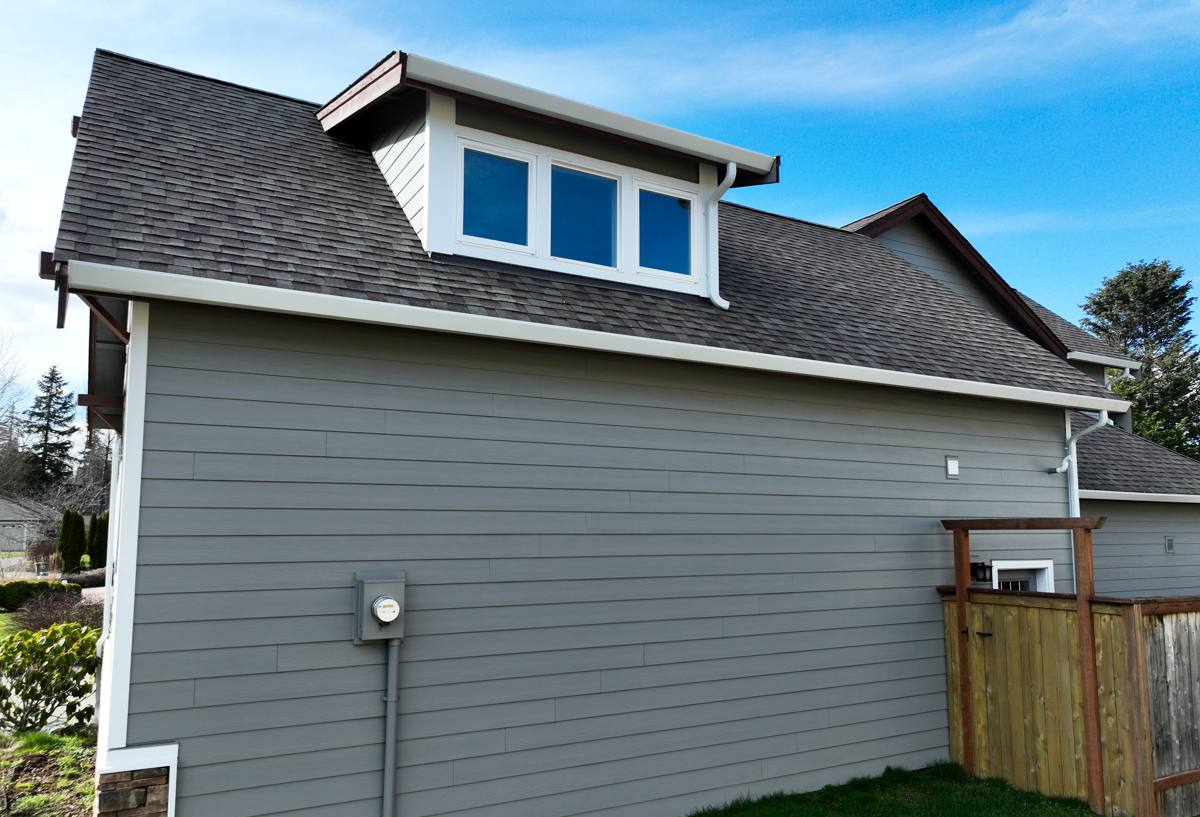
What Board & Batten Siding Is, and Why Homeowners Choose It
Board and batten is a vertical siding pattern: wide flat panels installed vertically, with a narrower strip — the batten — covering each seam between panels. It's a classic look on Pacific Northwest homes, cottages, and coastal properties, and it reads as more architectural than standard horizontal lap siding. It also tends to suit homes with a lot of vertical massing, gables, or a farmhouse or craftsman-style exterior.
The tradeoff is that board and batten has more vertical seams than lap siding, and every seam is a place where wind-driven water can be pushed if it isn't detailed correctly. That's a bigger deal in a wind- and rain-exposed spot like Birch Bay than it would be in a calmer inland neighborhood, which is part of why the material and the installation approach both matter more here.
The James Hardie System We Use for This Look
We install James Hardie vertical siding panels with HardieTrim boards used as battens, built specifically for engineered performance rather than assembled from general-purpose lumber or trim stock. The panels are fiber cement — sand, cement, and cellulose fiber — so there's no wood grain to swell, cup, or feed rot, and no organic wood fiber for moss and mildew to colonize the way they will on untreated or under-maintained wood. Hardie's HZ5 formulation is engineered for wetter, harsher climates, which fits a shoreline exposure like Birch Bay's better than a standard-climate product. The panels and trim carry a factory-applied ColorPlus finish, so the color and protective topcoat are baked on under controlled conditions rather than rolled or sprayed on-site.
What a Correct Board & Batten Installation Actually Involves
Drainage Plane and Rainscreen Gap
Every board and batten wall needs a weather-resistive barrier underneath the siding and, ideally, a rainscreen gap — a small air space between the back of the panel and the wall — so any moisture that does get past the surface can drain and dry out instead of sitting against the sheathing. On a wind-exposed site like Birch Bay, this detail isn't optional; it's the difference between a wall that sheds incidental moisture and one that traps it.
Flashing and Seam Detailing
Every vertical joint, window, door, and penetration needs flashing or flashing tape installed in the correct order — a shingle-lap sequence so water is always directed down and out, never into a seam. Battens are then placed to cover the panel joints cleanly, protecting the seam from direct wind-driven rain.
Fastening
Fastener spacing, type, and depth all follow the manufacturer's published specifications. In a salt-air environment, using corrosion-resistant fasteners isn't a nice-to-have — cheaper fasteners will show rust streaks bleeding down the face of the siding within a few seasons.
Finish
Because the ColorPlus finish is factory-applied, there's no field painting required at installation, and cut edges get factory-matched touch-up rather than a mismatched field coat. That matters in a salt-air climate because a factory-cured finish holds up to UV and salt exposure more consistently than a field-applied coat.
Where Board & Batten Jobs Commonly Go Wrong
Board and batten has more seams and more trim pieces than lap siding, which means there are more places for a rushed or under-specified installation to fail. The most common issues we see when we inspect other contractors' board and batten work, or when a homeowner calls us after a problem shows up, include:
- Battens face-nailed directly against the panel with no attention to the drainage path behind them, trapping moisture at the seam
- Seams relying on caulk alone to stay watertight, with no flashing behind it — caulk is a wear item, not a waterproofing system
- Field-cut panel and batten ends left unsealed or unprimed, which lets moisture wick into the cut edge over time
- Standard fasteners used in a coastal exposure, leading to visible rust streaking within a few years
- No rainscreen gap on a wall that's directly exposed to wind-driven rain off the water
None of these are exotic mistakes — they're shortcuts that are easy to miss on a standard job and expensive to ignore on a waterfront-exposed one.
Comparing Materials for a Board & Batten Look
Board and batten can be built out of several materials, and the choice matters more in a wind- and salt-exposed location than it would somewhere sheltered. Here's how the common options compare for this specific application:
| Material | Moisture & Salt Air Tolerance | Moss/Organic Growth Resistance | Finish Durability | Ongoing Maintenance |
|---|---|---|---|---|
| James Hardie fiber cement | Engineered for wet, coastal climates (HZ5) | No wood fiber to feed growth; surface still needs periodic cleaning | Factory ColorPlus finish, warranted | Low — periodic rinse and inspection |
| Primed wood (cedar/spruce) | Prone to swelling, cupping, and rot at end grain if not maintained | Organic material — most susceptible to moss and mildew | Field-painted, wears faster in salt air | High — repainting and sealing on a recurring cycle |
| Vinyl (board and batten profile) | Won't rot, but can become brittle and warp under UV and wind | Low growth risk on the surface itself | Color molded in, but fades and chalks over time | Low, but panels are harder to repair individually |
| Engineered wood (LP-type) | Wood-based core is moisture-sensitive at cuts and seams | Higher risk than fiber cement given wood fiber content | Factory finish varies by product | Moderate — edge sealing and inspection matter |
This is why we standardized on James Hardie for board and batten work rather than offering it in wood, vinyl, or engineered wood: it's the option best matched to what a Birch Bay exterior actually has to withstand year over year.
Our Process for a Birch Bay Board & Batten Project
- On-site assessment — we look at wind exposure, existing moisture damage, current wall assembly, and how much of the home's face is directly exposed to the bay versus sheltered by trees or neighboring structures.
- Product and layout selection — panel width, batten spacing, and color are chosen to fit the home's architecture and the coastal palette that tends to work well in this setting.
- Tear-off and prep — removal of existing siding, inspection of the sheathing underneath for hidden moisture damage, and installation of a weather-resistive barrier and rainscreen where called for.
- Panel and batten installation — installed to Hardie's fastening and flashing specifications, with corrosion-resistant fasteners given the salt-air exposure.
- Trim, flashing, and sealant detailing — windows, corners, and penetrations are flashed and finished so water is directed out, not trapped.
- Final walk-through — we review the completed work with the homeowner and go over basic care before we consider the job done.
Living With Board & Batten in a Salt Air, Moss-Prone Climate
A correctly installed Hardie board and batten system is genuinely low-maintenance, but "low-maintenance" isn't "no-maintenance" on a waterfront lot. A little seasonal attention keeps it looking and performing the way it should:
- Rinse salt spray and general grime off the siding periodically, especially on walls facing the water directly
- Keep gutters and downspouts clear so water isn't sheeting down the wall face during heavy rain
- Trim back trees and shrubs near shaded walls to improve airflow and reduce the conditions moss and algae need
- Check caulking at trim and penetrations once a year and have any cracked or failed sections redone
- Watch for rust streaking near fasteners or battens, which can signal a hardware issue worth addressing early
- Keep an eye on grade and splashback near the foundation, which can keep the lowest courses of siding wetter than the rest of the wall
Why It Matters to Hire a Crew That Already Works in Birch Bay
Wind and moisture exposure can vary meaningfully within a small area — a home set back from the water with tree cover faces a different reality than one with an open, direct line to the bay, even a few blocks apart. A crew that already works in Birch Bay and around Blaine has a feel for that variation, along with familiarity with Whatcom County permitting and inspection expectations, so the assessment and the installation approach are matched to the actual site rather than a generic spec. That local pattern recognition is part of what keeps a board and batten installation performing the way it's supposed to for decades, not just for the first few dry summers.
If you're weighing board and batten siding for a home in Birch Bay, we're glad to walk the exterior with you, talk through what your specific exposure calls for, and put together a straightforward, no-pressure estimate using the form below.