 Blaine
 Storm Damage Roof Repair for Blaine Harbor Homes
Blaine Harbor sits right where the weather comes ashore. Homes here take a different kind of beating than roofs just a few miles inland — driving wind off the water, salt-laden air that eats at metal fasteners and flashing, and a moss season that runs longer than most Whatcom County homeowners realize. When a storm rolls through, the damage isn't always the dramatic kind. Sometimes it's a handful of lifted shingles, a bent flashing seam, or granule loss you'd never notice from the ground. Left alone, that's exactly the kind of damage that turns into a much bigger repair by the time it shows up as a stain on your ceiling.
We work on roofs in this neighborhood regularly, and we've seen how the combination of salt air, moisture, and wind exposure plays out differently here than it does on a roof set back from the water. This page covers what storm damage actually looks like on a Blaine Harbor roof, what a proper repair involves, and how we approach the work so it holds up through the next storm season — not just until the next one.
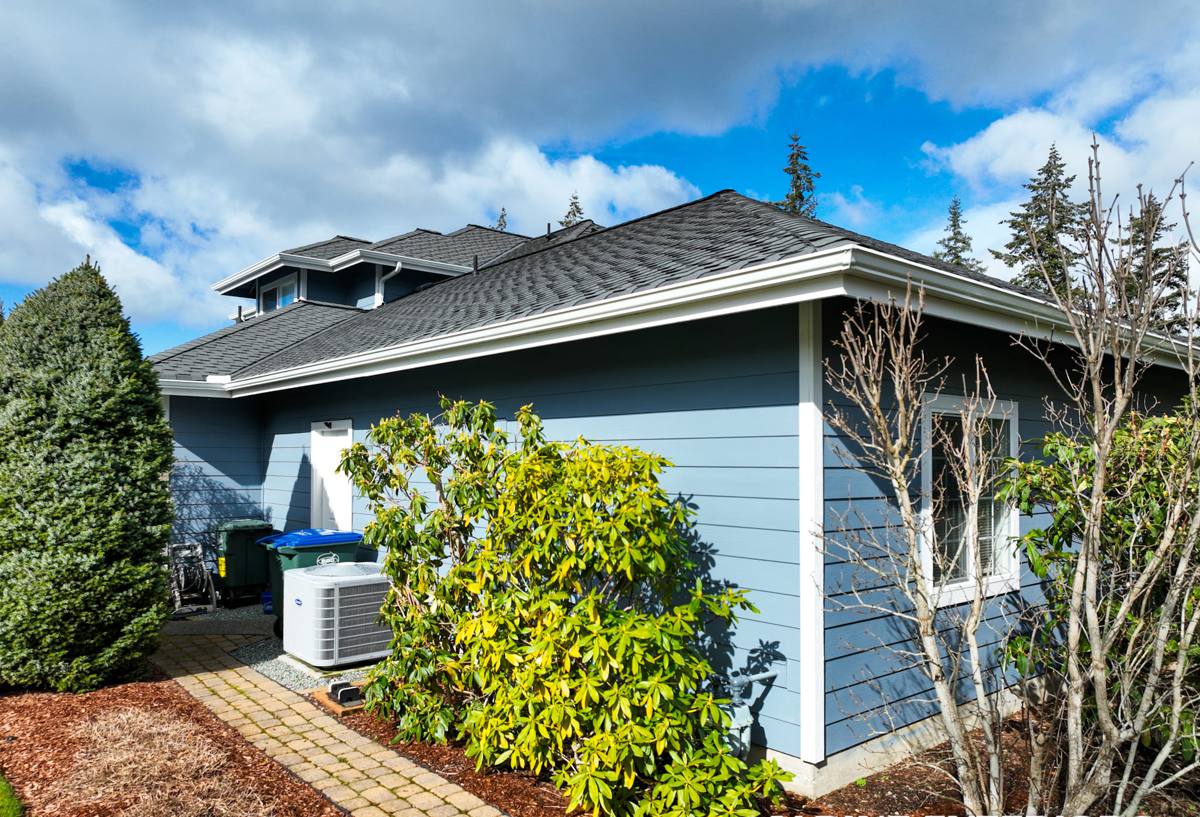
Why Blaine Harbor Roofs Take Extra Punishment
A few things stack up against roofs in this part of Blaine that don't affect every home in Whatcom County the same way.
Salt Air and Corrosion
Airborne salt from the harbor settles on everything, including your roof. It accelerates corrosion on exposed metal — nails, flashing, vent caps, gutter hardware — faster than it would happen a few miles inland. A fastener that's rusted through is a leak waiting to happen, and it's often invisible until you're up close or until water is already getting past it.
Driving Rain and Wind-Driven Water
Storms coming off the water don't just drop rain straight down — the wind pushes it sideways and up under shingle edges, around chimney flashing, and into any gap that a calmer rain would never find. This is one of the main reasons roofs near the water develop leaks in spots that would stay bone dry on a typical inland roof with the same age and materials.
A Long, Damp Moss Season
Whatcom County's shaded, moisture-heavy stretches of fall through spring give moss plenty of time to take hold, and harbor-adjacent homes with tree cover or north-facing slopes see it worse than most. Moss holds moisture against the roof surface, works its way under shingle tabs as it grows, and can lift edges just enough for wind-driven rain to get underneath. It's a slow process, but it's a steady one, and it compounds whatever storm damage is already present.
What Storm Damage Actually Looks Like
Most storm damage isn't a hole in the roof. It's smaller and easier to miss, which is exactly why it does the most damage over time.
- Shingles that are lifted, curled, or cracked at the edges, especially near roof edges and ridges where wind uplift is strongest
- Granule loss — check your gutters after a storm for a buildup of gritty debris
- Bent, loose, or separated flashing around chimneys, vents, skylights, and roof-to-wall transitions
- Nails backing out or rusted through, sometimes visible as small raised bumps under shingles
- Moss growth at seams and edges that has started to lift shingle tabs
- Water stains on interior ceilings or in the attic, which usually mean the leak has already been active for a while
- Debris damage from branches or wind-blown material striking the roof surface
If you've had a recent windstorm come through and you're seeing any of the above, it's worth getting a look before the next round of rain finds its way further in.
What a Correct Repair Involves
Storm damage repair isn't just replacing what's visibly broken. A repair that only patches the surface problem often leaves the underlying cause — a compromised underlayment, corroded flashing, or trapped moisture — to keep working on the roof from underneath.
Inspection First
We start by getting on the roof, not just looking at it from the driveway. That means checking flashing points, valleys, ridge lines, and the areas around any roof penetrations, along with the attic side if there's evidence of a leak. Salt air corrosion and moss damage both tend to hide in places you can't see from the ground.
Matching the Repair to the Cause
A shingle that's missing because of wind uplift gets replaced differently than one that failed because moss lifted it and trapped moisture underneath for months. If moss is part of the picture, we address the moss and the moisture it's been holding against the roof deck, not just the shingle on top of it. If it's corroded flashing, we replace the flashing with materials suited to a salt-air environment, not just a patch over the failure point.
Checking What's Underneath
Any time shingles come off for a repair, it's a chance to check the underlayment and decking beneath them. Wind-driven rain that's been getting past damaged shingles for a while can soak the decking before it ever shows up as an interior leak. A repair that skips this step can look fine from the curb while the problem underneath keeps going.
Sealing and Fastening for Wind-Driven Rain
Given how much of Blaine Harbor's storm damage comes from wind-driven rain rather than straight-down rainfall, proper sealing at shingle edges, flashing laps, and penetrations matters more here than it would on a more sheltered inland roof. We fasten and seal with that exposure in mind rather than using a standard inland approach.
Our Process
- Free inspection and estimate. We get on the roof, document what we find, and walk you through it in plain terms — what's storm damage, what's wear and tear, and what can wait.
- Honest scope of work. You get a written estimate that separates what needs to happen now from what's worth keeping an eye on. We don't pad a repair into a full re-roof unless the roof actually needs one.
- Repair. We replace damaged materials, address the root cause (flashing, moss, underlayment, or fastener corrosion), and check adjacent areas that took the same exposure.
- Cleanup and check-in. We clear debris, dispose of removed materials, and confirm the repair addressed what we found — including checking that no secondary damage was missed.
Repair vs. Replacement: Cost Factors
Not every storm-damaged roof needs a full replacement, and not every "just patch it" job is the right call either. These are the factors that actually decide which way it should go.
| Factor | Leans Toward Repair | Leans Toward Replacement |
|---|---|---|
| Roof age | Roof is under 15-20 years old | Roof is near or past its expected lifespan |
| Extent of damage | Isolated to one section or a few spots | Widespread across multiple slopes or roof faces |
| Decking condition | Decking is sound underneath | Decking shows rot or soft spots from long-term moisture |
| Moss history | Light, recently treated moss growth | Heavy, longstanding moss with shingle lifting throughout |
| Flashing condition | Flashing is intact aside from the storm damage | Flashing is corroded or failing in multiple locations |
| Prior repair history | Few or no previous patch repairs | Multiple past patches, especially in the same areas |
Broad rule of thumb: an isolated storm repair on a roof that's otherwise in decent shape is typically a modest, contained cost. A roof with a longer moss history, corroded flashing in several spots, or decking damage found during the repair usually points toward a larger scope of work. We'll give you a straight answer on which category your roof falls into rather than defaulting to the more expensive option.
What Homeowners Can Check Between Storms
You don't need to get on the roof yourself, but a few ground-level checks after a storm can catch problems early.
- Look in gutters and downspouts for shingle granules after heavy wind or rain
- Check for shingle pieces or flashing debris on the ground or in the yard
- Look up at roof edges and ridges for anything visibly lifted or missing
- Check ceilings and attic spaces for new water stains, especially after a wind-driven storm
- Note any areas of visible moss growth and whether it's spreading toward roof edges
If you notice any of these, it's better to have it looked at before the next storm than to wait until there's an active leak.
Why Local Experience with Blaine Harbor Roofs Matters
A roofing crew that mainly works drier, inland areas of Whatcom County isn't necessarily set up to recognize what salt air corrosion looks like at an early stage, or how aggressively moss establishes itself on a shaded harbor-adjacent roof. Working in this neighborhood regularly means knowing which flashing materials and fastener types hold up against the salt exposure here, and knowing that a repair that would be sufficient on an inland roof sometimes isn't enough this close to the water. That local pattern recognition is part of what keeps a repair from becoming a repeat visit.
Get an Honest Look at Your Roof
If a recent storm has you wondering whether your roof took damage, or you've noticed moss creeping toward the edges, we're happy to come take a look. We'll give you a free, no-pressure estimate and a straight answer about what your roof actually needs — whether that's a small repair, a larger fix, or just keeping an eye on it for now.