 Blaine
 Replacing Siding on a Custer Home Is a Different Job Than It Looks Like
Custer sits on flat, open agricultural land in Whatcom County, close enough to the Salish Sea that salt-laden air reaches most properties in town, not just the ones nearest the water. There's little in the way of a windbreak out here, which means storms that would lose some of their force moving through a more sheltered inland town arrive at full strength, pushing rain sideways into walls instead of straight down. Add a moss and mildew season that runs long on shaded, tree-lined lots, and you've got three separate stresses working on a home's exterior at once, year after year. A siding replacement in Custer has to answer to all three, not just cover up whatever's failing on the surface.
That's the frame for this page. We do siding replacement work across this part of Whatcom County regularly, and we install James Hardie fiber cement exclusively — no vinyl, no LP SmartSide, no Cemplank, Allura, primed spruce, or cedar. This page is specifically about what a siding replacement project looks like for a Custer home: what tells you it's time, what a correct job actually involves, how our process runs, and why the crew doing the work matters as much as the material going on the wall.
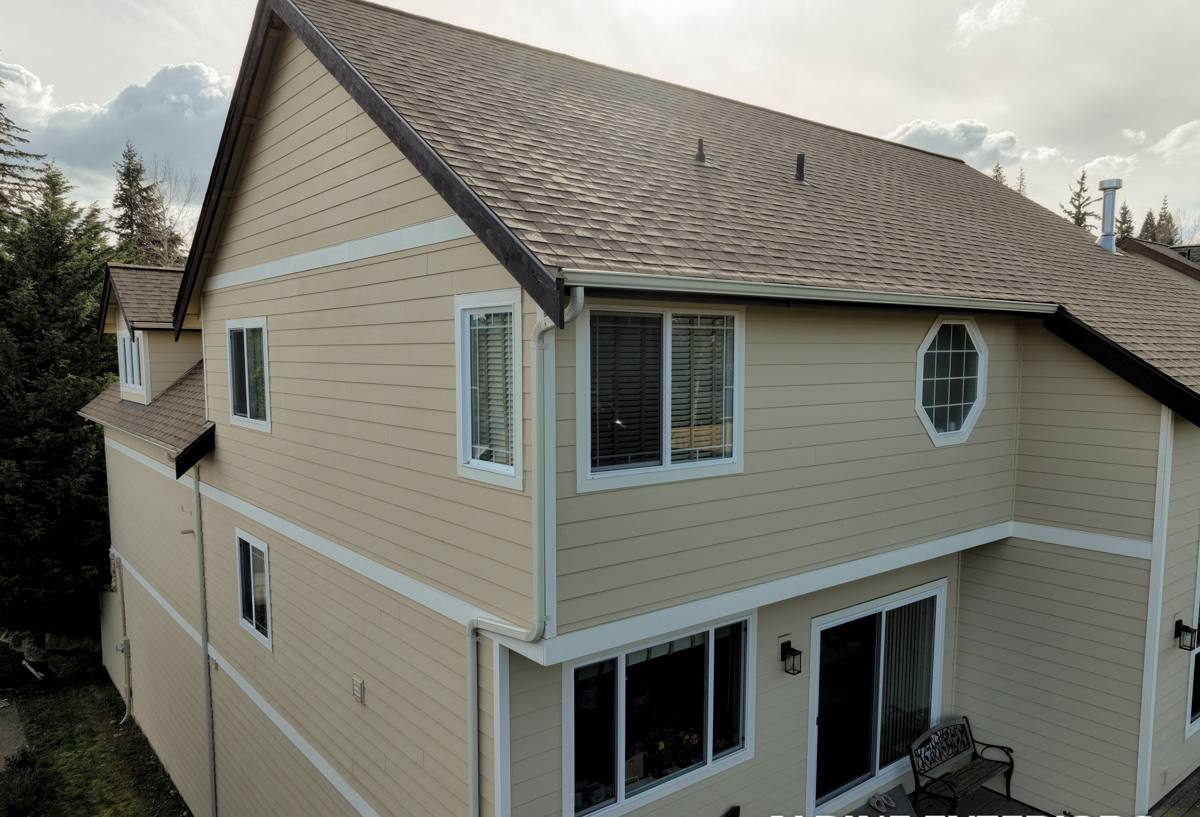
Signs a Custer Home Is Actually Due for Replacement
Not every siding problem means a full re-side. Some issues are cosmetic or localized and can be repaired. But a handful of signs, especially in combination, usually point to replacement rather than patching:
- Moss or dark staining that comes back within weeks of cleaning, especially on north-facing or tree-shaded walls
- Soft, spongy, or bulging siding when pressed, particularly near the base of the wall or around window and door trim
- Visible warping, cupping, or cracking across multiple boards or panels, not just one damaged spot
- Paint or finish that's peeling or chalking heavily rather than just fading evenly
- Rust streaks running down from fasteners or trim hardware
- A musty smell or staining on interior walls that back up to exterior siding
- Siding that's original to a home 20-25 years or older, with no documented replacement
Any one of these is worth a look. Several together, especially soft spots plus interior staining, usually mean moisture has already reached the sheathing behind the siding, which changes the scope of the job before a single new board goes up.
What Correct Siding Replacement Actually Involves
Given how much of Custer's climate pressure comes from wind-driven rain finding its way behind the cladding rather than through the face of it, a replacement that just swaps old boards for new ones in the same condition underneath is doing half the job. A correct replacement has to address the wall assembly, not just the visible surface.
Tear-Off and Sheathing Inspection
Once the old siding comes off, the sheathing underneath gets checked for rot, soft spots, or staining before anything new goes up. This is the point where hidden moisture damage — the kind that doesn't show from outside — actually gets found. Covering damaged sheathing with new siding just moves the problem behind a fresh wall, where it keeps getting worse out of sight.
Weather-Resistive Barrier and Flashing
The house wrap, window and door flashing, and every point where something penetrates the wall need careful attention here. On open, wind-exposed ground like Custer sits on, wind-driven rain gets tested against these details every wet season, not just during the occasional storm. This step is easy to rush and nearly impossible to inspect once the new siding is up, so we treat it as a non-negotiable part of the job, not an assumed extra.
Installation to Manufacturer Specification
James Hardie's warranty is tied to installation following their published specs: correct fastener type, placement, and spacing; proper clearance from grade, decks, and rooflines; factory-cut edges used wherever possible, with any field cuts sealed to spec. That's the baseline we install to on every job, not an upgrade option.
Final Walkthrough
We walk the completed job with the homeowner, cover what maintenance actually looks like on a property with this kind of exposure, and confirm the finished work matches what was estimated before calling it done.
Why We Only Replace Siding With James Hardie Fiber Cement
We narrowed our siding offering to one product line after seeing, on repair and tear-off calls across this area, what actually holds up against sustained salt air, driving rain, and long moss seasons versus what performs fine on paper but struggles a few winters into real exposure. Fiber cement's inorganic core doesn't absorb and release moisture the way wood-based siding does, so it isn't fighting the same swell-and-dry cycle that drives most of the moisture damage we find on older Custer homes. James Hardie's HZ5 line is engineered specifically for regions with heavy moisture exposure and freeze-thaw cycling, and the factory-applied ColorPlus finish holds color and adhesion longer under salt air and UV than a field-applied paint job.
How the Common Alternatives Compare, Climate-Specific
| Material | Behavior Under Custer's Conditions | Ongoing Maintenance |
|---|---|---|
| Vinyl siding | Panel seams give wind-driven rain an entry point; can warp or become brittle under sustained UV and temperature swings | Low, but limited repair options if panels crack or fade unevenly |
| LP SmartSide / engineered wood | Wood-strand core absorbs moisture at unsealed cut edges and fastener points; performance depends heavily on install precision | Regular caulk and cut-edge inspection, especially on shaded walls |
| Primed spruce or cedar | Organic material; combustible; moss and mildew find a damp wood surface especially hospitable here | Ongoing paint or stain schedule required to prevent rot |
| James Hardie fiber cement | Dimensionally stable; doesn't swell, warp, or rot; HZ5 formulation targets this climate specifically | Lower — no repainting cycle for the substrate itself |
We don't install the products in the first three rows above, and we're upfront that each has a legitimate place in the broader market. Our position is a professional standard specific to this climate: given the combination of salt exposure, wind-driven rain, and moss pressure a Custer property deals with year-round, we'd rather stand fully behind one system than offer a lower-cost option that quietly shifts maintenance risk onto the homeowner down the road.
Our Siding Replacement Process
Inspection and Estimate
Every project starts with a straightforward look at the house: current siding condition, any visible or suspected moisture issues, and how exposure varies across the different walls given the property's orientation and tree cover. That assessment drives the estimate, rather than a flat per-square-foot number handed over sight unseen.
Scheduling Around the Weather
Tear-off exposes bare sheathing to the elements, so we plan around Custer's wetter stretches rather than starting a job we can't reasonably protect if a storm moves through mid-project. That sometimes means a slightly longer lead time, in exchange for not gambling with an open wall during a wind-driven rain event.
Tear-Off, Repair, and Rebuild
Old siding comes off, the sheathing gets inspected and repaired as needed, the weather barrier and flashing go in correctly, and the new James Hardie siding goes up to manufacturer spec. Each of these stages matters on its own — skipping or rushing any one of them is where long-term problems usually start.
Cleanup and Walkthrough
We clear the site of old material and debris and walk the finished job with the homeowner before considering it complete.
What Affects the Cost of a Siding Replacement
Every estimate is specific to the house, but a handful of factors consistently move the number one way or another:
| Factor | Why It Matters |
|---|---|
| Total square footage and number of stories | Directly drives material and labor quantity |
| Trim and detail work around windows, doors, and rooflines | More detail work means more cutting, fitting, and flashing time |
| Condition of the sheathing once old siding is removed | Rot or moisture damage found mid-project adds repair scope |
| Wind and moisture exposure of the specific site | Open, unsheltered lots may warrant extra attention at flashing and clearance details |
| James Hardie product line and color selected | Different lines and factory finishes carry different material costs |
We walk through these factors directly during the estimate, so a homeowner understands what's driving the number rather than just receiving a total with no explanation behind it.
Why a Local, Blaine-Based Crew Matters for a Custer Job
We work this part of Whatcom County regularly, which means being on job sites here through every season rather than treating Custer as an occasional stop between larger jobs elsewhere. That repeated exposure to the specific way wind, salt air, and rain behave on this open, flat terrain shapes real decisions on a job: where extra flashing attention earns its keep, which walls stay damp longest given the property's orientation, and which install-day shortcuts simply don't survive a full wet season out here. It also means that if a warranty question or maintenance issue comes up years later, it's a call to a crew still working in the area, not a company that's moved on to other regions.
Caring for New Siding After Replacement
James Hardie fiber cement needs less upkeep than wood-based alternatives, but "low-maintenance" isn't "no-maintenance," especially in a climate this consistently damp. A few habits go a long way toward getting the full service life out of a new installation:
- Rinse siding gently with a garden hose once or twice a year to clear pollen, dust, and early moss growth before it establishes
- Avoid pressure-washing directly at seams and joints, which can drive water behind the siding rather than just cleaning the surface
- Keep gutters clear and functioning, since overflow at the roofline is a common source of concentrated moisture on the wall below
- Trim back tree limbs and vegetation that keep a wall shaded and slow to dry after rain
- Have caulking at trim and penetrations checked periodically, since caulk is the one component that does age faster than the siding itself
If your Custer home's siding is showing its age, or you'd just like a straight opinion on whether repair or full replacement makes more sense, we're glad to come take a look. Reach out using the form below for a free, no-pressure estimate.