 Blaine
 Roof Repair Built for Custer's Weather, Not a Generic Playbook
Custer sits close enough to the water and far enough into farm and timber country that its homes take on a mix of problems most roofing crews only see one at a time. You've got salt-tinged air drifting in off the Strait, long stretches of driving rain through fall and winter, and a moss season that never really ends because the shade and moisture barely let a roof dry out between storms. A roof repair here has to account for all three, not just patch the one problem you happened to notice from the driveway.
We work throughout Whatcom County, and Custer roofs tend to show a specific pattern of wear: moss working into the granule layer on north-facing slopes, corrosion starting early on exposed fasteners and flashing, and small leaks that don't announce themselves until they've already stained a ceiling or soaked attic insulation. Catching and fixing that pattern correctly is the whole point of a repair — not just covering the visible spot.
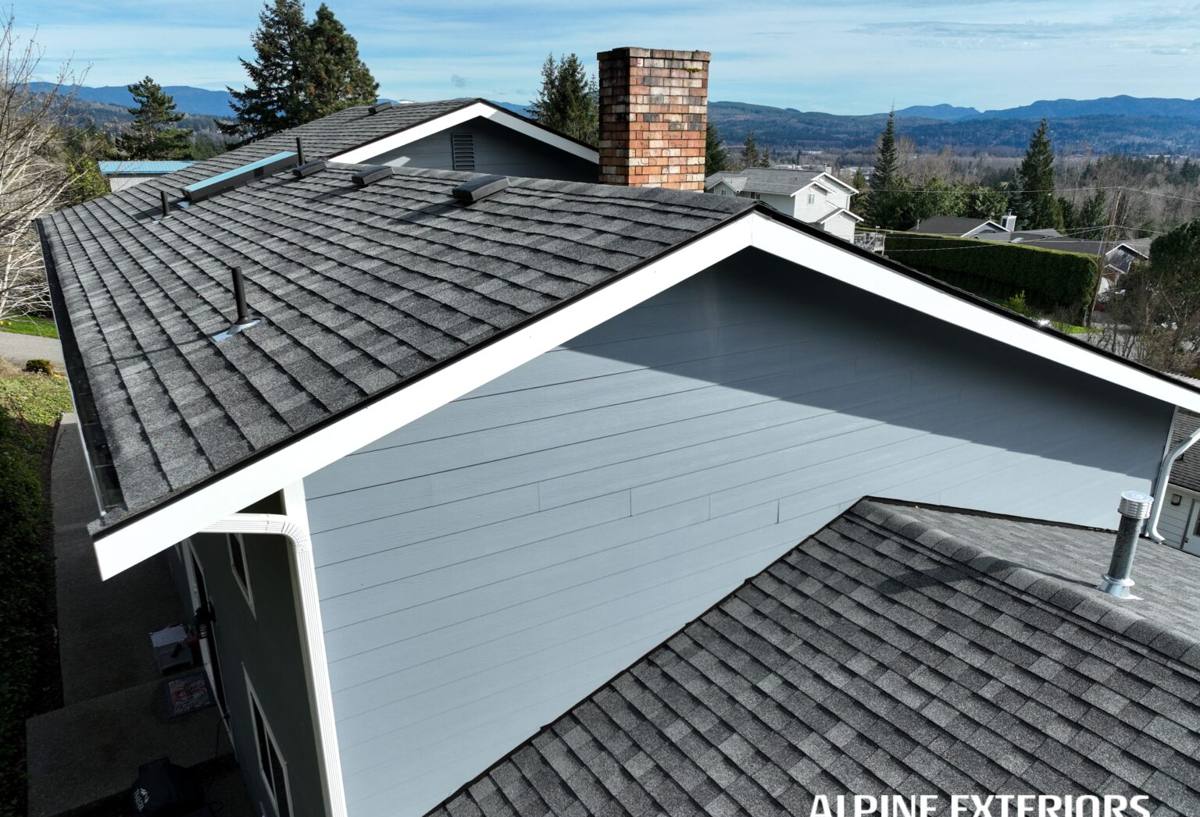
Signs a Custer Roof Needs Repair, Not Just a Look
Most homeowners call us after they've already noticed something, but a lot of damage builds quietly first. Here's what we tell Custer homeowners to walk their property and check for, ideally after a hard rain when problems are easiest to spot:
- Dark streaking or thick moss patches on shaded or north-facing roof sections
- Granules collecting in gutters or at downspout outlets — a sign shingles are wearing thin
- Soft spots, sagging, or a slightly spongy feel when walking the attic deck
- Water stains on ceilings, especially near chimneys, skylights, or where roof planes meet
- Rusted, lifted, or missing flashing around vents, valleys, or chimneys
- Shingles that are curling, cracked, or missing after a windstorm
- Daylight visible through the roof deck from inside the attic
- A musty smell in upper rooms or closets, which often means moisture is getting past the roofline before it ever reaches a visible stain
Any one of these on its own might be minor. Two or three together usually means water has already found a way in, even if the ceiling underneath still looks fine.
Why Moss and Salt Air Cause More Damage Here Than Elsewhere
Moss Season
Moss isn't just cosmetic. Once it takes hold, it holds moisture directly against the shingle surface far longer than open air would, which accelerates granule loss and speeds up the breakdown of the asphalt mat underneath. On a lot of Custer properties, tree cover and north-facing slopes create exactly the shaded, damp conditions moss needs, and once it's established it keeps spreading unless it's physically removed and the roof is treated to slow regrowth.
Salt Air and Driving Rain
Being this close to the water means metal components — nail heads, flashing, gutter fasteners — corrode faster than they would further inland. Combine that with wind-driven rain that hits roofs at an angle instead of falling straight down, and you get water finding its way under laps and around flashing that would otherwise hold up fine in a drier climate. A repair that doesn't account for wind-driven rain often looks fine for a season and then fails at the first real storm.
What a Correct Roof Repair Actually Involves
A roof repair is only as good as the diagnosis behind it. We don't patch the spot you noticed and call it done — we trace the problem to its source, because leaks almost always show up somewhere other than where the water actually entered.
- Full roof inspection — not just the reported problem area, but the whole roof plane, flashing points, and attic underside where accessible
- Source identification — tracing stains and moisture back along the roof deck and rafters to find where water is actually getting in
- Moss and debris removal — clearing growth and buildup before any repair, since patching over moss just traps moisture under the fix
- Deck and structure check — confirming the roof sheathing underneath is sound before new material goes down; soft or rotted decking gets replaced, not covered
- Matched material repair — shingles, flashing, or underlayment replaced with materials that integrate properly with what's already there
- Flashing and seal work — vents, valleys, and chimney flashing resealed or replaced, since these are the most common actual failure points, not the open shingle field
- Final water test and walk-through — confirming the fix holds before we consider the job finished
Repair or Replacement? How We Decide
Not every roof problem needs a repair, and not every repair is the right call if the roof is near the end of its life. We look at age, extent of damage, and how many separate problem areas exist before recommending either path.
| Factor | Points to Repair | Points to Replacement |
|---|---|---|
| Roof age | Under 15-20 years, depending on material | Near or past expected lifespan |
| Damage extent | Isolated to one section or feature | Spread across multiple slopes or repeated leak history |
| Decking condition | Solid, no rot found | Soft, rotted, or damaged in multiple spots |
| Moss history | First occurrence, treatable | Chronic regrowth despite prior treatment |
| Granule loss | Minimal, localized | Widespread, bald patches visible |
If a roof only needs one or two of these addressed, repair is almost always the more sensible and cost-effective route. We'll tell you plainly if we think a full replacement makes more sense — there's no reason to sell a repair on a roof that's genuinely done.
Our Process for Custer Repair Calls
Because we already work this area regularly, we're not learning the local conditions on your dime. Our process is straightforward:
- Inspection and estimate — we walk the roof (weather permitting) and the attic where accessible, and give you a written estimate before any work starts
- Clear scope — you'll know exactly what's being repaired and why, not a vague line item
- Scheduled around weather — repair work needs a dry window to do right, so we plan around forecasts rather than rushing a patch into wet conditions
- Cleanup — old materials, moss debris, and nails are cleared from the roof and property before we leave
- Follow-up — if anything about the repair doesn't hold up as expected, we want to know and address it
Materials and Methods We Rely On
For Custer repairs, we match materials to what's already on the roof whenever a reasonable match exists, since mismatched shingle profiles or colors age visibly differently over time. Where flashing is involved, we favor corrosion-resistant metal given how much salt-laden air moves through this part of the county — plain galvanized flashing has a shorter service life here than it would further from the water. On moss-prone sections, we'll talk through zinc or copper strip options as a preventive measure, since these release trace amounts that discourage regrowth without harsh chemical treatments.
We're honest about trade-offs. Some lower-maintenance-looking products carry more sensitive installation requirements or narrower warranty conditions, and we'd rather install something correctly that fits the actual roof and budget than push a product that looks good on paper but adds installation risk or upkeep the homeowner didn't sign up for.
What Roof Repair Typically Costs, and What Changes the Price
Repair costs vary a lot based on scope, so we won't quote a number without seeing the roof. What we can tell you is what moves the price up or down:
| Cost Factor | Why It Matters |
|---|---|
| Size of damaged area | A single flashing repair costs far less than a multi-section shingle replacement |
| Roof pitch and access | Steep or hard-to-access roofs take longer and require more safety setup |
| Decking condition | Rotted sheathing adds material and labor beyond the surface repair |
| Material match availability | Discontinued shingle lines may require a wider replacement area to blend properly |
| Moss removal extent | Heavy, long-established moss takes more time to clear safely than light surface growth |
We'd rather walk you through these factors on your actual roof than throw out a broad range that doesn't mean much until we've seen the damage.
Why Local Experience in Custer Actually Matters
A crew that already works Custer and the surrounding Whatcom County area isn't guessing at how moss behaves under your specific tree cover, or how wind-driven rain off the water hits a west-facing slope differently than an inland roof. We've seen how these roofs age in this specific climate, which means less time spent diagnosing and more time spent fixing the actual problem. It also means we're realistic about seasonal timing — pushing a repair into a dry window instead of a soggy one, and not promising a fix that won't hold once the fall rains set in.
After the Repair: Keeping a Custer Roof Ahead of the Weather
A repair holds longer with a little upkeep. We recommend a visual check twice a year — before the fall rains and again in spring — looking for new moss growth, loose debris in valleys, and clogged gutters, since backed-up water is one of the fastest ways a fine roof develops a new leak. Keeping tree branches trimmed back from the roofline also cuts down on the shade and debris that feed moss growth in the first place. None of this requires a professional visit every time, but if you notice any of the warning signs again after a repair, it's worth a call before it turns into a bigger job.
If you're seeing moss buildup, a stain on the ceiling, or storm damage on your Custer home, we're happy to take a look and give you a straightforward, no-pressure estimate — just fill out the form below to get started.