 Blaine
 Why Board & Batten Fits Lynden's Character
Lynden sits in Whatcom County's farm country, and its homes lean into that heritage more than most towns nearby — clean-lined farmhouses, barns converted into living space, newer builds designed to look like they belong next to a century-old outbuilding. Board and batten siding is part of that visual language. The wide vertical panels and narrow battens covering each seam read as simple and honest, which is exactly why the style has stuck around on agricultural buildings for well over a century and why it keeps showing up on new construction and remodels across the region.
But board and batten isn't just a look. It's a different water-management system than horizontal lap siding, and it behaves differently in Whatcom County's weather. Done right, it holds up as well as anything we install. Done wrong — which we see more often than we'd like on vertical siding jobs — it fails at the seams and behind the battens years before it should.
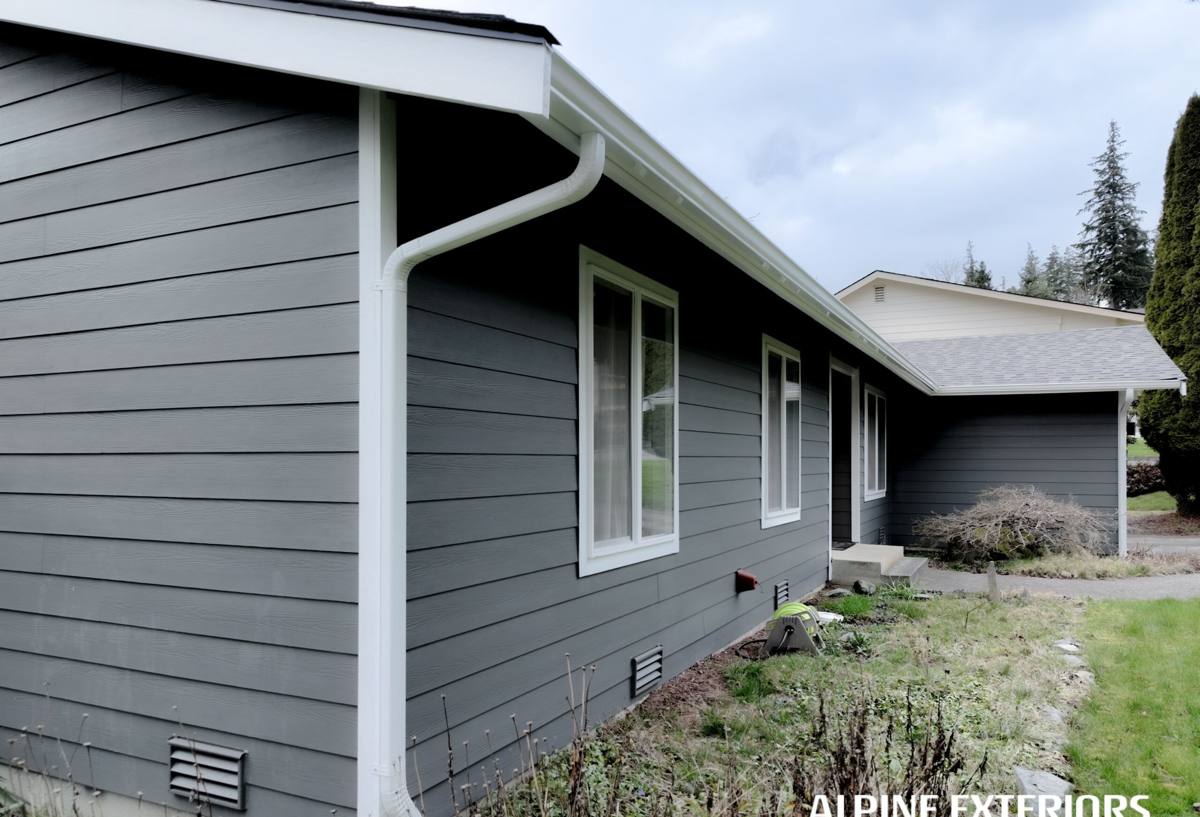
What Lynden's Climate Does to Vertical Siding
Lynden is inland from Blaine, but it's not sheltered from the weather patterns that define this corner of Washington. Salt-laden air off the Strait of Georgia and Puget Sound reaches well past the immediate waterfront, driving rain off the Pacific comes through in long wind-and-water events rather than short showers, and the region's overcast, damp stretch from fall through spring gives moss months to establish itself on anything that stays wet.
Salt Air and Fastener Corrosion
Salt in the air accelerates corrosion on anything metal — nail heads, batten fasteners, flashing. On a board and batten wall, the battens are fastened directly through the panel joints, which means every one of those fastener points is a potential path for water once corrosion sets in. We spec corrosion-resistant fasteners rated for coastal exposure on every board and batten job in this area, not just the ones directly on the water.
Driving Rain and Vertical Seams
Horizontal lap siding is designed so gravity does most of the water-shedding work — each course overlaps the one below it. Vertical board and batten relies instead on the battens covering the seams between panels and on the wall assembly behind the siding to drain anything that gets past them. Wind-driven rain, common through Whatcom County's storm season, can push water sideways into those seams. If the drainage plane behind the panel isn't built correctly, that water has nowhere to go but into the wall.
A Long Moss Season
Whatcom County's damp season runs long, and board and batten's texture — the ridge where each batten sits proud of the panel — gives moss and algae more surface area and more shaded, still-air pockets to take hold than a flat panel does. North-facing walls and anything shaded by trees or a neighboring structure are the areas we watch most closely on inspections.
Why We Install James Hardie for Board & Batten
We install James Hardie fiber cement exclusively — we don't do vinyl board and batten, LP SmartSide, primed spruce, or cedar. That's a deliberate standard, not a lack of options. For a vertical siding style specifically, the material choice matters even more than usual, because the panels and battens sit in direct, sustained contact with weather at every seam.
Fiber cement doesn't absorb and swell the way wood-based products can, so panel edges and batten faces stay dimensionally stable through Lynden's wet winters and drier summers — no cupping, no swollen seams pulling away from fasteners. It's non-combustible, which matters more each year as wildfire smoke and dry summer stretches become a bigger part of the Pacific Northwest's calendar. And Hardie's ColorPlus factory finish gives board and batten jobs a consistent, baked-on color across every panel and batten, which is harder to achieve with field-painted wood battens that weather at a different rate than the panels they're nailed to.
For board and batten specifically, we build the look using HardiePanel vertical siding as the field panel with HardieTrim boards used as the battens — a system engineered to work together, with a defined installation spec for gaps, fastening, and drainage rather than a mix of products improvised on site.
What a Correct Board & Batten Installation Involves
Board and batten hides a lot of workmanship — good or bad — behind a simple appearance. Most of what determines whether the job lasts happens before the first panel goes up.
- A drainage gap behind the siding — furring strips or a rainscreen product that create a gap between the panel and the weather-resistant barrier, so any water that gets past the panel can drain and dry instead of sitting against the sheathing.
- A continuous weather-resistant barrier underneath, properly lapped and taped at every seam and penetration.
- Correct panel gaps — Hardie specifies a gap at every panel joint that the batten is sized to cover with margin, not a tight butt joint that leaves no room for material movement.
- Batten fastening through to solid framing, not just through the panel into open air behind it.
- Flashing at every horizontal transition — window and door heads, water tables, roof-to-wall intersections — where vertical siding is especially prone to leaks if flashing is skipped or undersized.
- Correct fastener type and spacing, matched to the panel thickness and this region's exposure category.
- Factory-finished or properly primed and painted cut edges, since any exposed, unsealed edge is where fiber cement is most vulnerable to moisture intrusion over time.
Skip any one of these and the wall can still look right for a year or two. The failures show up later — usually as staining, soft spots at the base, or paint failure concentrated right at the battens.
How Board & Batten Materials Compare
| Factor | James Hardie Fiber Cement | Engineered Wood (LP-Style) | Vinyl Board & Batten | Cedar |
|---|---|---|---|---|
| Moisture behavior | Dimensionally stable, engineered for wet climates | Vulnerable at cut edges and panel joints if seal fails | Won't rot, but seams can trap moisture behind the material | Absorbs water; needs consistent maintenance to prevent rot |
| Fire resistance | Non-combustible | Combustible | Combustible, can deform in heat | Combustible |
| Finish | Factory-baked ColorPlus, consistent panel to panel | Field-painted or factory-primed, repaints needed sooner | Color molded in, fades over time, cannot be repainted easily | Stain or paint, ongoing recoat schedule |
| Salt-air performance | Strong; fastener corrosion is the main risk to manage | Moderate; edge sealing is critical near salt exposure | Holds up to salt but batten seams can loosen over time | Weathers faster in salt air without regular upkeep |
| Typical lifespan when installed to spec | Multiple decades | Shorter, especially at joints | Long but appearance degrades faster | Shorter without diligent maintenance |
We only install and stand behind the first column. This table isn't meant to disparage the other materials — each has legitimate uses — but for the way board and batten specifically loads stress onto seams and cut edges, fiber cement is the material we trust on Lynden homes.
Our Process, Start to Finish
Every board and batten job starts with a walk-around, not a quote pulled from a square-footage number. We look at wall orientation, existing moisture damage, roof overhangs, and how much shade and wind exposure each elevation actually gets — that's what drives decisions about drainage detailing and fastener spec, not just the size of the house.
- Assessment and measure — we check the sheathing condition once old siding is off, not before, since that's the only way to know its real state.
- Tear-off and sheathing repair — any soft or water-damaged sheathing gets replaced before anything new goes on; covering a problem never fixes it.
- Weather-resistant barrier and drainage plane installation — the part of the job nobody sees but that determines whether the wall survives the next twenty winters.
- Panel and batten installation — set to Hardie's fastening and gap specifications, with flashing integrated at every horizontal break.
- Trim, caulking, and finish detail — corners, window and door surrounds, and any field touch-up needed at cut edges.
- Final walkthrough — we go over the finished work with the homeowner before calling the job done.
Maintaining Board & Batten Through Whatcom County's Wet Season
A correctly installed Hardie board and batten wall needs far less upkeep than wood, but "far less" isn't "none" — and the moss and moisture pressure in this region rewards a little seasonal attention.
- Rinse pollen, road film, and moss spores off the siding once or twice a year, especially on shaded or north-facing walls.
- Keep gutters clear so overflow doesn't run down the wall face and concentrate moisture at specific battens.
- Trim back vegetation and tree limbs that shade a wall and keep it damp longer than surrounding areas.
- Watch caulked joints at trim and penetrations for cracking, and have them resealed before they open up.
- If moss does establish on the surface, treat it gently — avoid high-pressure washing directly at seams, which can force water behind the battens instead of removing it.
Why Hire a Crew That Already Works in Lynden
Board and batten installation isn't complicated in concept, but it's unforgiving of shortcuts, and every one of those shortcuts is easy to hide behind a finished wall. A crew that already works this part of Whatcom County knows which elevations on a typical Lynden property take the worst of the wind and rain, understands the permitting expectations for exterior work in the area, and has already seen how older farmhouse-era construction here was built — which matters when tear-off reveals sheathing or framing that needs attention before new siding goes up. That familiarity shows up in fewer surprises mid-project and a wall assembly built for the conditions it actually has to survive, not a generic install.
If you're weighing board and batten for a home in Lynden, we're happy to walk the property, look at your specific wall exposures, and give you an honest, no-pressure estimate — just fill out the form below to get started.