 Blaine
 Living on the Water in Sandy Point Means Your Siding Works Harder
Sandy Point sits close enough to the water that homes there don't get to live by the same rules as siding twenty miles inland. Wind off the Strait carries salt, rain comes in sideways more often than straight down, and the tree cover and shade that keep these lots private also keep siding damp longer than it would be in a sunnier spot. None of that is a reason to avoid siding your home well — it's just the reason the choice of material and the quality of the install matter more here than almost anywhere else in Whatcom County.
We install James Hardie fiber cement siding, exclusively, on homes in and around Blaine — including Sandy Point. This page is about what that means specifically for a house in this neighborhood: what the climate actually does to siding over time, what a correct Hardie installation looks like for a shoreline-exposed home, and why we think a crew that already knows this stretch of coastline does a better job than one seeing it for the first time.
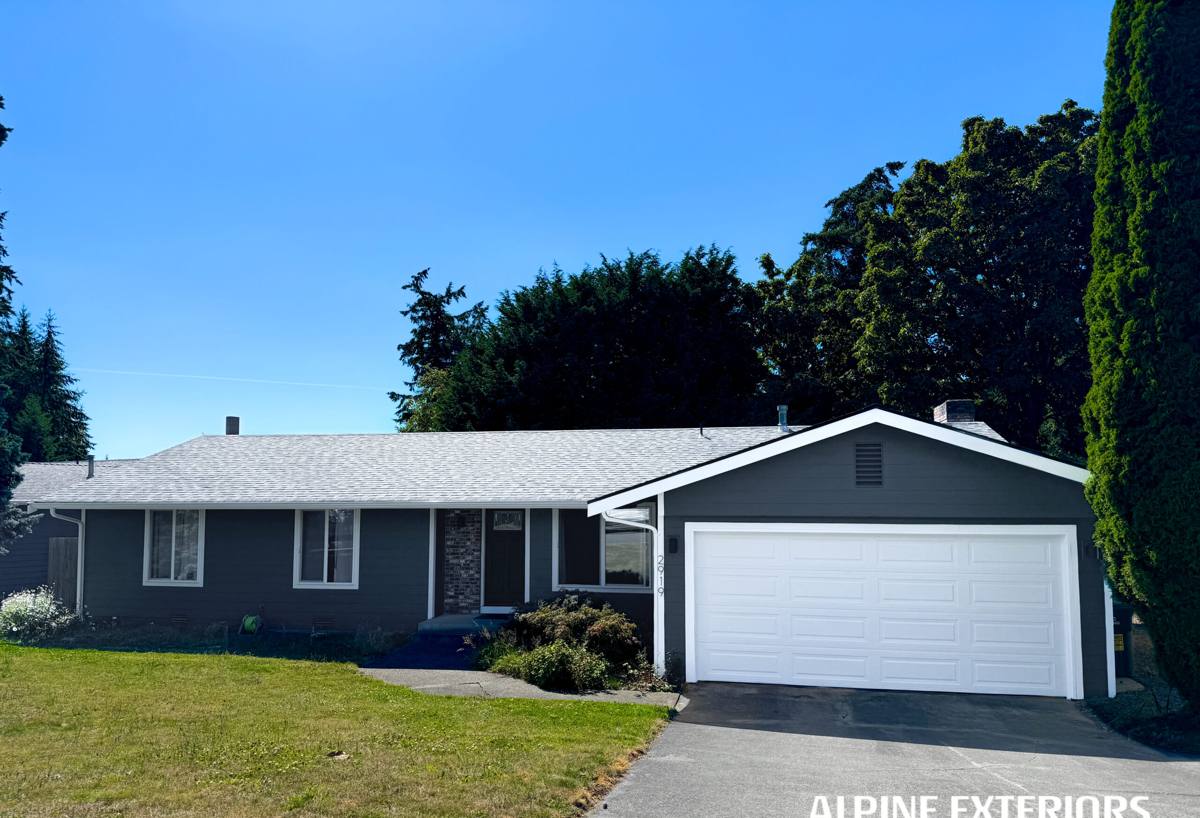
Why Salt Air, Driving Rain, and Moss Break Down the Wrong Siding
Three things do most of the damage to exterior cladding near Blaine's waterfront neighborhoods, and they compound each other:
- Salt air accelerates corrosion of fasteners, flashing, and any exposed metal trim, and it can degrade lower-quality paint and coating systems faster than inland exposure would.
- Driving rain — rain pushed sideways by wind off the water — gets forced into laps, seams, and joints that would stay dry in a calmer climate. Siding systems that rely on caulk and paint alone to keep water out eventually fail at these pressure points.
- A long moss season means shaded north and west walls stay damp for extended stretches of the year. Moss and algae hold moisture against the siding surface, and on materials that absorb water, that moisture doesn't just sit on top — it gets in.
The materials most vulnerable to this combination are the ones that either absorb moisture into their core (wood, some engineered wood products) or rely heavily on an intact paint film to stay protected (vinyl looks fine but offers little real defense once water gets behind it). Once moisture gets behind or into siding in a shaded, salt-exposed spot like Sandy Point, it doesn't dry out quickly — and that's when rot, delamination, and paint failure start.
What James Hardie Brings to a Home in This Climate
We standardized on James Hardie fiber cement for every siding job we take on, and a coastal Whatcom County neighborhood like Sandy Point is close to the exact scenario the product line was engineered for.
Non-combustible, moisture-stable core
Hardie's fiber cement composition doesn't rot, and it isn't a food source for the moss and algae that thrive in shaded, damp conditions the way wood-based products can be. That matters directly here — a north-facing wall under tree cover in Sandy Point stays wet longer than the same wall on an open, sunnier lot, and the siding on that wall needs to be able to tolerate it.
HZ5 engineered for this region
James Hardie makes climate-specific product formulations, and the HZ5 line is engineered for the wetter, harsher weather zones — which is what the Pacific Northwest coastline is. Using the region-appropriate HZ formulation, rather than a generic version of the product, is one of the details that separates a correct Hardie install from a merely adequate one.
ColorPlus factory finish
ColorPlus is baked on at the factory under controlled conditions, with a finish designed to hold up to UV and moisture cycling far better than a field-applied paint job. In a salt-air environment, where field-applied coatings tend to chalk and fade faster, a factory finish is a meaningful advantage — and it comes with its own finish warranty separate from the product warranty.
A warranty that's actually transferable
Hardie's product warranty is designed to transfer to a new owner if the home sells, which matters in a desirable waterfront-adjacent community where resale value and disclosure history matter to buyers.
What a Correct Installation Actually Involves
Fiber cement siding is only as good as the installation underneath it. This is where most of the real-world failures we get called out to diagnose actually originate — not the material, but the install.
Flashing and clearance
Every window, door, and roofline intersection needs proper flashing that directs water out and away, not just caulk covering a gap. Siding also needs correct clearance above rooflines, decks, and grade — tight clearances trap moisture against the bottom edge of the siding, which is exactly where driving rain in this area tends to collect.
Moisture barrier behind the siding
A correctly installed weather-resistive barrier and properly lapped house wrap behind the siding gives water a way to drain out if it ever does get past the cladding — which, in a driving-rain climate, it eventually will at some point over a home's life. This layer is invisible once the job is done, but it's often the difference between a minor nuisance leak and hidden rot.
Fastening and joint treatment
Hardie specifies fastener type, spacing, and placement for a reason — under-fastened or incorrectly placed fasteners loosen over time, especially with wind exposure off the water. Butt joints and seams need to be treated per manufacturer spec, not just caulked and painted over.
Comparing Siding Materials for a Sandy Point Exposure
| Material | Salt air tolerance | Moss/moisture resistance | Maintenance burden |
|---|---|---|---|
| James Hardie fiber cement (HZ5) | Strong — non-corrosive core, factory finish | Strong — does not rot or feed organic growth | Low — periodic gentle washing |
| Vinyl siding | Moderate — can chalk and fade in salt exposure | Weak seams trap moisture behind panels | Low surface care, but hidden moisture risk |
| Cedar / primed spruce | Weak — absorbs salt-laden moisture | Weak — organic material, feeds moss/algae | High — regular refinishing required |
| LP SmartSide / engineered wood | Moderate — dependent on coating integrity | Moderate — vulnerable if edges swell | Moderate — edge sealing and inspection |
We don't install the last two rows of that table, and this climate is a big part of why. Wood-based products can perform reasonably well in a dry, sheltered location, but a shaded, water-adjacent lot in Sandy Point is close to the worst-case scenario for anything that absorbs moisture or depends on an intact coating to stay protected.
Our Process, Start to Finish
The steps don't change much from house to house, but the details we pay attention to are specific to this location.
- On-site assessment. We look at wall exposure, shade patterns, existing moisture or rot damage, roofline clearances, and any signs of past water intrusion around windows and trim.
- Tear-off and substrate check. Old siding comes off and the sheathing underneath gets inspected — this is where hidden rot from a previous inadequate install often shows up.
- Weather-resistive barrier and flashing. House wrap and flashing go in correctly lapped, with extra attention at windows, doors, and any roof-to-wall transitions.
- Hardie installation to spec. Correct HZ5 product, correct fastening, correct clearances, correctly treated joints.
- Trim, caulking, and final inspection. We walk the finished job checking clearances, seams, and flashing details before calling it done.
Maintenance Checklist for Sandy Point Homeowners
A correctly installed Hardie system is low-maintenance, not no-maintenance. In this climate, a short annual routine goes a long way:
- Rinse salt residue off exterior walls once or twice a year, especially after winter storms
- Check shaded, north- and west-facing walls for early moss or algae growth and clean gently before it builds up
- Keep gutters clear so overflow doesn't run down the siding face
- Trim back vegetation and tree cover that keeps a wall shaded and damp longer than necessary
- Walk the exterior once a year looking for cracked caulk at trim joints or gaps at flashing lines
Cost Factors for a Sandy Point Siding Project
| Factor | Why it affects cost |
|---|---|
| Wall exposure and access | Waterfront and sloped lots can require more staging and site prep |
| Extent of existing damage | Rot repair or substrate replacement adds labor before siding goes on |
| Home size and wall complexity | More corners, dormers, and trim details mean more cutting and flashing work |
| Product line and finish | Plank profile, panel style, and ColorPlus color selection affect material cost |
| Trim and accessory scope | Full trim replacement alongside siding changes overall project scope |
We don't quote prices sight unseen because these factors vary too much house to house — an accurate number comes from actually looking at the walls.
Why a Crew That Already Works Sandy Point Matters
A siding crew that mostly works inland jobs isn't necessarily going to get the details wrong — but they're less likely to instinctively account for wind-driven rain angles, salt exposure on fasteners and trim, or the extended damp season a shaded shoreline lot deals with compared to a sunnier inland yard. Those are the kind of details that don't show up as a problem in year one — they show up in year five or six, as a failure point that traces straight back to the install.
We work throughout Blaine and Whatcom County's shoreline neighborhoods regularly, which means Sandy Point's particular mix of salt air, driving rain, and moss pressure isn't a special case for us — it's the standard we build every install to meet.
If you're planning a siding project in Sandy Point, we're happy to take a look at your home and walk you through what a correctly installed James Hardie system would involve — no pressure, no obligation. Fill out the form below to request a free estimate.