 Blaine
 Why Grandview Homeowners Are Asking About Metal Roofing
Grandview sits close enough to the water and to Blaine's marine weather patterns that roofing decisions here can't be made off a generic checklist. Salt-laden air, wind-driven rain coming off the Strait, and a moss season that can run most of the year all put specific stress on a roof that homes further inland don't deal with in the same way. Metal roofing has become a common upgrade in this part of Whatcom County because, installed correctly, it handles those three problems better than most alternatives — but "installed correctly" is doing a lot of work in that sentence, and that's really what this page is about.
We're not here to tell you metal is right for every house or that other roofing products are bad. We're here to explain what a Grandview roof actually deals with year to year, what a correct metal roof installation looks like in this environment, and how to tell a good installation from one that will cause problems in five or ten years.
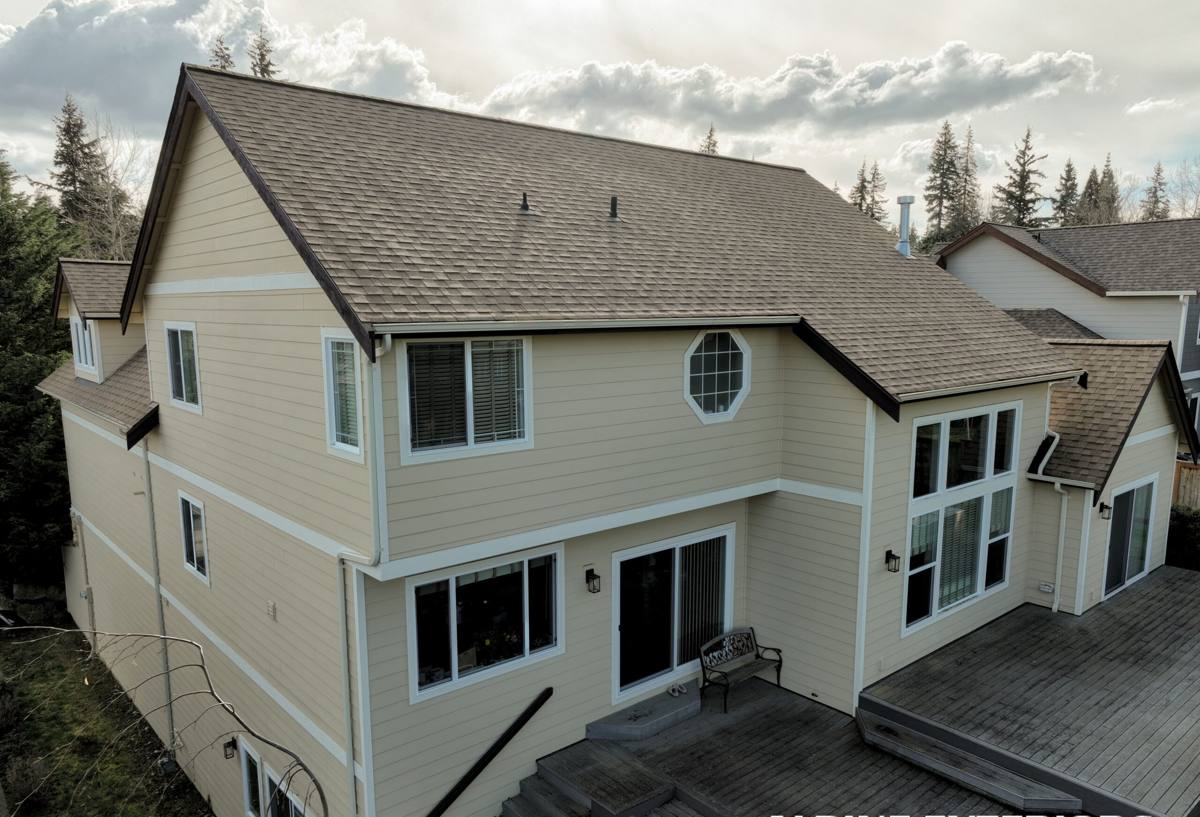
What Blaine's Marine Climate Actually Does to a Roof
Salt Air
Proximity to Semiahmoo Bay and the Strait of Georgia means the air moving over Grandview carries salt content that inland Whatcom County homes simply don't see. Salt air accelerates corrosion on any exposed metal — fasteners, flashing, gutters, and the roofing panels themselves if the coating or alloy isn't suited for a coastal environment. It also settles into moss and organic debris on a roof, which holds moisture against the surface longer than plain rainwater would.
Driving Rain
Blaine gets wind-driven rain that doesn't fall straight down — it gets pushed sideways and upward under laps, at ridge lines, and around penetrations like vents and chimneys. A roofing system that only sheds water well in calm conditions will eventually let water find its way under a lap, a flashing edge, or a fastener that wasn't seated correctly. This is less about total rainfall and more about the direction and pressure it arrives with.
Moss Season
The combination of shade, moisture, and mild temperatures in this area gives moss a long growing window — realistically most of the year, with the heaviest growth during the wetter, cooler months. Moss holds water against roofing material, works its way under laps and shingle tabs, and on wood or asphalt surfaces it can shorten the life of the roof considerably. Metal doesn't feed moss the way organic or granulated surfaces do, but it isn't immune — moss and organic debris can still collect in valleys, behind chimneys, and anywhere airflow is restricted.
Why Metal Holds Up Better Here — With Honest Caveats
Metal roofing has real advantages for a climate like this: it doesn't absorb water the way wood shakes or aging asphalt shingles can, it sheds moss more readily than granulated surfaces, and a quality coating resists salt-driven corrosion far longer than bare or poorly coated metal. Steep-slope metal panels also handle wind-driven rain well because water is directed off the panel quickly rather than sitting on a textured surface.
That said, metal roofing is not maintenance-free, and the trade-offs matter:
- Fastener and flashing detailing has to be done correctly the first time — metal roofing is far less forgiving of sloppy installation than shingles, because water intrusion at a single bad seam or fastener can travel further before it's noticed.
- Not all metal roofing is coastal-rated. Some coatings and base metals corrode faster near salt air, which is why material choice matters as much as installation quality.
- Noise and expansion/contraction need to be planned for with proper underlayment and fastening methods, especially on a house with an occupied attic or bedroom directly under the roof deck.
Metal Roofing Options for a Grandview Property
Not every metal roofing system is a good fit for a marine, moss-prone climate. Here's how the common options compare for a home in this area:
| System | Coastal Performance | Moss Resistance | Typical Lifespan |
|---|---|---|---|
| Standing seam (concealed fastener) | Strong — no exposed fasteners to corrode | Very good; smooth surface sheds debris | 40-60+ years |
| Exposed-fastener panel | Good, but fasteners need regular inspection | Good | 25-40 years, fastener-dependent |
| Stone-coated steel | Good with proper coating | Fair — textured surface can trap organic debris | 30-50 years |
| Uncoated or budget-grade metal | Poor near salt air | Fair | Highly variable, often shortened |
For most Grandview homes, we lean toward standing seam because the concealed fastener design removes the single biggest long-term weak point in a coastal metal roof — exposed screws that loosen or corrode over time. Exposed-fastener panels can still be a sound, more budget-friendly choice when properly installed and maintained, but they need honest expectations set about periodic fastener checks.
What a Correct Installation Actually Involves
A metal roof is only as good as what's underneath it and how it's fastened down. For a Grandview home, we pay particular attention to:
- Deck condition — any soft, water-damaged, or improperly ventilated decking gets addressed before a single panel goes down. Installing metal over a compromised deck just hides a problem.
- Underlayment — a high-quality synthetic or self-adhered underlayment rated for the fastener penetrations and wind-driven rain exposure typical of this area, not a minimum-code product.
- Flashing details — valleys, chimneys, vents, and wall transitions are where the vast majority of roof leaks originate. These get properly formed, lapped, and sealed with materials compatible with the panel metal to avoid galvanic corrosion.
- Fastener selection — coastal-rated fasteners with corrosion-resistant coatings, torqued correctly so panels can still expand and contract without stress cracking around the fastener.
- Ventilation — proper intake and exhaust airflow so moisture doesn't get trapped against the underside of the roof deck, which is a common issue when a roof is upgraded without revisiting the attic ventilation plan.
Where Cheap Installations Fail First
When we've been called to look at a poorly performing metal roof in this area, the failure almost always traces back to one of a few things: mismatched fasteners causing corrosion, flashing that was reused or improperly lapped during a re-roof, or panels installed without accounting for thermal movement. None of these are metal roofing problems — they're installation problems, and they're avoidable with correct technique.
Moss and Ongoing Maintenance
Metal roofing dramatically reduces moss problems compared to wood or aging asphalt, but a Grandview roof still needs periodic attention:
- Clear debris from valleys and behind chimneys or other penetrations where organic material can accumulate and hold moisture
- Keep gutters clear so water isn't backing up under the drip edge
- Check exposed fasteners on non-standing-seam systems every year or two for early signs of corrosion or loosening
- Trim back overhanging branches that keep sections of the roof shaded and damp longer than the rest
- Address any moss or algae growth promptly with methods appropriate for coated metal — pressure washing or harsh chemicals can damage finishes and void warranties
Our Process for Grandview Metal Roofing Projects
We keep the process straightforward because a roofing project shouldn't feel like a mystery:
- On-site assessment — we look at the existing roof, deck condition, ventilation, and any trouble spots specific to your property before recommending anything.
- Material recommendation — based on your home's exposure, budget, and how long you want the roof to last with minimal maintenance, not a one-size-fits-all pitch.
- Written estimate — clear scope, materials, and price before any work starts, no vague allowances.
- Installation — deck repair as needed, underlayment, flashing, panels, and ventilation work done in the sequence that actually protects the house, not the sequence that's fastest.
- Final walkthrough — we go over the finished roof with you, including what maintenance to expect and when.
What Affects the Cost of a Metal Roof Here
Every Grandview property is a little different, but these are the factors that most commonly move the price:
| Factor | Why It Matters |
|---|---|
| Roof complexity (valleys, dormers, penetrations) | More flashing and cutting work, more labor time |
| Deck condition | Repair or replacement of damaged sheathing adds cost but is non-negotiable for a sound install |
| Panel system chosen | Standing seam costs more upfront than exposed-fastener panels but reduces long-term maintenance |
| Tear-off vs. overlay | Removing an old roof adds labor but avoids hiding existing problems |
| Access and pitch | Steep or hard-to-access roofs require more safety setup and time |
We give straightforward ranges during the estimate rather than a number pulled from a brochure — every roof is different enough that a real number requires a real look at the property.
Signs Your Grandview Roof May Be Ready for a Metal Upgrade
- Recurring moss or algae growth despite regular cleaning
- Shingles that are curling, losing granules, or showing bald spots, especially on shaded slopes
- Visible corrosion or rust streaking on existing metal flashing or fasteners
- Leaks or staining near valleys, chimneys, or vent penetrations
- A roof approaching or past its expected service life that you'd rather replace once than patch repeatedly
Why Local Experience in Grandview and Blaine Matters
A crew that regularly works in this part of Whatcom County already understands how the local exposure to salt air, wind direction, and moss growth patterns should shape material choice and installation detail — it's not something you learn from a manufacturer's install guide alone. That familiarity shows up in the small decisions: which flashing details get extra attention, which fastener coatings hold up here versus further inland, and where moss tends to collect first on a Grandview roofline. It's the difference between a roof that's technically installed to code and one that's actually built for the conditions it will face for the next several decades.
If you're weighing a metal roof for your Grandview home, we're happy to take a look and give you a straight, no-pressure assessment of what your roof actually needs. Use the form below to request a free estimate.